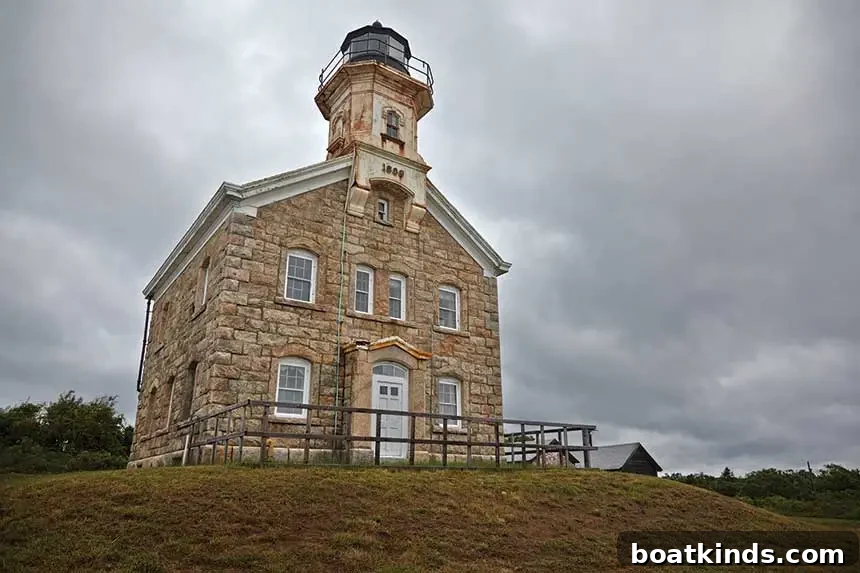
For boaters heading east through Long Island Sound, Plum Island is a familiar navigational landmark. The three-mile-long island sits between Orient Point, New York, and Fishers Island, New York, and is the last prominent feature skippers see before Connecticut’s coastline about 10 miles away. Plum Island Lighthouse, standing since 1869 and listed on the National Register of Historic Places, marks the island’s presence. From the water, and if you overlook the government research facility on the island’s western shore, Plum Island can appear much like a natural preserve.
That appearance belies a long-running dispute over the island’s future. In mid-February, four U.S. senators—Chris Murphy and Richard Blumenthal of Connecticut, and Chuck Schumer and Kirsten Gillibrand of New York—reintroduced the Plum Island Conservation Act in the Senate. Soon after, a bipartisan group of 11 members of the U.S. House, led by Republican Rep. Lee Zeldin of New York and Democratic Rep. Joe Courtney of Connecticut, filed matching legislation called the Plum Island Preservation Act of 2019. Both bills aim to prevent a federal sale of Plum Island to private developers and instead protect its ecological, historical, and research value.
“Plum Island supports hundreds of wildlife species and contains many important historical sites,” Senator Murphy said in a press release. “Protecting the island’s natural and historic resources is a top priority. I will continue working with colleagues from Connecticut and New York to stop the federal government from selling this treasured island to the highest bidder.”
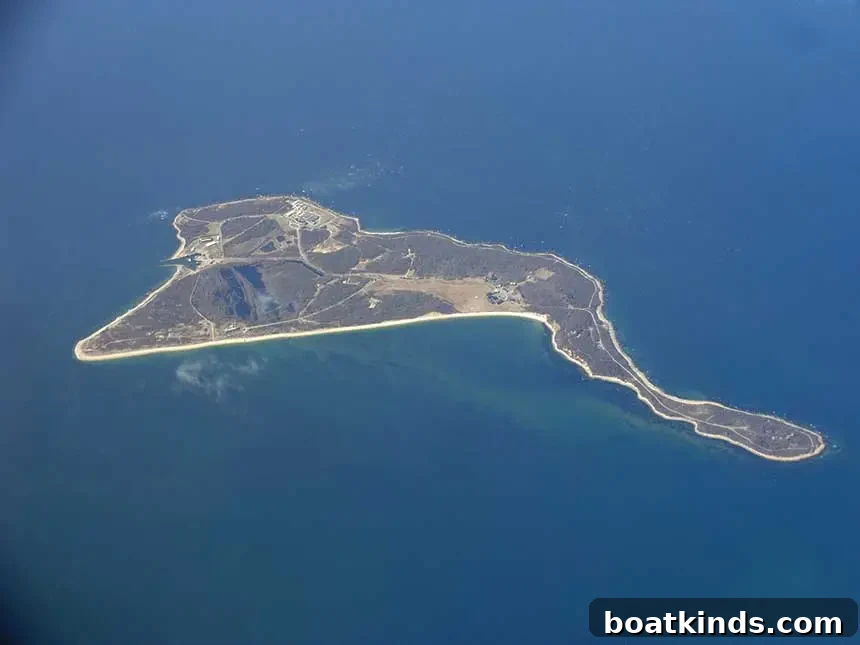
Plum Island’s reputation as an ecological jewel has persisted since the mid-20th century, but its alternating cycles of development and natural regeneration go back further—to the Spanish-American War era of the late 1800s. Fears that a powerful foreign navy might threaten New York Harbor prompted the federal government to fortify the island. Those fortifications were state-of-the-art then, but military technology advanced quickly. By the end of World War I naval invasion was no longer the primary concern, and by World War II defenses had shifted to counter long-range weaponry. Amy Folk, Southold town historian and co-author of A World Unto Itself: The Remarkable History of Plum Island, New York, explains that the island’s guns were eventually removed or repurposed and the military presence diminished.
When the U.S. military vacated Plum Island in the mid-1900s, the landscape began reverting to a natural state. Before military use, the island had been farmland. Afterward, without intensive development, it quickly returned to a rich habitat. That restoration occurred while much of Long Island and nearby Manhattan were undergoing rapid suburban expansion, making Plum Island one of the last remnant habitats preserving the plants and animals once common on Long Island.
Today, the Preserve Plum Island Coalition—an alliance of more than 100 organizations—says the island supports or provides foraging habitat for more than 200 bird species. Notably, Plum Island is a breeding ground for piping plovers, a shorebird whose East Coast breeding population rose from roughly 790 pairs in the mid-1980s to nearly 2,000 today in part because of protected sites like this. The island is also an important haul-out for harbor seals; Save the Sound’s New York natural areas coordinator Louise Harrison notes the south shore is among New York’s largest seal haul-outs.
Harrison and other conservation advocates say the recently reintroduced congressional legislation seeks to correct the consequences of a 2009 law signed during the George W. Bush administration that directed the sale of Plum Island. At that time, the government planned to use proceeds to relocate the federal animal disease research facility to Kansas. That research center is well known for work preventing livestock diseases such as hoof-and-mouth. Critics argue the 2009 law short-circuited the normal disposition process for surplus federal land and overlooked Plum Island’s historical and ecological importance.
Normally, when the federal government divests property, there is an ordered process: federal agencies are first offered the property, followed by state and local governments, and then nonprofit organizations if no public entity expresses interest. Harrison points out that the 2009 action bypassed that sequence by mandating a sale to raise funds.
Since that law passed, federal funds have been appropriated to build the replacement research facility in Kansas. Because the relocation is already underway, proponents of the new bills argue there is no longer a financial need to sell Plum Island. The reintroduced legislation would prevent a sale to the highest bidder and allow the island to transfer instead to another federal agency—such as the National Park Service—to state or local government, or to a private steward committed to preserving Plum Island’s environmental integrity.
If local control becomes an option, the town of Southold has already taken steps to shape future uses. Although federal ownership currently exempts Plum Island from local zoning, Southold adopted zoning measures in 2013 to influence any potential private development. The town created a Plum Island Research District to encourage research and jobs tied to the island’s lab, and a Plum Island Conservation District to protect the island’s natural and historic areas. The zoning language intentionally remains flexible to accommodate compatible uses.

The Preserve Plum Island Coalition is developing a detailed stewardship plan to guide future management if Congress prevents a sale. That plan—expected to be finished by the end of the year—will outline how research activities could coexist with conservation goals, who would manage and secure the island, and how historic sites would be preserved. The coalition hopes a clear, actionable plan will strengthen the case for protecting Plum Island.
Plum Island’s future has provoked disputes before. In the mid-20th century, the federal government once planned to sell the island to Suffolk County, New York, on the condition it be used for education, parks, and recreation. County officials later considered private development, prompting the federal government to withdraw the offer. Whether the current legislative effort will lead to permanent protection—allowing boaters to someday safely dinghy ashore for birdwatching and history—remains uncertain.
Lawmakers from New York and Connecticut are pushing to advance the reintroduced bills during this congressional session, where they could reach the president’s desk. As Plum Island’s complex history continues to unfold, local historians and conservationists remain engaged. “It’s certainly been interesting since the government took control,” Folk says, “and now another chapter is being written.”
This article originally appeared in the May 2019 issue.