
Easterns are built the traditional way, hand-laid in open molds for a classic, durable finish.
Bob Bourdeau proudly displays a photo of his five grandsons wearing orange foul-weather gear from Grundens. Like their grandfather, the boys are drawn to lobstering and the life on the water.
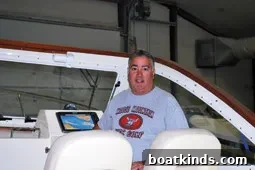
“I run a 31-foot Eastern,” says Bourdeau, 57, who bought the Milton, New Hampshire company from founder Carmen Carbone in 1993 and now serves as its president and owner.
“I have a pot hauler and run 40 to 50 traps a year — just enough to feed the family. It’s a lot of fun and gets me out on the water.”
Getting people out on the water is central to Eastern’s mission, Bourdeau explains. He started in the business at 14 as a yard boy and has stayed rooted in New England boatbuilding ever since. Eastern offers boats from 18 to 35 feet under four brand names — Eastern, Seaway, Rosborough and Sisu — each carrying the region’s traditional aesthetic. Beyond looks, these boats are designed for practical, efficient performance: lower power requirements, reduced maintenance and comfortable, reliable handling.
Bourdeau lives in Milton with his wife Lorrie and serves on the town planning board. His two children, Jake and Ashlee Maimes, work at the company. He also runs Lobo Realty, which renovates older homes, and operates a snow tubing and disc-golf business on his 700-acre mountain. “I like to dabble in everything — water, snow, soil,” he says.
Q: What do people like about your boats?
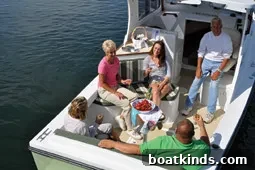
A: Our niche is trailerable Down East-style boats. Models like the 31 and 35 do well, but when buyers say “Down East” and “trailerable,” they often mean us. Many customers choose our boats for their classic appearance, but they also appreciate practical benefits: lower horsepower requirements (150 hp is a large engine for many of our models), good fuel efficiency, a comfortable ride and low maintenance. We offer a range of designs to serve both fishermen and family cruisers.
Q: Is simplicity and ease of maintenance a strong selling point?
A: Absolutely. From about 2002 to 2007 we added more features and refined interiors to meet growing demand for comfort and convenience. But the recession forced us to rethink pricing. We simplified some models and reintroduced more basic Seaway Sport versions that sell very well. Today’s buyers are often more cost-conscious; some want a fully equipped boat, but others simply want a reliable, no-frills boat to get on the water.
Q: What are some of your newer models?
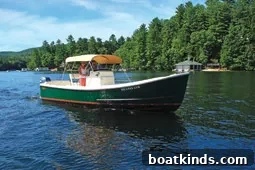
A: The Eastern 248 debuted in 2010 during a slow economy and has been a steady seller ever since. We also introduced a 27-footer with a 10-foot beam that’s in high demand. After acquiring Rosborough, we revived the 22 Sea Skiff (previously the 22 Sisu) and relaunched it; sales have been very strong.
Q: What’s the difference between Eastern and Seaway models?
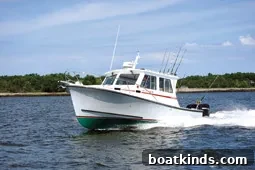
A: For boats between 18 and 24 feet, we offer both lines. Eastern models have round chines and deliver a softer, more cushioning ride, while Seaway boats have hard chines that plane earlier and handle chop better. The Seaways also feature popular teak options — teak windshields and coamings — for buyers who want that traditional, manicured look and are willing to maintain it.
Q: Do your boats sell well farther south along the East Coast?
A: Yes. Our dealer in the Florida Panhandle reports strong sales of cabin models, which offer sun and rain protection and can include air conditioning. Center consoles have been less successful there, which makes sense given Florida’s strong center-console market.
Q: Where do your boats fall on the price spectrum?
A: Prices vary by model and features. Our center consoles are mid-range; our cabin boats tend to be competitively priced for the value they provide. Example prices: an Eastern 18 with a 50-hp motor and trailer can be around $23,995; the new 27s retail roughly $175,000 to $180,000; larger 35-foot models can reach around $330,000. We also have budget-friendly Seaway Sport options, like a promoted 21 Sport cabin model under $40,000 and a 24-footer around $54,000.
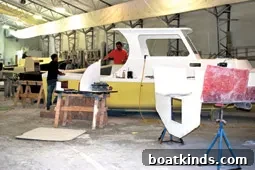
Q: How do you build your boats?
A: We stay rooted in traditional methods: hand-layup and open-mold construction. While we’ve invested in equipment for resin infusion, our workforce is experienced with conventional techniques, and we’ve continued to improve materials and processes over the years. We have long used synthetic coring materials — for example, Divinycell in decks and transoms since 1989 — and vinylester skin coats to protect against blistering. The factory is organized into three buildings: laminating, assembly (where stringers and decks are fit), and final rigging for windshields, rub rails and hardware.
Q: What does the future lineup look like?
A: We don’t plan to build larger yachts; requests for 40- to 42-foot boats have come and gone. Our focus remains on servicing our niche with models that meet customer demand. We filled gaps in the fleet with the new 27, and we’ll continue to offer a balance of features based on what buyers want.
Q: Will boats carry more features going forward?
A: We need to offer both ends of the market: stripped-down, affordable boats and higher-end models with more options. Buyers are clearly split between those who want simplicity and those who want bow thrusters, microwaves, and other conveniences. For example, the 24 originally sold for about $75,000 and now typically sells for $95,000 to $100,000 — much of that increase reflects buyers adding more features.
Q: How did you get into boatbuilding?
A: I began as a yard boy at Ray’s Marina in Milton and moved into mechanics and rigging, attending Johnson outboard and MerCruiser schools. By the early 1980s I was managing boat operations at Ray’s. In 1989 I joined Eastern Marine and worked on the manufacturing side, and in 1993 I bought the company from Carmen Carbone.
Q: What do you enjoy about boatbuilding?
A: I’ve always loved building things. Early on it was a very custom business with lots of one-off projects and close customer interaction. As we grew into a dealer network, the work became more standardized and production-focused. I still love the craft, but now I spend more time on management and paperwork than I used to.
Q: When did you start boating?
A: As a kid I water-skied almost every day. Gas was inexpensive, and we would hop from boat to boat with our small tanks, spending every day on the water. My parents’ boat was an 18-foot aluminum Starcraft on Milton Three Ponds in New Hampshire.
Q: What boats have you owned?
A: My first purchase was a 16-foot Starcraft, followed by a used pontoon, then a 19-foot closed-bow Renken and a Renken 22 Seamaster walkaround. For the past several years I’ve owned Easterns exclusively. I ran a 31-footer with a Volvo Penta diesel and am about to launch a new 31 with a 380-hp Yanmar. I briefly sold the 31 to build a new 27 for myself, but I missed lobstering — so I’m back to a 31.
Q: Are there other styles of boats you enjoy?
A: I have fond memories of 1970s-era boats like those from Glastron. We were a big Glastron jetboat dealer and had a lot of fun with those jetboats back then. More recently I bought my kids a 24-foot Tige ski boat so they could experience water sports. After a few years, they returned to preferring ocean boating, but it was great to share that part of the experience with them.
August 2014 issue