
In recent decades, trawlers have surged in popularity as more boaters embrace a cruising lifestyle built around long-distance, leisurely travel. Many new trawler owners are converts from sailing; they sought similar cruising experiences but preferred the comfort and convenience of a powerboat. Marc Mittelman, a former sailor who bought a Nordhavn 43 five years ago, says that most trawler owners he knows started out on sailboats. “I had sailboats for more than 20 years,” he recalls, “sailing off Southern California, cruising on Lake Ontario when I lived in Canada, and spending much of my time in New England aboard a Sabre 36.”
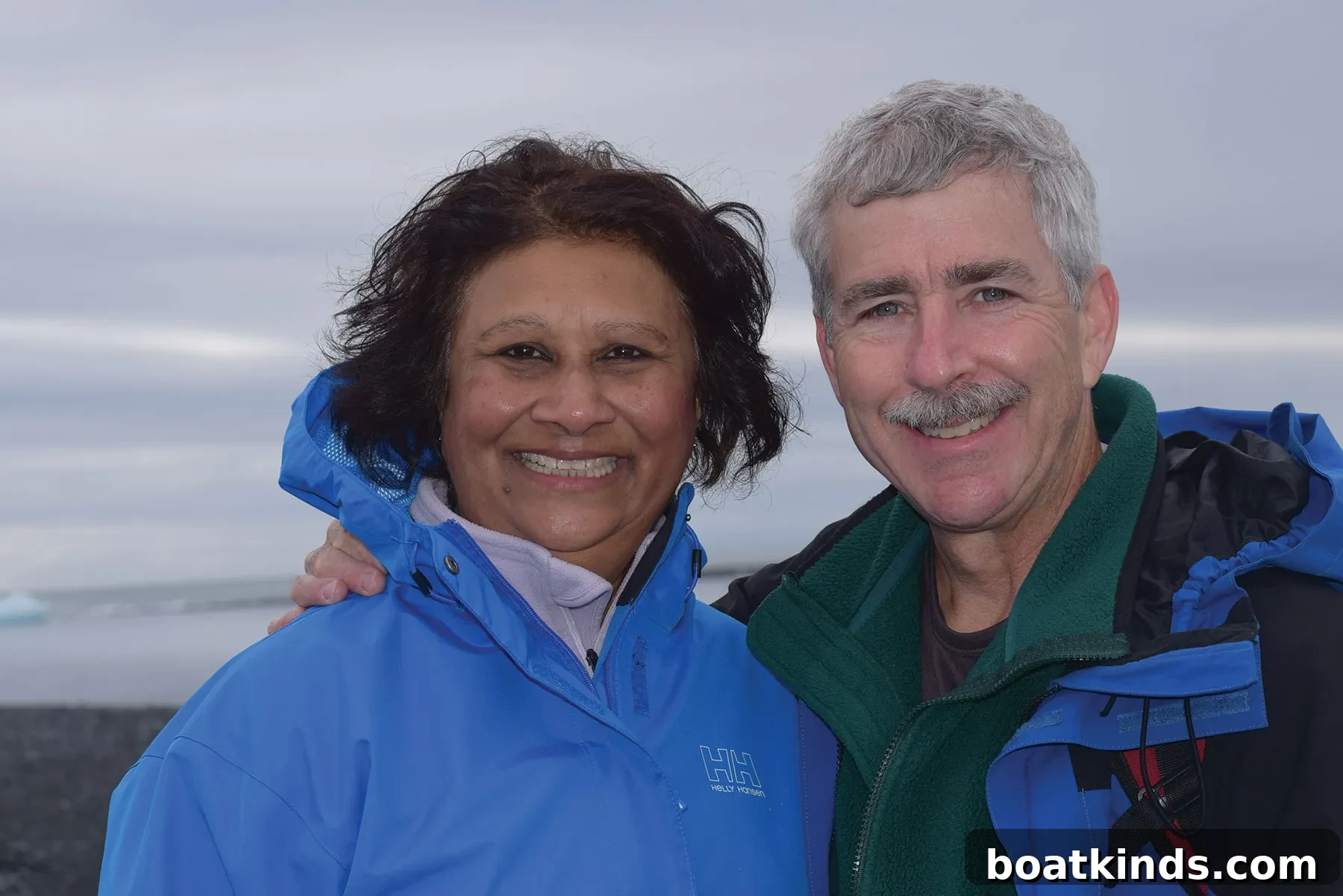
In February 2018, Marc and his wife Jayshree purchased their Nordhavn, named Wanderer, largely because Jayshree was not entirely comfortable returning to a sailboat life. “There are days I miss our Sabre,” Marc admits, “but we’re fortunate to have Wanderer. For Jayshree and for friends who join us, the destinations matter more than the motion of the journey.”
Their home port is Safe Harbor Sakonnet, situated on the Sakonnet River just south of Mount Hope Bay in Portsmouth, Rhode Island. When conditions on the open Atlantic are rough, Narragansett Bay provides a nearby alternative with protected anchorages and easy island access. Those local cruising grounds offer classic New England destinations and short passages ideal for learning the rhythms of trawler life.
The Mittelmans chose a Nordhavn because of the brand’s reputation for safe, long-range cruising yachts. Initially they considered the Nordhavn 40, but Jayshree insisted on having two heads so guests would be comfortable onboard. “Who was I to argue?” Marc says, acknowledging that a slightly larger boat better suited their needs.
During their first year of ownership they completed a number of upgrades identified during the survey. “The hydraulic stabilizers needed a refit, which turned out to be more involved and costly than I expected,” Marc notes. The main generator and the 130-hp John Deere–based Lugger diesel engine were in good condition, and the couple invested in refreshed upholstery and a sunshade for the boat deck. They also prioritized electronics redundancy, adding a second radar and a backup autopilot to increase safety and reliability for extended cruising.
Wanderer has a top speed of about 8.4 knots, though Marc typically cruises at 7 knots to optimize fuel economy. “There’s a steep fuel penalty beyond 7 knots,” he explains, noting that fuel consumption increases sharply at higher speeds. The boat also carries a 30-hp Yanmar auxiliary engine, which Marc runs regularly whenever they depart the dock to ensure it remains reliable. Electric bow and stern thrusters make fine maneuvering straightforward when docking the roughly 30-ton vessel, and for off-boat excursions the Mittelmans stow a 350-pound, 10-foot RIB with a 20-hp Yamaha outboard on the boat deck just aft of the flybridge.
In their first season with Wanderer, the couple made local cruises to classic New England ports such as Provincetown, Martha’s Vineyard, and Nantucket, allowing them to gain confidence handling the trawler in tight spaces and to adapt to life aboard a power cruiser. They particularly value the increased comfort and liveaboard amenities that a trawler provides. Their longer cruising highlights include a voyage as far north as Halifax, Nova Scotia, and passages to Casco Bay and Penobscot Bay in Maine. Marc looks forward to future explorations along the southern coast of Newfoundland, inspired by travel narratives he admires.
Walkthrough
The Nordhavn 43 is a raised pilothouse trawler designed around a displacement hull for efficient, comfortable passages. The design features a high forward freeboard, a Portuguese bridge, and an offset cabin structure that yields a safe, walkable sidedeck to starboard. Entry to the main salon is through a waterproof aft bulkhead door. Inside, the social area offers L-shaped lounges arranged around the centerline, with matched teak paneling providing a warm, classic finish. A large U-shaped galley to port is positioned to serve diners in the salon as well as guests in the raised pilothouse above, which is accessed by a short four-step staircase.
The pilothouse itself includes a bench seat and table for off-watch crew or casual dining, and the helm offers roughly 270 degrees of visibility—an important feature for extended cruising. Dutch-style waterproof doors on either side of the pilothouse make it simple to step outside quickly. The accommodation layout places the owners’ cabin amidships with an en suite head, while a guest cabin is located forward, providing privacy and comfort for extended trips with company.
Specifications
LOA: 43’0”
Beam: 14’10”
Draft: 5’3”
Displacement: 60,000 lbs.
Power: (1) 160-hp diesel
Fuel: 1,200 gallons
Water: 300 gallons
If you’re shopping for a pre-owned boat, consider searching specialized listings and classifieds operated by reputable marine publishers and brokers to compare inventory and pricing.
This article was originally published in the May 2022 issue.