
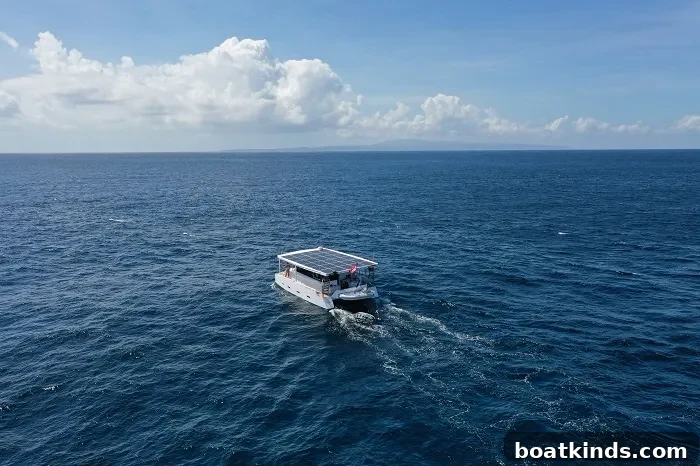
Azura Marine’s Aquanima 40: A Solar-Powered Catamaran Designed for Silent, Emission-Free Cruising
All-electric cruising catamarans are gaining traction among owners who prioritize sustainability, quiet operation, and low running costs. Singapore-based Azura Marine recently demonstrated those qualities with a sea trial of its Aquanima 40, the 43-foot catamaran prototype named Solar Eclipse, tested off the coast of Bali, Indonesia.
During a four-hour trial the Solar Eclipse posted encouraging real-world results. At wide-open throttle the vessel exceeded 8.5 knots. In steady cruising mode she maintained 4.5 knots while drawing less than 2 kW of electrical power per hour. At the same time the vessel’s solar array—30 panels mounted across the roof—produced more than 8 kW. After completing a series of higher-speed runs, the yacht returned to her mooring with fully charged batteries.
The Aquanima 40 is outfitted with a 10 kW solar roof and a 60 kWh battery bank. Azura Marine says the combination of generation and storage gives the boat an effectively unlimited continuous range “day and night,” removing the dependence on shore power or fossil fuel for routine cruising. The solar roof is a multifunctional design element: in addition to generating electricity it can collect rainwater and serves as an upper deck for seating or shade.
Azura Marine positions the Aquanima 40 for buyers who want a different cruising experience—one that emphasizes comfort, silence and environmental responsibility over high-speed performance. Commercial director Simon Turner explains that many customers are intentionally moving away from fossil fuels. “These people are not interested in thrashing around at 30 knots but more in having a joyous, silent, cruising experience, safe in the knowledge that they are not harming our oceans and marine life, let alone not incurring a single cent of fuel cost,” Turner said.
Hull development for the Aquanima series was carried out at Harbin Engineering University in China, with research overseen by professor and Azura cofounder Xueqian Zhou. The academic collaboration informed the hull forms and efficiency targets used in the design.
Azura Marine is offering a flexible approach to propulsion and configuration. The Aquanima 40 can be ordered with more powerful electric motors for higher performance, and buyers may choose hybrid propulsion or sailing packages depending on their cruising profile. As a safety and range backup, all yachts include an emergency generator that will automatically engage if the battery state of charge becomes critically low.
Looking beyond the 40, the company is developing a larger model—the Aquanima 45—with a flybridge, intended for owners who want additional living and social space while retaining the same solar-electric philosophy.
The key takeaways from Azura’s prototype trials are practical: a well-integrated solar array and battery bank can sustain meaningful continuous cruising speeds with minimal external energy input, and careful hull design and system integration make an emission-free, low-noise yacht viable for coastal and near-shore use. For owners focused on eco-friendly operation, reduced operating costs and a peaceful onboard environment, the Aquanima concept represents a compelling alternative to combustion-powered cruising catamarans.
More information is available from Azura Marine and the Aquanima model pages directly on the manufacturer’s website.