
Review: Aspen Carbon Cat — A Lightweight Carbon-Fiber Tender Built for Durability and Comfort
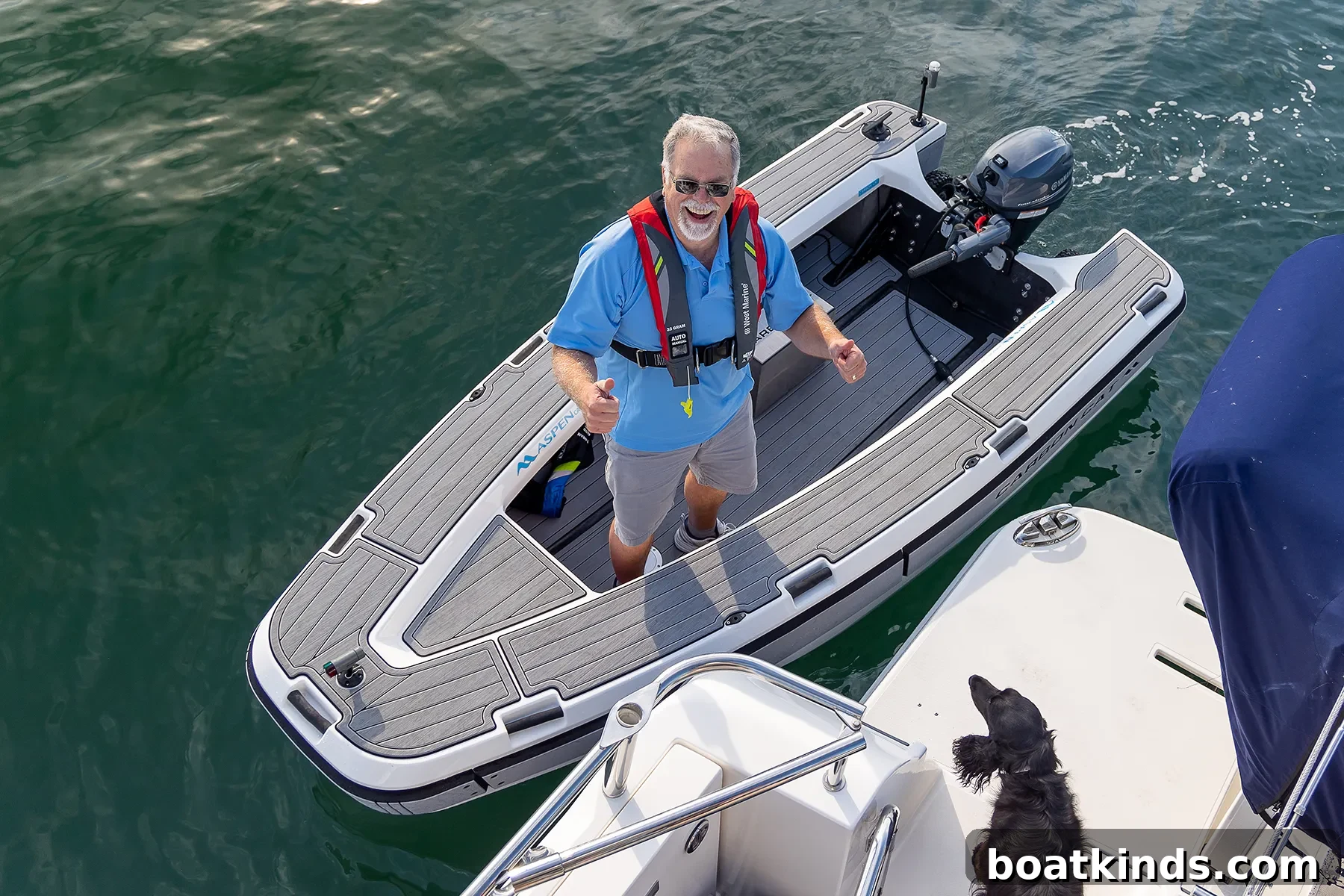
At the Annapolis Powerboat Show I stepped down from the dock onto the side deck of the 11-foot Aspen Carbon Cat and immediately noticed how solid and secure the footing felt. SeaDek covers the coaming and main deck, providing a nonslip surface that makes boarding and moving about confidence-inspiring. Once on board I met Larry Graf, the designer and builder of the Aspen Carbon Cat and the founder of Aspen Power Catamarans, and we set off for a sea trial in Annapolis Harbor.
The Carbon Cat was conceived to address common shortcomings of conventional inflatable dinghies and RIBs. Graf’s goal was simple: build a tender that avoids the common problems of inflatables—slow leaks, heavy weight, a wet ride at speed and a limited service life. “Traditional inflatables leak, they are heavy, they are wet when run hard and they don’t last very long before needing replacement,” Graf explains. “I wanted to build a dinghy that would last 20 or more years.”
The engineering choices reflect that ambition. Graf chose carbon fiber and S-glass laminates over traditional fiberglass to achieve a dramatically higher strength-to-weight ratio, combined with a Divinycell core for stiffness and resilience. The result is a hull that is light—about 150 pounds for the 11-foot model without options—yet strong enough to withstand the stresses of repeated use and support an outboard reliably.
The hull design itself is distinctive and purposeful. Forward the Carbon Cat has a plumb bow and a monohull section with molded spray rails that cut through waves. Aft the hull transitions to twin hulls, turning the hull form into a hybrid that blends monohull and catamaran characteristics. That configuration traps aerated water between and under the twin hulls, which reduces drag and softens the ride in chop while the twin hulls provide notable lateral stability both at rest and underway.
On our run in 1-foot chop the single Yamaha 9.9-hp four-stroke carried the 11-footer to a top cruise of around 18 mph. The ride was comfortable and free of the shocky, wet pounding you sometimes get in small inflatables. There was no cavitation in the turns and no water coming aboard—evidence that the boat’s running surface and hull geometry are doing their jobs.
Apart from the composite layup, Aspen avoids foam fill in the void between hull and deck because foam can absorb and retain water over time, adding weight and changing handling characteristics. Instead, the void is sealed and accessible through round deck inspection plates so owners can check it visually. The transom is reinforced with a 1-inch-thick Coosa Composite board that won’t take on water; it adds torsional stiffness for mounting outboards and serves as the foundation for optional beach-launching wheels.
Light weight is a practical advantage. At 150 pounds the 11-foot Carbon Cat is light enough that, with optional beach wheels fitted, one person can roll it ashore and pull it above the tide line. Aspen also offers a 10-foot model at about 130 pounds and a 9-foot model at roughly 117 pounds. Base prices for the line start at $9,800 for the 9-footer, $10,200 for the 10-footer and $10,800 for the 11-footer; these are preliminary figures on the company’s early builds and Graf believes there’s potential to shave more weight from future hulls.
In use the Carbon Cat is a compelling alternative to inflatables for cruisers who want a tender that remains dry at speed, resists the common maintenance headaches of tubes and seams, and delivers long-term durability. Its combination of carbon-fiber construction, thoughtful hull form and practical features like SeaDek decking and a water-resistant transom make it an attractive option for owners who value performance and low upkeep in a small tender.
— John Wooldridge
This article was originally published in the December 2022 issue.