
Robalo R-160 — Affordable 16-Foot Center Console Built for Coastal Fishing
Priced under $20,000, the Robalo R-160 delivers an attractive package for first-time boat buyers, families looking for a small coastal fishing boat, or parents who want a safe, reliable boat for their teenagers. The R-160 emphasizes value, simplicity and practical features that make ownership straightforward and enjoyable.
What You Get for the Price
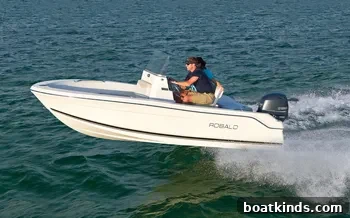
For $19,795 the Robalo R-160 is offered as a turn-key center console package that includes a Yamaha F50 four-stroke outboard and an aluminum trailer, according to East Coast sales manager Joe Pegg. There are higher-power factory options available as well: the R-160 can be equipped with a Yamaha F70 for $20,795 or an F90 for $21,995. The pricing strategy positions the R-160 as a competitively priced entry-level center console while still offering dependable Yamaha power and a trailer suitable for towing and storage.
Power, Performance and Seaworthiness
Robalo designed the R-160 for real coastal use rather than just calm lakes. Its Kevlar-reinforced, modified-vee hull and relatively high freeboard help the boat handle choppy coastal conditions, and the self-bailing cockpit adds a measure of safety and convenience when waves or spray are present. With the standard F50 the 16-foot R-160 reaches a reported top speed of about 31 mph. Choosing the optional F70 increases top speed to roughly 36 mph, while the F90 option can push the boat to near 41 mph. These figures give buyers the flexibility to balance cost, cruising speed and performance based on their needs.
Practical Layout for Fishing and Family Use
The R-160’s layout focuses on versatile, functional spaces for anglers and small families. A bow casting platform and a forward console seat provide elevated vantage points for casting and spotting structure. Both areas include insulated storage compartments, and the forward console seat doubles as a live well when needed. At the helm, a leaning post houses a cooler and features a seat back that pivots forward to create an aft-facing passenger seat—useful when cruising or watching children on the water.
Two cockpit jump seats include storage beneath and have fold-down backrests that convert the transom area into an aft casting platform. The center section of the transom conceals a 16-gallon portable fuel tank, keeping fuel accessible without sacrificing deck space. Grab rails outboard of each jump seat add safety and handholds when moving around the cockpit in rough water.
Simplicity, Storage and Maintenance
One of the R-160’s selling points is how straightforward it is to own. Pegg highlights that the boat is easy to store, clean and maintain—important considerations for first-time owners and families. The R-160 offers a folding console windshield as an option and comes with a trailer whose tongue folds down to reduce the boat’s garage footprint. These space-saving features make the R-160 practical for owners with limited storage and help simplify trailering and launching.
Electronics, Controls and Finishing Touches
The console is intentionally simple, with a breaker panel to starboard and ample room for flush-mounted electronics for those who want to add a chartplotter, fishfinder or other instruments. That clean, uncluttered dash makes it easy to configure the boat for fishing or casual cruising without overcomplicating the helm.
Who Should Consider the Robalo R-160?
The R-160 is a smart choice for buyers who want a compact, capable center console that balances cost and capability. It suits new boat owners, budget-minded anglers, families that need a safe coastal boat and those who want a manageable platform for teaching teenagers basic boat handling and fishing skills. Its construction and layout make it more than a simple skiff while its price and ease of maintenance keep ownership accessible.
For additional details and to confirm current pricing and options, contact Robalo Boats, Nashville, Georgia, (229) 686-7481.
This article originally appeared in the September 2015 issue.