
FDR’s Houseboat Years: The Larooco Log
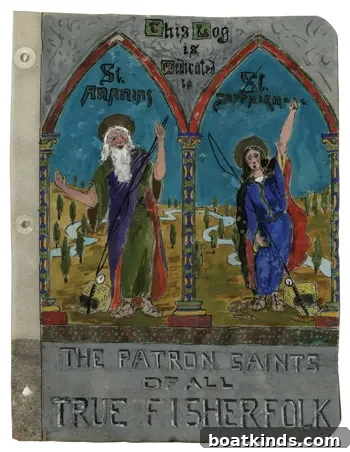
During the Roaring Twenties, a politically ambitious young man disabled by polio bought a houseboat so he could cruise the warm coastal waters and pursue treatments for his damaged legs. After Franklin Delano Roosevelt was struck by polio in August 1921 at age 39, he retreated from public life. He spent three winters aboard a houseboat, from 1924 to 1926, keeping a near-daily handwritten log in a three-ring binder. He wrote in black ink and sometimes in turquoise, filling the pages with candid observations and playful notes.
Roosevelt had loved boats and the water since childhood; at five years old he sent his mother a drawing of sailboats in his very first letter. Then, one night in August 1921, he was stricken with polio and never walked again. The New York Times reported his illness on August 28, noting his serious condition without detailing the full extent of his paralysis.
Franklin D. Roosevelt Better
Franklin D. Roosevelt, former Assistant Secretary of the United States Navy, who had been seriously ill at his summer home at Campobello, N.B., is recovering slowly. He caught a heavy cold and was threatened with pneumonia. Mrs. Roosevelt and their children are with him.
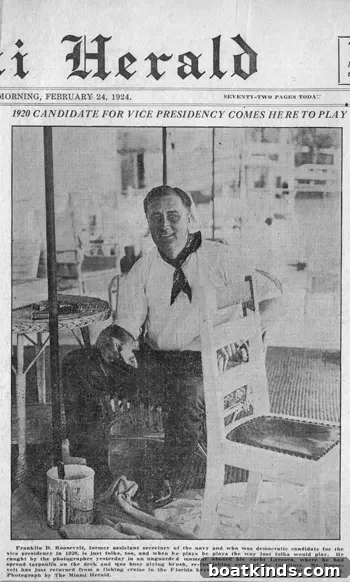
From that moment, FDR pursued treatment after treatment in his determined effort to walk again. In 1923, aiming for relief from the cold northern winters, he rented a houseboat called the Weona and spent six weeks in Florida waters—fishing, resting and entertaining. He wrote to his mother, Sara, that the warmth and exercise were “doing lots of good,” and described the casual life aboard, where guests wandered about in pajamas, nightgowns and bathing suits.
His wife Eleanor felt obliged to accompany him for the sake of his health, though she disliked the boisterous, carefree atmosphere. “I tried fishing but had no skill and no luck; when we anchored at night and the wind blew, it all seemed eerie and menacing to me,” she later recalled, and left the Weona after a few days.
In the summer of 1923 Roosevelt vacationed with Louis Howe, his close political adviser, at Howe’s cottage on Horseneck Beach in Massachusetts. Missy LeHand, his assistant, stayed to manage correspondence. There, under the care of the well-known neurologist Dr. William McDonald, FDR tried vigorous treatments for his legs. He joked that if he ever became president the doctor would be the first visitor to the White House. Louis Howe, who often brought him breakfast, would say encouragingly, “This is to make you strong. I will see that you become President of the United States.”
Roosevelt sometimes crawled across the hot dunes on his hands and knees until exhausted, then returned to the cottage where Howe would fix drinks. He did not mind crawling because he could do it himself—what he resented was making others carry him from place to place.
One summer day his college friend John Lawrence visited the cottage. They had sailed together on the Weona the previous winter and now, inspired by that experience, they planned to buy a houseboat for the coming winters. Roosevelt sought a vessel low in the water so he could slip overboard and crawl back on deck. In the fall he found what he called “a real bargain” on Long Island and wrote to Lawrence that the owner was “apparently up against it financially, and must sell quick!”
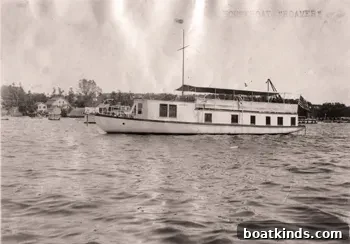
The two purchased a 71-foot houseboat named Roamer for $3,750. She was 19 feet across, drew 3.6 feet, had a roughly 15-year-old cypress-planked hull and was powered by two 35-horsepower engines. They debated a new name—Roosevelt suggested Larose or Rosela to mark their partnership—until Lawrence proposed the playful contraction LAROOCO (Lawrence Roosevelt Co.). With the double O and seven letters thought to be lucky, Roamer became the Larooco.
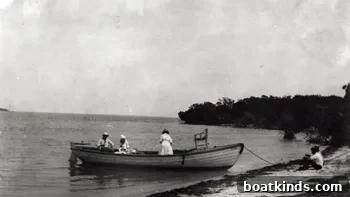
For three winters FDR lived aboard the Larooco: fishing, swimming, sunbathing, entertaining friends, playing games and focusing intensively on physical therapy. He recorded these seasons in a log, which mixes nautical notes—weather, routes, fish caught, engine troubles, guests and meals—with domestic detail and occasional wry humor. Below are edited selections from that log, interspersed with context and uncaptioned snapshots taken during the cruises.
Roosevelt used initials in many entries; for clarity, the editor substituted full names where possible. In some places the entries were condensed, rearranged or shaped into brief poetic lines to improve readability; the words remain Roosevelt’s own. Entries that preserve full punctuation are reproduced exactly as written.
Log Entries — 1924
Rules For Log Book Scribes
I. This log must be accurate and truthful. In recording weights and numbers of fish, the following tables may be used.
Weights:
2 oz. make — 1 log-book pound
5 log-book pounds make — “a large fish”
2 “large fish” make — “a record day’s catch”
Measures:
2 inches make — 1 log-book foot
2 log-book feet make — “Big as a whale”
Anything above “whale” size may be described as an “Ichthyosaurus.”
(Note — In describing fish that got away, these measures may be doubled — it is also permitted, when over 30 seconds are required to pull in a fish, to say “After half an hour’s hard fighting—.”)
II. The poetically inclined are warned that LAROOCO does not rhyme with Morocco. Likewise, contrived rhymes that force “Roosevelt” or “Lawrence” into awkward verse are forbidden.
III. Verbatim reports of the chief engineer’s private arguments with his carburetor should be represented only thus – “x ! ! x ! — ? ? X ! —.”
IV. All references to “community life” must be written in code.
V. The leaves of this log are easily removable. Frank opinions on the character and habits of shipmates written after three days of northwesterly wind and no fish will be removed.
Saturday, February 2
At Jacksonville, Florida, FDR boarded and commissioned the Larooco. Sailing master Robert S. Morris and Mrs. Morris spent the day provisioning; trunks were unpacked, fishing gear stowed, and a shelf was filled with a “Library of the World’s Worst Literature.”
Sunday, February 3
Gave all hands the opportunity to go to church—no takers. Left dock at 11:30 a.m., ran down the St. John’s River about 18 miles, then south into a narrow canal cut through pine lands. Moored to old pilings at 5:30 p.m., two or three miles short of the toll chain. Pondered interior colors for the boat—green or light blue—or both?
Monday, February 4
Marshy river. Strong headwind. Anchored at St. Augustine. Heavy rain late afternoon. Delicious oysters and whitefish. New leaks in the cabin and my stateroom.
Tuesday, February 5
When approaching town yesterday we saw flags at half-mast — President Wilson had died Sunday morning.
Wednesday, February 6
Underway at St. Augustine, south through the drawbridge. Steering cable slipped and we blew sideways onto a sand bar as the tide went out. Larooco soon lay high and dry. Maunsell, Missy and FDR went fishing—one sea trout. Large flock of black skimmers and a flock of greater snow geese. All hands played solitaire until the incoming tide lifted Larooco clear.
Thursday, February 7
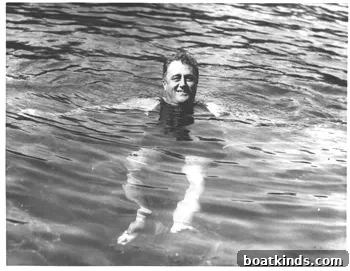
Stopped by a freight ship in the canal; the freight boat was aground and seven other boats were lined up. Wind had driven the water out. Missy and FDR went fishing from the launch—no luck. Painted three-quarters of a chair a beautiful blue.
Saturday, February 9
A very cold night. Waited for the northeaster to blow more water into the narrow canal. At 4 p.m. the freight boat got through, then the Lounger; Larooco and the second boat behind us stuck. We were lucky to get ahead, but soon the port shaft struck a rock and bent. Tied up at the toll bridge five miles south.
Tuesday, February 12
Uneventful day. Engines recovered from what we jokingly called “pneumonia.” Left Daytona and continued south until we stuck in the mud before the Haul-Over. Anchored for the night. Much playing: solitaire and Parcheesi.
Wednesday, February 13
Stopped at Haul-Over for very superior eggs. Entered the broad expanse of the Indian River and made a fine day’s run.
Thursday, February 14
Yesterday Maunsell took a bath—reason shrouded in mystery. Today is his birthday. With no other gifts, I bathed in his honor. Heavenly warm day—shirt-sleeve weather. We painted two dining room chairs blue. Continued southward and anchored off Fort Pierce at 6 p.m. Had cake and flowers for the birthday dinner. This Indian River is a wonderful body of water, stretching north and south for miles and separated from the ocean by a narrow beach—shallow almost everywhere.
Friday, February 15
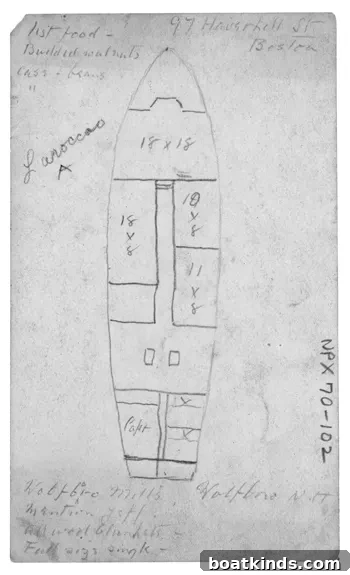
A hot day—we are approaching the nearest point to the Gulf Stream. While passing through Peck Lake at 3 p.m., we ran aground and stuck aft. Engines would not move her in the 50-foot channel. We secured a hawser to a mangrove tree and, by the combined efforts of the engines, Mac in the motor boat, the captain, Maunsell and Roan on the windlass, she came off within an hour. We passed through the lovely winding Lower Jupiter Narrows into Hobe Sound and anchored for the night off the Olympia Beach Club.
Saturday, February 16
Left Olympia of the Very Mortals at 9:30, taking our time and running aground two or three times en route. Reached Palm Beach at 4. Maunsell went ashore for papers and mail. We spent hours trying to discover why the world continued to turn in our absence.
Excerpt from FDR On His Houseboat, by Karen Chase. Copyright © 2016 by Karen Chase. Reprinted by permission SUNY Press. All rights reserved.
This article originally appeared in the February 2017 issue.