
Capt. Jonathan Boulware, executive director of the South Street Seaport Museum in lower Manhattan, remembers two events above all from his time leading the institution: the devastation of Hurricane Sandy in 2012 and the triumphant return of the museum’s flagship, Wavertree, after a major restoration.
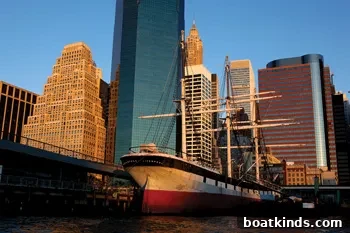
Hurricane Sandy arrived at a moment when the museum had only recently recovered from the economic fallout of the 2008 recession and the impact of the 9/11 attacks on nearby lower Manhattan. As the storm approached, Boulware and his team monitored models day by day. A crew of about 60 volunteers brought extra mooring lines and prepared the seaport’s vessels docked at Pier 16—home to the Wavertree, Peking and Ambrose, among others. They worked to secure each ship, carefully balancing tension so the vessels had some slack without being able to break free.
The museum staff sandbagged the front steps at 12 Fulton St., stacking them three high. “It was almost comical,” Boulware recalls. “No stack of sandbags could have stopped that surge.” He and two colleagues stayed inside the museum through the night not to prevent damage but to serve as first responders—ready to document and respond to the wreckage after the storm.
When the surge hit, it came with surprising force. Boulware heard water rushing from the basement into the front lobby and climbed to the roof to look out. “One minute the streets were dry, the next they were wet,” he says. The tide and wind created a powerful surge that drove water through Lower Manhattan. The surge reached approximately 14 feet, and water rose to about 6½ feet inside the museum. Streets flooded so quickly the receding water burst out through nearby first-floor store windows as it sought a way to drain. Clothing, wine bottles, tables and chairs were scattered across the area. Heavy greenheart logs—each as substantial as steel girders—were dislodged from Pier 16 and rolled several blocks away.
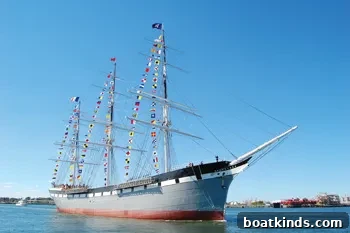
Despite the chaos, the museum’s fleet fared well and the institution’s collection of roughly 26,000 maritime artifacts had already been moved to the second floor. Still, the pier and museum sustained extensive damage. Official estimates put the loss at about $22 million; Boulware believes the true cost was higher. In the aftermath the museum received $4 million from New York City, $11.6 million from the Federal Emergency Management Agency and $4.8 million from the Lower Manhattan Development Corporation. Most repairs have been completed, though the elevator remains out of service.
The other vivid memory for Boulware is more celebratory: a bright Saturday in September when the fully restored Wavertree returned home after a $13 million restoration. Boulware traveled to Staten Island’s Caddell Dry Dock and Repair Co. to inspect the ship and finalize preparations. He worried the new ensign might be too large, but he decided to hoist it even though the masts were still wet with fresh tar. “I set it, and the breeze caught,” he says. “That was the moment she came alive. She had a proper flag where it belonged.”
Back at Pier 16, Boulware joined the crowd awaiting the ship’s arrival. With the assistance of three tugs, the iron-hulled windjammer slid into her home berth. The return after a 16-month program of hull repairs, replacement of two decks and restoration of a historical “tween deck felt like a debutante moment. The extensive rigging work restored the vessel to the condition she held when she last sailed in 1910, reviving her appearance and profile for visitors to see.
The 131-year-old Wavertree, built of riveted wrought iron in Southampton, England, in 1885, represents the class of cargo sailing ships that once lined New York’s South Street by the dozen. Those ships created the waterfront’s towering forest of masts from the Battery to the Brooklyn Bridge. New York City’s Department of Design and Construction managed the restoration project, and funding came through the Department of Cultural Affairs with support from the mayor’s office, the city council and the Manhattan borough president’s office.
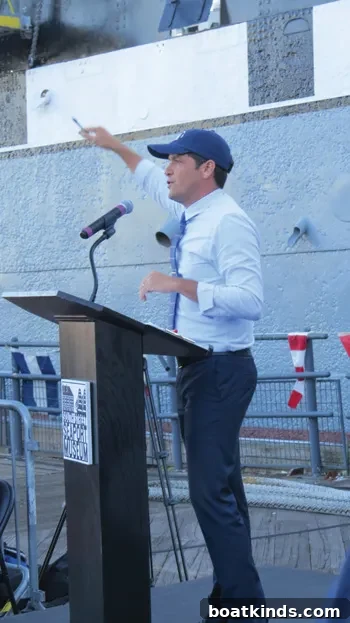
City leaders and special guests marked the occasion. “In New York’s earliest days, the waterfront teemed with tall ships bringing people from all over the globe to the shores of our city,” said then–Mayor Bill de Blasio. “With the return of the Wavertree, we are proud to welcome back a living piece of that maritime heritage.” He added that the restoration makes the museum an ideal place to explore how people, goods and ideas have arrived in New York across the ages.
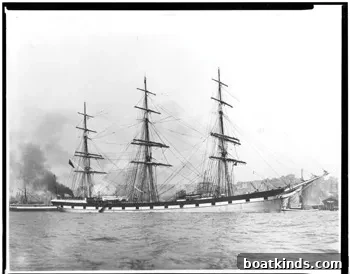
After 25 years of global voyages, the Wavertree was damaged in a Cape Horn storm in 1910 that toppled her masts and ended her career as a cargo vessel. She spent decades as a floating warehouse and later as a sand barge in South America, where dockworkers called her el gran velero—“the great sailing ship.” In 1968 the museum saved the vessel, towing her to New York to become a signature exhibit on the museum’s waterfront.
Boulware notes the municipal restoration was unique: “No city in the U.S. has ever undertaken a comparable, municipally funded restoration of a sailing ship. Wavertree is the very type of ship that made New York New York. She is our city’s ship, and we’re thrilled to welcome her back to the museum and to the Street of Ships.”
When she left for restoration she had been a rusty hulk; when she returned she was fully dressed, her rigging restored up to the royal yards for the first time since 1910 and her ensign proudly flying. “She looked smart, like a proper ship,” Boulware says. “Wavertree is a ship saved by a city, and we are a museum saved by a ship. She’s a powerful symbol for us.”
This article originally appeared in the December 2016 issue.