
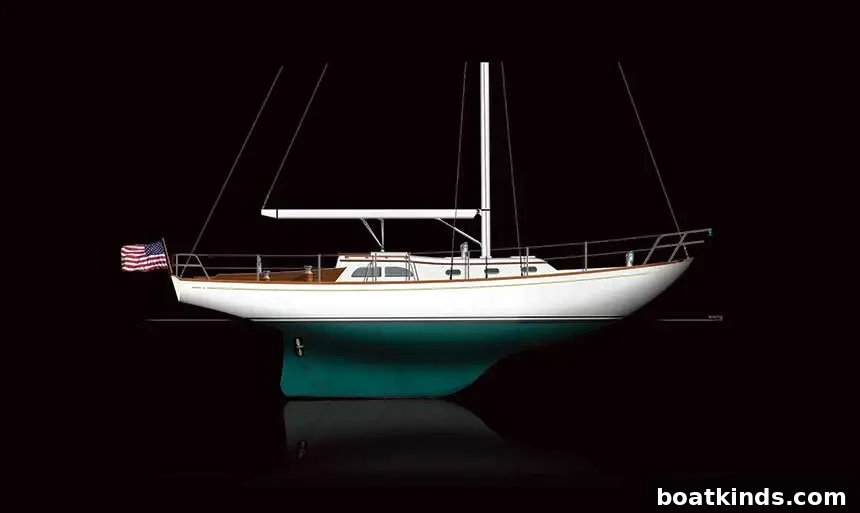
LeComte Northeast 38: A Classic 1960s Fiberglass Cruiser
The 1950s and 1960s marked a golden era in sailboat design, driven in large part by the arrival of fiberglass as a practical boatbuilding material. Fiberglass relaxed many of the constraints of wood and enabled designers and builders to experiment with new shapes, lighter structures and production techniques. Out of that period emerged a wide variety of vessels: pure racers, racer/cruisers and family cruisers that remain prized today. Among these enduring designs is the LeComte Northeast 38, a yacht from the early fiberglass era that continues to attract loyal owners.
Built by Adolf “Dolf” LeComte in Holland, the Northeast 38 was one of the first of his models constructed in fiberglass. LeComte had an established reputation for quality wooden boats before making the transition to fiberglass in 1961. The Northeast 38, which debuted in 1962, was the second hull he produced using the new material and quickly found an audience for its combination of performance and traditional styling.
William Tripp Jr., a prominent American naval architect, was responsible for the design. Tripp had earned a strong reputation for competitive designs and had collaborated with notable builders including Columbia Yachts and Hinckley. His work combined an understanding of racing performance with practical seakeeping qualities, and those traits are evident in the Northeast 38. Tripp produced the model in both sloop and yawl configurations, employing a then-modern modified fin keel and a masthead rig that balanced speed with handling.
Construction for the Northeast 38 employed an all-fiberglass hull with Airex-cored decks, a technique that provided stiffness and reduced weight compared with solid laminate decks of the era. Interiors were finished in the classic varnished-wood style popular with cruising sailors of the time, creating a warm, traditional cabin ambiance. Owners and enthusiasts have long praised the boat for its seakindly motion, roomy cockpit and comfortable interior—qualities that helped position the design as a favorite among cruisers who appreciate classic lines and solid handling.
The interior layout adhered to a conventional, practical arrangement familiar to cruisers of the period. A V-berth occupies the forward section, the main cabin features a drop-leaf table flanked by settees, and the companionway leads down to a compact but functional galley and a navigation station. This straightforward plan favors livability and easy movement below decks, making the Northeast 38 a capable long-distance cruiser as well as a pleasant weekend boat.
During its production run, LeComte-Holland built roughly 60 Northeast 38s. Over nine years the model received two incremental updates: the MK II in 1966 and the MK III in 1969. These iterations introduced modest refinements—changes to hull and transom angles, modified keel shapes and alternative rudder options—meant to improve handling and adapt to owner preferences without altering the character of the design. In 1971, the Northeast 38 was succeeded in LeComte’s line by the ALC 40 sloop, yet the original remains a standout wherever classic boats gather.
What sustains the Northeast 38’s appeal today is a blend of attributes common to the best designs of its era: timeless aesthetics, solid construction for the period, and sailing behavior that pleases both nostalgic cruisers and practical-minded owners. Its varnished interior and traditional layout evoke the feel of a midcentury yacht, while its fiberglass hull and Airex-cored decks reflect the technological advances that shaped modern boatbuilding. For collectors and sailors who value classic lines combined with capable seakeeping, the Northeast 38 continues to be a sought-after example of 1960s design ingenuity.
Though the LeComte Northeast 38 is over half a century old, it still turns heads in marinas and at regattas, a testament to thoughtful design and the durability of early fiberglass construction. Owners who maintain these boats often report a deep affection for their yachts, describing them as ideal companions for coastal cruising and nostalgic passagemaking.
This article originally appeared in the May 2019 issue.