
Brian Thompson: Britain’s Four-Time Non-Stop Circumnavigator Eyes Even Bigger Records
Brian Thompson, a 50-year-old sailor from Southampton, is one of 14 crew members aboard Banque Populaire V, the record-setting 131-foot trimaran that now holds the Jules Verne Trophy for the fastest non-stop circumnavigation. By completing that voyage, Thompson became the first British sailor to finish four non-stop racing circumnavigations. Far from content, he says he intends to complete at least two more.
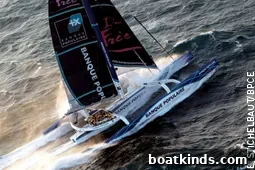
Thompson already shares the overall crewed non-stop record and the Jules Verne Trophy with his teammates on Banque Populaire. “Now I’d like to beat the non-stop solo [around-the-world] record,” he said. That ambition sits alongside other goals on his list: competing in the Vendee Globe, the solo non-stop around-the-world marathon often called the “Everest of Sailing,” and attempting a solo non-stop sprint on a 105-foot trimaran to challenge the solo circumnavigation record.
On Jan. 6 Banque Populaire completed a record circumnavigation in 45 days, 13 hours, 42 minutes and 53 seconds, cutting 2 days, 18 hours, 1 minute and 59 seconds from the previous mark set by Franck Cammas’ Groupama 3 in 2010. The trimaran’s instruments logged 29,002 miles at an average speed of 26.51 knots and a top speed of 48 knots. The World Sailing Speed Record Council (WSSRC), which ratifies records and calculates distances on the basis of a spherical Earth, assessed the course at 24,857 miles with an average speed of 19.75 knots.
Regardless of which mileage figure is quoted, the voyage was relentlessly fast and high-pressure. “All the way around, you’re pushing the boat to the edge, always with the risk of capsizing or damaging something,” Thompson explained. Any damage or capsize would have ended the attempt and dashed the crew’s hopes.
Thompson was a helmsman and trimmer on the crew and took turns steering in three-hour watches. “It requires very intense concentration, like a qualifier for the [Indianapolis 500],” he said. His focus was on blending speed with safety: steering fast and clean, maintaining a high average, and keeping the main hull just kissing the water when possible.
Banque Populaire started its record bid on Nov. 22 from the English Channel between Ushant and Lizard Point. A 30-knot northerly pushed the boat to the Equator ahead of Groupama 3’s split two years earlier, and the trimaran entered the Indian Ocean south of the Cape of Good Hope in just 12 days—three days faster than the previous effort. The crew held that lead through the leg to Australia.
They lost some time while threading ice-strewn waters en route to Cape Horn. To avoid heavy pack ice they pushed north, increasing mileage, slowed to pick a safe route through hazardous fields, and sailed around a high-pressure ridge with little wind, all of which cost time. The crew made those miles back in the Atlantic as they pushed for home.
Overall Thompson rated the weather a “6 out of 10—slightly better than average.” The crew, however, was a solid 10: disciplined, focused and professional, but also good-humored. Most of the sailors were French, so the lingua franca on board was French. Thompson, the only British crewmember, said he wasn’t fluent at the outset but returned home having mastered French sailing terminology and much improved conversational French. “It was a great experience. It stretched me,” he said.
Loick Peyron, Banque Populaire’s skipper, drew particular praise. “He was fantastic, extremely experienced and competent; a very, very good people person; a good leader—always in a positive mood. He made the whole team happy,” Thompson said. Peyron balanced an unwavering focus on the record with a pragmatic approach to risk, pushing for speed but avoiding reckless moves that might break gear or jeopardize the voyage.
“It wasn’t until the last five miles, literally, that we could start to relax a little and know we were going to do this,” Thompson recalled. Even then, the crew recognized how fragile success can be: a single structural failure, a collision with floating debris, or a prolonged run of bad weather could have spoiled the attempt.
Thompson’s career spans a long list of high-profile multihull campaigns. Over his lifetime of sailing he has been part of or led teams that broke 27 WSSRC race records—more than any living sailor he knows of. His first round-the-world speed mark came in 2004 on Steve Fossett’s 125-foot catamaran Cheyenne (formerly PlayStation). He skippered the catamaran Doha in Tracy Edwards’ Oryx Quest in 2006, and in the Vendee Globe 2009 he completed a solo non-stop circumnavigation, finishing fifth on the 60-foot Bahrain Team Pindar.
Thompson traces much of his multihull experience to The Race in 2000, when he crewed on PlayStation. He later sailed more than 100,000 miles with Steve Fossett and credited Fossett as a remarkable and formative influence. “It was a great privilege to have sailed with him so long,” Thompson said.
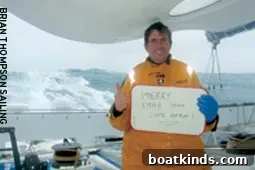
This article originally appeared in the May 2012 issue.