
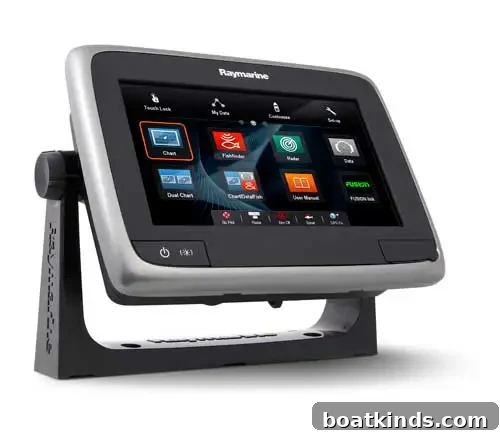
Raymarine Debuts Lighthouse II, New Charts and Engine Interface at Offsite Demo
Raymarine brought its latest marine electronics to the water on Wednesday, staging an offsite demonstration at the Hilton Marina aboard a 32-foot Boston Whaler center console. The event highlighted the company’s updated operating system for multifunction displays, Lighthouse II, alongside new charting options, autopilot components, sonar and a new engine interface designed to bridge modern propulsion systems with Raymarine displays.
Designed to simplify onboard navigation, Lighthouse II introduces a streamlined menu and faster access to commonly used functions. Raymarine marketing manager Jim McGowan emphasized that the most frequently used features are placed at the top of menus for quicker access, making everyday tasks like creating waypoints and planning routes more intuitive for users. The new interface was demonstrated on the display suite installed on the Whaler, showing the clearer menus and simplified workflows in real-world conditions.
To complement the updated OS, Raymarine launched Lighthouse Charts — a new chart engine offering both raster and vector charts built from U.S. government data sets. According to McGowan, Lighthouse Charts are intended to give boaters more choices for digital cartography while Raymarine continues full support for Navionics charts, preserving the company’s existing relationship with that chart provider. Raymarine has said the Lighthouse II update and the new charts will be made available as a free download to current Raymarine customers, with availability expected in mid-December.
The Whaler’s helm showcased a full Raymarine package: an e125 12.1-inch display and a 7-inch display on the leaning post facing aft to demonstrate charts and software, while the helm featured twin e165 15.5-inch displays and a Raymarine p70R autopilot controller with a 3.5-inch screen. Along with the e-Series multifunction displays, the boat’s electronics package included Raymarine’s Evolution Autopilot, a CP100 sonar module with CHIRP DownVision capability, and thermal imaging—components commonly used to enhance situational awareness, target detection and route tracking while underway.
The fall has been particularly active for Raymarine. In September the company introduced the ECI-100, an engine and drive-by-wire steering interface that simplifies connectivity between modern engines, steering systems and Raymarine multifunction displays. Priced at $299, the ECI-100 gathers and transmits key engine information—performance metrics, fuel consumption and alarm data—so operators can view that information directly on Raymarine MFDs.
The ECI-100 began shipping in October and supports a range of major manufacturers. Raymarine lists compatibility with Volvo Penta, Yamaha (Command Link Plus), Caterpillar and Yanmar engines, and notes that the unit interfaces with Volvo Penta IPS and Yamaha Helm Master autopilot systems. For boatbuilders, installers and owners, the interface addresses the growing need to integrate modern electronic control and monitoring systems with multifunction displays for a cohesive bridge experience.
At the demonstration, the combined hardware and software stack showcased how Raymarine is working to deliver a more integrated, user-friendly navigation environment. Lighthouse II’s emphasis on usability, paired with Lighthouse Charts and the ECI-100 interface, illustrates the company’s approach to providing charting flexibility, engine data integration and advanced sensor capabilities in a package suitable for both new builds and refits.
While Raymarine continues to support third-party chart providers such as Navionics, its move to offer native Lighthouse Charts gives vessel owners an alternative option drawn from authoritative government datasets. Free software updates for existing Raymarine customers, together with a clear rollout plan, aim to make the transition to Lighthouse II straightforward for owners who already rely on Raymarine multifunction displays.
Overall, the demo on the Boston Whaler provided a practical look at how the new software and interfaces function together at sea. The combination of larger display options, intuitive menus, enhanced charting and tighter engine-system integration reflects trends in marine electronics toward greater consolidation of navigation, propulsion and situational awareness systems on a single, easy-to-use bridge.
— Chris Landry