
Photos by Alison Langley
Nathaniel S. Wilson: Preserving Traditional Sailmaking in East Boothbay, Maine
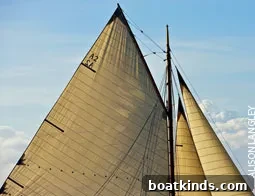
Overlooking the harbor at East Boothbay, Maine, Nathaniel S. Wilson Sailmaker Inc. has spent decades producing sails using time-honored, hands-on techniques. Now in its 37th year, the loft continues to cut and hand-sew woven sailcloth the same way Wilson learned during his service at the Coast Guard Academy sail loft in the early 1970s. “In those days the Coast Guard did all its sails in-house,” Wilson, now in his mid-60s, recalls, and he has maintained that in-house attention to detail ever since.
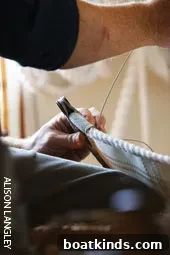
Wilson favors traditional methods over computer modeling. He designs sails on paper with a cut sheet, following the same pattern-drafting approach used by classic lofts such as the Herreshoffs a century ago. His small team of four craftsmen complete each sail with hand-stitching, employing a stout needle, waxed thread and a leather palm—a wraparound strap with a thumb hole and a metal disc at the heel to push the needle through heavy fabric. These manual techniques are deliberate choices that emphasize durability, authenticity and the nuanced finish that only experienced hands can provide.
Wilson attributes his methods to the training he received as an enlisted man at the academy and to apprenticeships at established lofts, including Ratsey & Lapthorn’s in City Island, New York. He describes these practices as “well-proven and well-tested,” and he emphasizes that they remain effective for restoring and outfitting classic yachts and historic ships. One important part of his mission is passing these skills on to a new generation of sailmakers who are drawn to building sails for traditional vessels. His son, Eben, has participated in the work, helping to keep that craft alive.
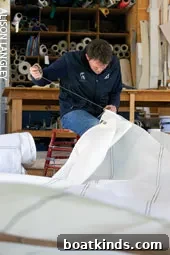
Wilson’s loft has produced sails for many notable historic and replica vessels. Clients have included the USS Constitution, the Coast Guard barque Eagle, Sultana, Clearwater, Spirit of Massachusetts, Pride of Baltimore II, American Eagle, Lettie G. Howard, Mayflower II, Godspeed and Discovery. During a recent winter season, the loft was building sails for the 1926 Frank Paine–designed Q-boat Falcon, several Murray Peterson–designed schooners and the Kalmar Nyckel, Delaware’s tall ship. These commissions reflect a specialty market: owners of restored and replica vessels who seek sails that are both historically appropriate and functionally dependable.
Wilson works exclusively with soft woven fabrics. He commonly uses Oceanus, a synthetic polyester cloth that closely resembles natural cotton duck in look and hand, as well as Egyptian cotton for projects that call for an especially period-appropriate feel. Choosing the right material is part of the loft’s commitment to authenticity: owners want sails that not only perform well but also look and feel like the originals from the boats’ era.
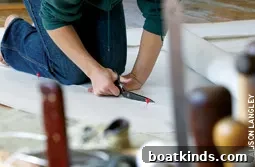
Clients who commission sails from Wilson are typically committed to historically accurate restoration, and they expect craftsmanship that honors the original construction. Whether fitting a replica tall ship or re-rigging a restored classic yacht, Wilson’s approach emphasizes the balance between art and engineering: the aesthetic lines and textures of traditional sails must also meet practical standards for strength and handling.
For Wilson, the work is both an art and a science. It combines the careful judgment of an experienced sailmaker—selecting materials, drafting patterns by eye and feel—and the precise technique required to stitch and finish sails that will stand up to wind and weather. In a small loft overlooking a Maine harbor, that blend of tradition and technical skill continues to serve owners and restorers who value authenticity and time-tested workmanship.
This article originally appeared in the April 2012 issue.