
The Thimble Islands are a scenic cluster of pink granite islets off the Connecticut coast, clustered around the friendly harbor village of Stony Creek. Favored by boaters and day-trippers on Long Island Sound, the Thimbles offer classic New England shoreline scenery, peaceful anchorages, and easy access to the shops and services of Stony Creek.
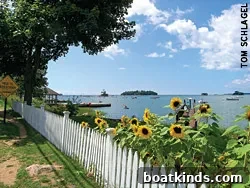
Depending on tidal range and how one defines an island, between roughly 100 and 300 rocky islets lie within three miles of Stony Creek, which sits between Branford and Guilford, Connecticut. The islands vary from bare granite ledges to densely wooded knolls and privately landscaped properties. Sizes range from under half an acre to about 12 acres, and around two dozen islands are occupied year-round or seasonally. The chain was likely named for the native thimbleberry, a close relative of the black raspberry once noted in the area.
Each island has its own character. Some remain natural and unadorned, while others feature cottages, Victorian houses, or elaborate estates with porches, docks and gazebos. Houses on the Thimbles span styles from simple seasonal cottages to restored Tudor and grand Victorian homes. Most islands rely on water piped from the mainland; only a few have full electrical service. There are no public hotels or lodging on the islands, and nearly all islands are privately owned.
European discovery of the islands is credited to Dutch explorer Adrian Block in 1614, although Native Americans had long used the islands for fishing and called them Kuttom-quosh, meaning “beautiful sea rocks.” Over the centuries the islands supported activities such as sheep grazing, shipbuilding and pink-granite quarrying. That pink granite from Stony Creek and nearby quarries supplied stone for prominent projects, and the local quarry remains in operation today after more than a century of use. Many island properties have stayed in families for generations while others were purchased by private buyers and notable residents.
Among more recent owners was party-supply magnate John Svenningsen, who acquired West Crib Island in 1976. After his passing, his widow, Christine, purchased several additional Thimble Islands over the following decades, preserving and renovating the properties rather than creating new developments. The islands have also attracted public figures — for example, cartoonist Garry Trudeau and journalist Jane Pauley have owned homes in the area.
A boat ride to local lore
One of the best ways to appreciate the Thimble Islands is from the water. Narrated tours provide history, geology and local stories while carefully respecting islanders’ privacy. Two longtime local options include the Volsunga IV with Capt. Bob Milne and the Sea Mist with Capt. Mike Infantino. Capt. Bob, a Stony Creek native who has offered tours since the late 1980s, guides a covered 40-foot vessel that accommodates up to 48 passengers; his tour is known for a mix of practical navigation and entertaining local tales. Sea Mist is a 44-foot tour boat operated by another native captain who shares regional history and island anecdotes. Websites (non-clickable): www.thimbleislands.com and www.thimbleislandcruise.com.
Tours typically point out how the islands’ rocky composition supported shipbuilding and quarry operations. Natural formations called “cribs” were used historically to frame and launch small vessels. Several islands, including Rodger’s Island (formerly Granite Island) and Bear Island, were quarried in the late 1800s. That Stony Creek pink granite was used in many notable structures and remains a defining feature of local architecture.
Island houses reflect varied pasts: a restored 27-room English Tudor on Rodger’s Island; Money Island, a once self-contained summer community now featuring about 30 homes on 12 acres; and Governor’s Island, with its cluster of Victorian houses and a distinctive octagonal building. Pot Island and Potato Island demonstrate creative island development: Pot Island hosted a mid-1800s hotel that is now private, while builders once filled around rock outcroppings at Potato Island to create gardened land with a pagoda-roofed house rather than a period Victorian.
Davis Island, nearly five acres, boasts a large Victorian mansion that served as a summer retreat for President William Taft for two summers. Gazebo Island is a tiny spot with a dock and picnic gazebo. Two islands are protected for science and conservation: Horse Island, the archipelago’s largest, is managed by Yale University’s Peabody Museum for ecological research and natural restoration; Outer Island, the farthest from shore, is part of the Stewart B. McKinney National Wildlife Refuge and is used for research and education in partnership with local institutions. For federal refuge information and reservations, contact the U.S. Fish and Wildlife Service.
The chain has weathered severe storms: the New England Hurricane of 1938 destroyed buildings and boats and washed away wooden bridges between some islands, with tragic loss of life on Money Island. Local lore includes tales of buried pirate treasure attributed to Capt. Kidd on Money and Pot islands, and romantic stories etched in stone on islands like Cut-In-Two East, where island lore links performers from 19th-century traveling shows to engraved names and legend.
Village of Stony Creek
Stony Creek is a compact coastal village with a low-tide harbor and a relaxed waterfront atmosphere. The town dock provides short-term dinghy space with a four-hour limit and a nearby boat ramp serves small craft. Thimble Marine Service offers outboard repair and maintenance near the ramp (203-481-0590). The village has limited provisioning, so visitors should plan ahead, but local dining options include small deli-style eateries offering breakfast, lunch and seasonal pizza and salads.
The Willoughby Wallace Memorial Library is a helpful resource for visitor information and hosts cultural events such as the annual Stony Creek Art Show. The village supports several small galleries and antique shops, and cultural attractions include the long-running Stony Creek Fife and Drum Corps (founded in 1886) and the Puppet House Theater, home to a rare collection of large Sicilian hand puppets crafted in the early 1900s. For puppet-house information, call (203) 488-5752. The Church of Christ, built of local pink granite in 1903, is notable for its stained-glass windows and hosts community events such as the summer peach festival and a seasonal Blessing of the Fleet.
Outdoor activities in and around town include a small park with a sandy beach and boat ramp, local kayaking and guided kayak tours, and the Stony Creek Trolley Trail — a gentle paved and gravel route through tidal marsh adjacent to the village. Local providers offer lessons, rentals and guided paddles that let visitors explore sheltered coves and island shorelines.
Approaches and anchorages
Navigation into the Thimble Islands requires attention to marked channels and tidal conditions. The tidal range is roughly six feet, so many rocks are only visible at low water. Mariners should consult NOAA charts 12372 and 12373 and note that buoy positions can shift slightly over time. If approaching from the east, pass south of Sachem’s Head and Goose Rocks Shoals, then proceed northwest toward red nun 4 off Wayland Island and follow the channel to green can 11, entering the main anchorage between High Island and Pot Island. From the west, stay south of Negro Heads and Gangway Rock, then steer past Inner Reef with Outer Island to starboard before turning into the same main anchorage.
The primary anchorage lies between green can 11 off East Crib Island and green can 1 by High Island. Beware of submerged cables and pipelines between islands and of a 6-mph no-wake speed limit inside the Thimbles and within 100 yards of shore. The main anchorage is generally sheltered from most directions except southwest and can be busy on summer weekends with tour and shuttle traffic; activity usually subsides after dark. With local knowledge you can also anchor north of Cut-In-Two Island or to the side of the main channel if you leave adequate room for passing vessels. Private moorings exist but are not available for public rental.
If the Thimble anchorages are full, alternative nearby spots include anchoring south of Green Island in Branford Harbor or near Kelsey’s Island by the Farm River in East Haven. For shore access from Branford Harbor, bring your dinghy up the Branford River and inquire at marinas about dinghy dockage; there is a state boat ramp farther upriver and an easy 25-minute walk from there to Main Street and town restaurants.
Marinas
Overnight dockage is not available in the Village of Stony Creek, but several Branford River marinas serve transient visitors. Options include:
- Branford Landing — transient slips for boats to about 45 feet with 5–6 feet at mean low water; power and water available; contact by phone at (203) 483-6544 for rates and availability.
- Branford Yacht Club — transient dockage for boats to about 50 feet with 5–6 feet at mean low water; slips typically include water and electric; contact (203) 488-9798, VHF channel 16.
- Brewer Bruce & Johnson’s Marina and Brewer Bruce & Johnson’s West Marina — transient slips up to 65 feet with 8 feet at mean low water; showers, laundry, pool, picnic area and fuel at the West Marina; contact (203) 488-8329, VHF channel 9.
- Indian Neck Yacht Club — may offer slips or moorings for boats 22–40 feet when members are away; gas available; contact (203) 488-9276, VHF channel 5.
Plan ahead for summer visits, consult current charts and local notices to mariners, and respect private property and the quiet character of the Thimble Islands and Stony Creek while enjoying this unique coastal destination.