
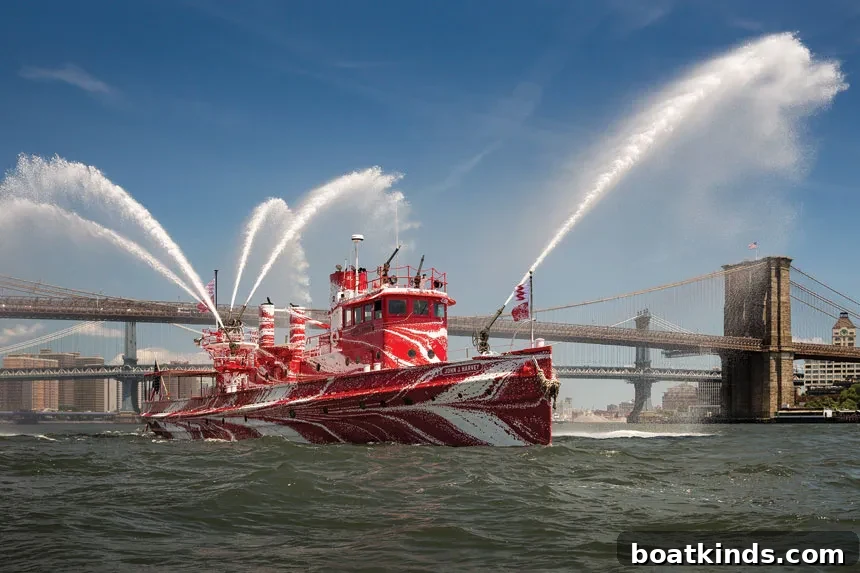
Dazzle Camouflage Reimagined: Tauba Auerbach’s Transformation of the Fireboat John J. Harvey
During World War I, British artist Norman Wilkinson introduced striking, high-contrast paint patterns—later called dazzle camouflage—designed not to hide ships but to confuse enemy submarines and make it harder to estimate a vessel’s range, speed, and heading. Inspired by that legacy, contemporary artist Tauba Auerbach applied a modern interpretation of dazzle patterning to a historic New York City fireboat, turning a working vessel into a large-scale floating artwork.
The subject of the project is the John J. Harvey, a 1931 fireboat that served New York City for decades before retiring. For the World War I centennial commemoration that concluded on November 11, 2018, Auerbach created “Flow Separation,” a public art installation that references Wilkinson’s original visual strategy while translating it into a contemporary, painterly language. The result is a bold, geometric composition of contrasting shapes and colors that engages both the history of naval camouflage and the language of abstract painting.
Funding for the project came from two public arts organizations: Public Art Fund and 14-18 NOW. AkzoNobel, a global paints and coatings company, supplied the materials used to coat the vessel. During the project’s public programming phase, the John J. Harvey offered rides around New York Harbor in the summer and fall, giving visitors a chance to experience the painted surface in motion and to see how the pattern interacts with water, light, and the city skyline.
Beyond the temporary rides, the intention for the season was to present the restored and repainted fireboat as a stationary public sculpture. The John J. Harvey was expected to return to her home berth at Hudson River Park’s Pier 66 in Chelsea for display as a floating sculpture through the winter and into the spring. The installation invited viewers to consider the intersections of maritime history, visual perception, and public commemoration, while also highlighting how historic vessels can be repurposed as platforms for contemporary art.
Auerbach’s “Flow Separation” does more than echo a historic technique: it reframes dazzle painting as a lens for discussion about visibility, movement, and the relationship between form and function. Where Wilkinson’s designs were utilitarian responses to wartime threats, this project uses the same vocabulary of sharp contrasts and fragmented planes to provoke reflection on memory and maritime heritage. Painting the John J. Harvey in this manner emphasizes how a vessel’s surface can carry meaning far beyond its original operational purpose.
The use of a retired fireboat for a public art installation also underscores broader efforts to preserve and celebrate maritime history in urban settings. The John J. Harvey is itself a piece of New York City’s living history: a vessel built in 1931 that later became an emblem of civic service and resilience. By transforming the boat into an artwork, the project linked that historical identity to a contemporary cultural moment—the centennial remembrance of World War I—and to ongoing conversations about how cities curate and display historic artifacts.
Visitors who boarded the vessel during the summer and fall experienced the paint scheme from multiple vantage points—on deck, along the waterline, and from the surrounding piers. Moving through the harbor allowed audiences to see how the patterns read differently at varying distances and speeds, echoing the original optical challenges dazzle camouflage aimed to create for enemy observers. As a floating sculpture moored at Pier 66, the John J. Harvey offered a stationary but still visually dynamic presence: a reminder that public art can animate familiar civic landscapes and invite renewed attention to neglected historical objects.
The collaboration brought together art institutions, a contemporary artist, and industry partners to realize a project that honored historical precedent while offering fresh artistic interpretation. It demonstrated how public art can create new contexts for historic vessels, turning a retired fireboat into a platform for education, commemoration, and visual experimentation.
At once a tribute to a wartime invention and a contemporary exploration of perception, “Flow Separation” highlights how paint and pattern can transform both form and meaning. The John J. Harvey’s moment as a dazzled fireboat offered New Yorkers and visitors an opportunity to engage with maritime history through a striking visual intervention that bridged past and present.
—Pim Van Hemmen
This article originally appeared in the November 2018 issue.