
Chris-Craft Commander 38: The Fiberglass Breakthrough That Reshaped an Icon
In the early 1960s, Chris-Craft — then the largest boatbuilder in America — faced a decisive moment. The marine market was shifting toward fiberglass construction, and the company’s traditional wooden boats were losing ground to newer, lower-maintenance designs from competitors. Builders such as Hatteras, Bertram, Boston Whaler and Sea Ray were already winning attention with fiberglass models, and Chris-Craft responded by making a bold, deliberate commitment to modern materials and methods.
R&D and Secrecy: Building a New Future
In 1962 Chris-Craft established a fiberglass research-and-development center in Pompano, Florida, and a Fiberglass and Tooling Activity Division in Holland, Michigan. The program was led by longtime designer and engineer Bill Mackerer, and the project was handled with strict secrecy. Even dealers were kept in the dark as shop windows were covered and doors remained locked. This level of discretion reflected the strategic importance of the move: Chris-Craft was not merely producing a new model, it was reinventing its approach to boatbuilding.
The 1964 Commander 38: Design and Construction
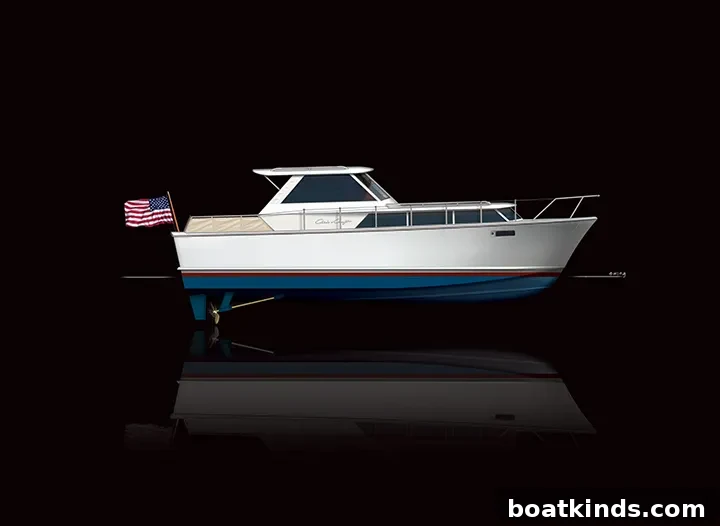
Two years into the R&D effort, Chris-Craft introduced the 38-foot Commander express cruiser — the company’s first all-fiberglass inboard cruiser. At the time it was among the largest production fiberglass boats available. The Commander 38 combined Chris-Craft’s signature aesthetic with the advantages of fiberglass: sleek, gleaming white hulls, a rounded bow that retained the brand’s classic character, and long, smooth horizontal lines across the deck, cabin top and pilothouse. Those elements gave the boat an elegant, contemporary profile that appealed to buyers who wanted both tradition and modern convenience.
Construction featured a robust, inch-thick modified-vee hull that balanced strength, seaworthiness and interior volume. Twin V-8 engines — available in 210- or 275-horsepower ratings — provided reliable inboard power and a top speed that reached into the 20s. Fuel and water capacities supported extended cruising: the Commander carried 200 gallons of fuel and 75 gallons of fresh water while maintaining a relatively shallow 3-foot draft.
Interior Layout and Amenities
The Commander 38 was designed for comfortable overnighting and extended weekends aboard. The layout accommodated six people, with a master stateroom complemented by a convertible day sofa and dinette. The boat featured two heads and a fully equipped galley that included a refrigerator, a three-burner electric range and an oven — amenities aimed at making the vessel practical for family cruising and entertaining. A flybridge was offered as an optional upgrade for owners who preferred elevated helm visibility and additional outdoor seating.
Production, Variants and Price
From 1964 through 1969, Chris-Craft built 262 examples of the Commander 38. The model was available in different configurations, including sedan and sportfishing versions, and the design underwent updates as production continued into the mid-1970s. Over time the Commander line expanded to include a broad range of models, ultimately stretching to lengths of up to 60 feet. At introduction, pricing reflected Chris-Craft’s positioning as a premium builder: the Commander 38 sold for $29,990 with twin 210-hp engines and $31,990 with twin 275-hp powerplants.
Legacy and Impact
The Commander 38 did more than add another model to Chris-Craft’s catalog; it signaled the company’s successful transition from wood to fiberglass and helped define the brand’s next generation. Owners and enthusiasts have long noted how the 1964 Commander combined classic Chris-Craft styling with the advantages of modern construction, creating a boat that felt both familiar and forward-looking. As one owner described the model, the 1964 Commander was a “revolutionary boat” — a view that reflects its importance in the history of American recreational boatbuilding.
By embracing fiberglass, Chris-Craft positioned itself to compete in an evolving market and to offer customers lower-maintenance, durable boats without sacrificing the design language that had made the company famous. The Commander 38 remains a milestone: a striking example of how a storied brand adapted to technological change while preserving the aesthetic and functional qualities that owners valued.
This article originally appeared in the July 2016 issue.