
Patrick Healey rarely goes a week without fishing from one of his Viking yachts. I caught up with Healey, Viking’s executive vice president, during a seven-day fishing stretch that began chasing sailfish off Jupiter, Florida, aboard a Viking 70 and finished on a 50-footer hunting Pacific sailfish off Los Sueños, Costa Rica.
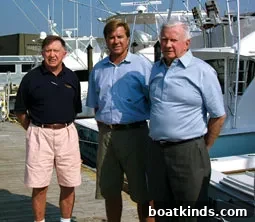
“You have to get out and use your boats to understand what your customers want,” says the 52-year-old Healey. His extensive bluewater experience has guided Viking’s prototype development, including the Viking 66 Open and Enclosed Bridge convertibles that debuted at this year’s Yacht & Brokerage Show in Miami Beach (VikingYachts.com).
Healey began working in the family business at 13, sweeping floors and doing hands-on jobs while learning every part of boatbuilding. His father, Bill, is president and chief operating officer, and his uncle, Bob, is chairman and chief executive officer. After graduating from St. Joseph’s University, Healey returned to Viking in full-time roles ranging from foreman to supervisor. In 1992 he became vice president of sales and expanded Viking’s dealer network. He also established the Viking Yacht Service Center in Riviera Beach, Florida, and started sister companies Palm Beach Towers and Atlantic Marine Electronics so customers could receive turnkey boats and services.
Healey and his wife, Leanne, live in Ocean City, New Jersey, with their three children. His sons, Sean and Justin, are being introduced into the business while his daughter Kaitlyn, 12, joins family outings and fishing trips.
Below, Healey discusses what sets Viking apart, his views on pod propulsion, how boatbuilding has changed, and Viking’s latest work on a near-100-foot convertible.
Q: What separates Viking from other boatbuilders?
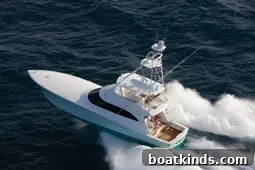
A: We go out and use these boats ourselves. I spend long days on the water—sometimes straight fishing from dawn into the night—and I still carve out time to manage emails and calls. That hands-on usage helps us design state-of-the-art products that meet real needs.
Another advantage is our long-term team and private, family ownership. My father and uncle bought the company in 1964 and have committed to continuous improvement. We push our vendors and dealers to be the best so the entire network is invested in quality. We also focus on making boats lighter and more efficient without pushing costs beyond reach. We operate in the upper end of the market, producing a modest number of boats annually—roughly 300 in a healthy year—and Viking builds around 60 of those each year even in tougher economies.
Q: Which Viking model is the most successful?
A: It depends on how you measure success. By dollars, the 82-footer is our top seller; by volume, the 42-footer dominates. A 42 is roughly a $1.2 million boat and an 82 can be about $7 million, so the financial impact differs from unit count.
Q: Do you see pod propulsion as a big part of Viking’s future?
A: We already offer pods on several models. The two 42 models—Open and Convertible—have been successful since their introduction in 2010, with about 20 delivered between both versions. We also recently introduced the Viking 50 with ZF pods paired with Caterpillar engines.
Over the next decade I expect propulsion to balance out—roughly half inboards and half pods—for boats up to around 2,600 hp. Pods suit smaller boats where the unit size is appropriate. For larger boats, pod housings grow heavy and create drag, so the benefit diminishes. Our engineering team has optimized hull, horsepower, and propellers for traditional inboard drivetrains, so the fuel and performance advantages of pods on our larger models are modest—typically a 5 to 6 percent gain in fuel efficiency in the installations we’ve tested.
My approach is to match the hull and propulsion to what best serves the boater in each class. For smaller sportfishing and convertible models, pods are a compelling option; for many larger yachts, a conventional inboard setup remains very competitive.
Q: What are you working on now—any new boats or technologies?
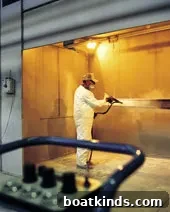
A: We’re designing a convertible in the 90-plus-foot range. Since 2008 we’ve delivered about 15 82-foot convertibles, and several owners want larger yachts. Lightweight construction is also a major focus—getting boats to go faster while burning less fuel is an ongoing priority.
Q: Are fuel prices a concern for your customers?
A: Absolutely. Regardless of wealth, customers dislike feeling overcharged. Fuel economy and operational costs matter to everyone, and that drives demand for more efficient hulls, propulsion, and systems.
Q: What was the smallest boat Viking ever built?
A: The smallest was a 33-footer—the company’s first full fiberglass boat—introduced around 1973. Before that, Viking combined wooden bottoms with fiberglass tops and bridges; by the early ’70s we transitioned to full fiberglass construction.
Q: How has boatbuilding changed in the last two decades?
A: The complexity has exploded. Twenty years ago a boat might have 30 systems; today a comparable boat can contain close to 1,000 systems. Modern boats include integrated electronics worth hundreds of thousands of dollars: touch-screen controls, cameras, night vision, automatic windows, electric doors, and automated bilge and drying systems. Lighting, climate control, entertainment, and safety systems are far more extensive than in the past, and making all of these systems reliable and easy to use is a major engineering challenge.
Q: Are there boatbuilders or boats you admire?
A: Roy Merritt of Merritt’s Boat & Engine Works is a respected leader in sportfishing and has influenced many design concepts. Carolina builders also do excellent work. I’d like to see U.S. boatbuilding stronger—many boats are now imported or built under foreign ownership despite being assembled in the U.S.
Q: Do you remember your first boat?
A: It was a 14-foot Thunderbird. I restored it with help from a plant colleague—new seats, paint, a rubrail—and we put a 40-hp Johnson on the transom. I water-skied and bay-fished from it for years. Later I owned center consoles and have kept one ever since. I fish everything—from flounder with my daughter to blue marlin around the world. If it swims and bites, I’m going after it.
Q: What center console do you have now?
A: I have a 31 Jupiter. Center console builders have advanced rapidly—brands like Bahama, Yellowfin, and Jupiter are pushing the envelope with impressive builds, often at 40 feet and with multiple outboards. They’re among the most progressive segments of boatbuilding.
Q: Have you ever considered building smaller boats?
A: We explored that seriously in 2005–2006 because of my interest in small boats, but our facility and overhead are optimized for larger yachts, so it wasn’t feasible to make small-boat production work economically.
Q: You started working for your father at age 13. What was that like?
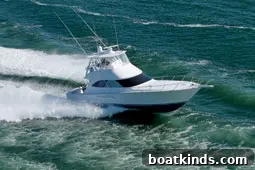
A: I swept floors, applied “green oil” to wooden hulls, fitted teak plugs, and did many hands-on tasks. I even drove the trash truck around the plant—an exciting responsibility for a kid. My father was strict about learning the business early; my sons are going through the same routine now and, although they sometimes resist at first, they enjoy it once they’re here.
Q: When did you decide to stay in the family business?
A: It was cemented the first time I went out on a boat with my father. He made it clear this was the life for me. I was reminded how different the boat business was from other industries in my family—my grandfather worked in steel—and I realized how fortunate I was to be building boats.
Q: What matters most to boaters today?
A: Comfort and convenience are top priorities. Owners want homes-away-from-home: well-appointed interiors, long-range capability, a smooth ride, and a reasonable operating cost. Even at the high end, buyers expect production-boat pricing rather than bespoke custom pricing, and they value strong resale. Our dealer network helps maintain resale values, which is a major benefit for customers.
This article originally appeared in the April 2012 issue.