
The closest I ever came to getting arrested was when a Coast Guard officer boarded for a routine law-enforcement check and asked to see my “dewatering device.” My blunt, amused refusal was not what he expected.
What followed was a serious discussion that revealed a simple misunderstanding: the term “dewatering device” can mean many things. Once the officer realized I wasn’t refusing to comply with a safety inspection but had interpreted his question differently, he was amused and satisfied. I told him, “Of course I have a dewatering device — which one would you like to see?” After a pause, he said, “Just show me a bucket. You’ve got one of those, don’t you? Or a scoop, or a shoe?”
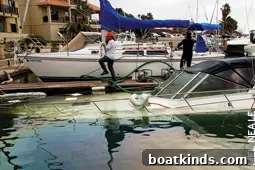
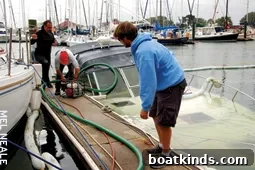
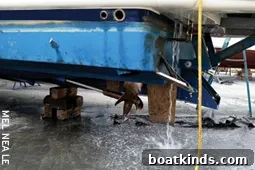
It turns out federal regulations use ambiguous language that can include anything from a bucket to a hand pump or shoe — any tool you might use to remove water from a boat. Over the years I’ve used most of them. I’ve never had a boat sink while I was aboard, but I have bailed out boats that were already underwater. People joke that nothing motivates a boater to bail faster than a bucket and the thought of sharks nearby. When I was young, the fastest bailer was always a kid determined to start his summer on the water.
Bailing the river
My first boats were pine, cross-planked flat-bottom skiffs. Every spring, regardless of how much paint and caulking I applied, the planks had to swell before the boat sealed and floated properly. I learned that overpacking seams with caulking just led to bulging and failures. Each spring I’d repaint, caulk the right amount, roll the boat to the beach and let it sit until it swelled tight. Then I’d swim her off the beach, anchor out in water deep enough to keep the hull from resting on the bottom, and wait several days while she settled. Once the gunwales were above the waves and she felt tight, I’d wade out with a bucket and start bailing.
On calm days I’d brace in the sand, reach over and scoop out water, even though sections of the sides and the transom cutout were below the surface. It felt like bailing the river back into the river, but it worked unless the wind pushed waves aboard. Wealthier boaters sometimes used gasoline-powered pumps, but I preferred the simpler approach. Pulling the boat up at high tide and draining it by opening the transom plug introduced sand and debris, so I stuck with the cleaner, purist method: bucket, coffee can, and persistence. After I bought my first outboard, I could also pull the plug and let the engine’s motion help drain the bilge.
The joy of a self-bailer
My first fiberglass boat was a revelation: it didn’t leak. When water from rain or waves collected on deck it simply ran out through a recessed drain in the stern, even when the boat was stationary. They called it “self-bailing,” and I thought it was the greatest invention since the Model A. Years later, when I see a self-bailing cockpit or transom drain work on my Mako, I still get that same thrill.
Later I owned a 27-foot sailboat with a bilge deep under the inboard engine — a hole you couldn’t walk into. It hid water and the creatures that crawled out when it got too full. For that boat I had a manual piston pump mounted in the cockpit locker with a hose down to the bilge. Pulling that handle felt high-tech to me then. It wasn’t as effortless as a self-bailer, but it was reliable and kept me unaware of the bilge until it needed attention.
As I moved up to larger boats, electric bilge pumps became standard. Early diaphragm pumps — the Par/ITT/Jabsco style — were robust and serviceable, with pistons, diaphragms and flapper valves. They were repairable in the field and provided positive displacement, which pushes water reliably even against head pressure. More recent centrifugal pumps are simpler, have fewer moving parts and move a lot of water, but they’re harder to repair in place and provide less “push” than a diaphragm pump.
Today my boat carries five operational bilge pumps: three centrifugal units with automatic switches, a Whale Gusher manual pump, and a large Edson manual pump mounted on a movable platform for salvage work. I also keep a spare centrifugal pump and two Rule high-water alarms that provide both visual and audible alerts. And yes, I still keep buckets for the dinghy and emergencies, though a bucket brigade wouldn’t reach the deep bilge on my big boat.
Electronics in the bilge
It’s as important to know your water level as it is to be able to pump it out. As a boat settles lower, flooding can accelerate, stability can be compromised, and free surface water can worsen rolls and even lead to capsize. High water can also submerge batteries and DC connections, disabling electric pumps, communications and engines. The more water you have, the longer it takes to regain control.
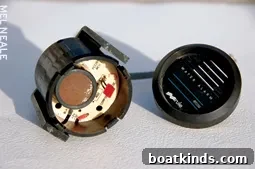
For those reasons I recommend both audible and visible high-water alarms positioned where you’ll notice them while managing the boat. Relying solely on an automatic pump is risky; switches and pumps fail, or the inflow can outpace pumping capacity. Many systems link the pump’s float switch to an alarm, but some pumps have internal switches that don’t permit an external alarm connection. In those cases, an independent alarm float or sensor placed slightly above the pump switch is wise so the alarm indicates a genuine problem rather than normal leakage.
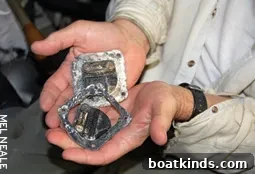
I’ve had alarm units fail without much warning, and that can be catastrophic. Regular inspection and scheduled replacement of vulnerable components are critical. Personally, I distrust complex electronics and printed circuit boards located inside a bilge pump. Systems that sense impeller resistance or use electronics to detect water can be clever in theory but unreliable in the messy, corrosive environment of a bilge. I’ve seen pumps that ran constantly or never shut off because the sensing mechanism misread conditions. If you use such a pump, test it frequently and be prepared to replace it if issues appear.
Some pumps claim to avoid pumping oil by sensing conductivity, which can prevent environmental discharge — but in practice oil and bilge contaminants can interfere with these sensors. I’d rather have an oily bilge pumped than risk sinking because a pump refused to operate. The more practical environmental approach is vigilance: inspect your bilge often, keep oil-absorbent pads on hand, and ensure any pads or absorbents don’t block float switches or the pump intake.
Because switches and wiring flex and wear, inspect float switches and leads regularly. A common best practice is to install at least two independent pumps and switches: a smaller daily pump at the lowest point and a larger backup above it. Where possible, fit the largest reliable pumps your space allows and keep spares on board.
Danger: long hose runs
Dewatering depends not only on the pump but also on the plumbing. The longer and more convoluted the hose run from the pump to the through-hull discharge, the more the pump’s rated output is reduced. Bends, hose wall roughness and elevation head create resistance that reduces flow. Deep-bilge boats are particularly vulnerable because discharges must often be routed well above the waterline to prevent backflooding.
A through-hull placed too low requires a vented loop or other backflow prevention, adding hose length and right-angle turns that further reduce pump efficiency and can promote air locks. Some install flap valves, but these also add restriction and can fail. The best practice is to place the discharge high enough above the waterline to avoid vented loops and to use short, smooth-lined, reinforced hose runs with as few bends as possible.
Long runs have another hazard: water remaining in the line can siphon back into the bilge after the pump shuts off, causing the pump to cycle repeatedly. Some centrifugal pumps use electronics to run a short post-cycle to clear hoses, but again, electronics in the bilge can be a single point of failure. Test any new pump and plumbing by flooding the bilge with dock water and observing the system, including alarms, under load. Repeat these checks regularly and replace components at the first sign of trouble.

If you doubt your dewatering system, consider a positive-displacement diaphragm pump mounted above the bilge. These pumps have strong suction and push, are often serviceable in the field, and can be a dependable backup to centrifugal units. Consult a qualified professional if you need help sizing pumps and designing plumbing; this is serious safety equipment.
And finally, remember the oldest lesson sailors learned when dewatering devices were nothing more than cupped hands and coconut shells: check your bilge often. Frequent inspection beats surprise flooding every time.
Tom Neale is technical editor for Soundings and lives aboard a Gulfstar 53 motorsailer. You can purchase his book, All in the Same Boat, and his two-disc DVD, Cruising the East Coast With Tom Neale, at tomneale.com.
This article originally appeared in the May 2012 issue.