
Wave Glider: How Autonomous, Wave‑Powered Roboboats Are Mapping the Oceans
In May 2013, Benjamin—a Wave Glider named after Benjamin Franklin—earned a Guinness World Record for the longest voyage by an autonomous surface vessel. This seven‑foot, surfboard‑shaped roboboat crossed 7,939 nautical miles from California to Australia, powered only by wave energy and guided by its onboard command-and-control computer. There was no skipper on board.
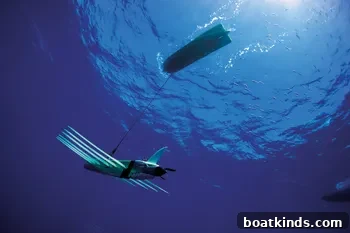
Designed and built by Liquid Robotics of Sunnyvale, California, the Wave Glider endured shark encounters, strong currents and Tropical Cyclone Freda during a 15‑month transit while continuously collecting and transmitting ocean, wave and weather data. It moves slowly—top speed around 3 knots and an average near 1.8 knots—but it is persistent. Solar panels power its sensors, onboard computer and satellite transceiver, so it requires no fuel, produces no emissions and can operate autonomously with a preprogrammed route or be guided remotely from a shore‑based console.
The Wave Glider’s propulsion comes from a two‑part design: a surface floater tethered to a submerged “wave engine.” The system exploits the difference between surface wave motion and calmer motion at depth. As the floater rides a wave, the propulsor’s horizontal foils move up and down, flipping like small flaps to convert vertical motion into forward thrust. This up‑and‑down foiling action propels the platform even in modest seas.
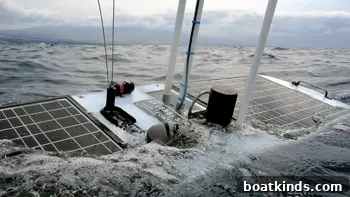
The floater’s deck doubles as a solar array that supplies electricity for instruments and communications. The latest SV3 model uses a 10‑foot floater and adds a small electric boost motor on the submerged unit to help in strong currents or calm conditions. That hybrid approach balances power generation and propulsion across sunny, low‑wave tropical waters and high‑wave, low‑sun higher latitudes.
Link to the undersea world
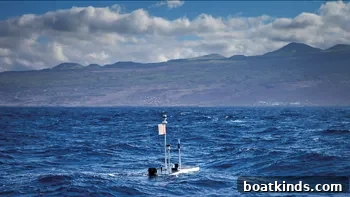
Autonomous, wave‑powered vessels like the Wave Glider are changing how scientists, governments and industry gather ocean data. They act as persistent, global sensors—complementary to satellites—capable of long deployments and continuous observations. In October 2014, seven autonomous platforms of four types from the U.S. and U.K., including Wave Gliders, took part in a 500‑mile trial hosted by the U.K.’s National Oceanography Center, collecting weather and ocean data along the boundary between the Atlantic and the English Channel.
These unmanned craft can expand our understanding of the seas by mapping seafloor topography, monitoring plate tectonics, inspecting drilling rigs for leaks, patrolling harbors, tracking whales, aiding offshore exploration, studying underwater volcanoes, monitoring fish stocks, detecting tsunamis, assisting anti‑submarine work and enforcing fisheries laws. They don’t necessarily replace crewed vessels but act as force multipliers—swarming around a mothership or operating far offshore to increase the density and persistence of ocean observations.
Liquid Robotics maintains a global fleet of Wave Gliders used by governments, businesses and universities. In 2011, NOAA deployed two Wave Gliders in the Beaufort Sea; over a 55‑day deployment they covered 2,700 nautical miles and gathered nearly 900,000 surface temperature readings that revealed unusually warm conditions. Other missions have included background radiation measurements for particle researchers and hurricane‑formation studies in the Caribbean.
Wider access to timely ocean and wave data benefits everyone: better weather forecasts, improved marine safety, richer fisheries intelligence, and enhanced maritime security. As autonomous data‑collection vessels proliferate, navigation safety becomes a priority. Wave Gliders are constructed from foam and fiberglass, equipped with lights and flags, and carry AIS receivers so their onboard systems can detect nearby vessels that broadcast AIS and take evasive action. Liquid Robotics is working with the U.S. Coast Guard on rules for AIS transmitters on unmanned platforms and developing acoustic sensors so gliders can “hear” approaching vessels and avoid collisions.
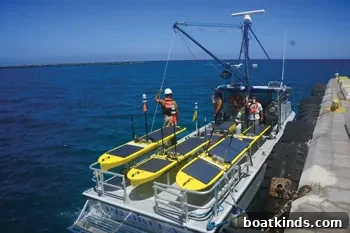
Retail prices for a basic Wave Glider platform are in the hundreds of thousands of dollars, according to company officials; customers outfit the platforms with their own scientific instrumentation. These systems are intended as durable, reconfigurable platforms that organizations can tailor to specific missions.
Humpback origins
The Wave Glider’s origin is rooted in a simple, practical need: a Silicon Valley venture capitalist wanted to stream live humpback whale songs to his home stereo in Hawaii. After experiments with a kayak, hydrophone and cable proved unreliable in sanctuary waters, he enlisted inventor and aerospace engineer Derek Hine and his son Roger, a robotics designer, to create an unmoored, station‑keeping buoy. Using a large fish tank and backyard prototypes, they demonstrated that wave motion alone could drive and station‑keep a device—leading to the founding of Liquid Robotics in 2007 and Roger Hine becoming the company’s first CEO.
Their backyard demonstrations revealed the platform’s commercial potential and seeded a new category of ocean robot that combines long endurance, low environmental impact and modular sensor payloads.
Navigating by computer and human
Autonomy in surface craft is advancing quickly. Competitions like the International Maritime RobotX Challenge promote innovation in sensors, perception and control. In one contest, 16‑foot autonomous catamarans navigated course gates, performed acoustic searches, identified assigned slips by shapes, docked and undocked, interpreted flashing light sequences and negotiated obstacle fields—tasks that require robust perception and decision‑making software.
Teams such as Florida Atlantic University and Villanova University equip their entries with laser scanners, vision systems, mapping software and electric propulsion. Faculty highlight perception as the core challenge: detecting an object is the first step; classifying it and deciding how to respond are far harder and demand sophisticated algorithms.
Interest in roboboats spans military, oceanographic and commercial sectors. Potential applications range from interdiction and mine clearance to persistent environmental monitoring and harbor patrols. In the near term, deployment will likely focus on military and open‑ocean science missions, with civilian and recreational uses—such as advanced autopilots that can “see” and “hear” hazards—following as sensing and software mature.
This article originally appeared in the November 2015 issue.