
This converted Pacific Northwest workboat is both durable and charming.
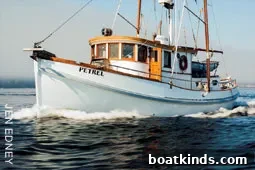
It’s almost a rule of thumb: a stroll along B-Dock at the Boat Haven in Port Townsend, Washington, will stop for a look at Petrel. Tied up there, the 42-foot converted salmon troller draws passersby — even those who don’t know much about boats — who pause to admire her. Compact, honest and handsome, Petrel looks like the kind of boat a child might draw from memory: a prominent bow, a neat wheelhouse and classic workboat proportions.
Her foredeck is dominated by a heavy-duty windlass and stacks of galvanized chain; trolling poles are lashed along the mast just behind the traditional fishboat wheelhouse; a springy sheer is finished with a varnished caprail and a light-gray rubbing strake; and her pinched stern gives her the double-ended look cherished in Scandinavian designs. Built for the northeastern Pacific, Petrel is in fine fettle at 86 years old — a testament to sturdy construction and careful maintenance.
Owner Chris Grace, a retired commercial real estate developer, used Petrel to cruise Puget Sound, the San Juan and Gulf Islands, and as far north as Desolation Sound in British Columbia with his wife Kathy, a nurse. Grace calls Petrel the “center of our boating universe,” notable praise considering the couple previously owned a 39-foot Concordia yawl and raced an Etchells. For their cruising style and the conditions of the Pacific Northwest, the practical, no-nonsense workboat suited them best.
These waters can be placid one moment and ferocious the next, with winds and countercurrents that test both boat and crew. Grace says motoring often made exploring easier and safer than sailing, and the couple appreciated that a powerboat allowed longer trips without the maintenance demands and limitations of a sailboat. They chose Petrel not out of a fetish for wood, but for practicality: she had been converted from a salmon troller into a cruiser and had been refastened with bronze while retaining Port Orford cedar planking. At her size — in the sweet spot of 35 to 45 feet — she’s manageable for a couple yet roomy enough for comfortable cruising.
Grace enjoys the boat’s timeless lines. “Like any well-designed classic — think a Mustang P-52 or a Jaguar E-Type — you wouldn’t change much,” he says. Petrel’s aesthetic, however, grew from function more than from cosmetic intent. Built in 1928 in Astoria, Oregon, by Matt Tolonen at the Columbia Boat Building Co., she emerged from an era when builders were also designers, often working from half models and sketches. Her first owner, Matt Sorvaag, a Norwegian-born sailor, reportedly fished her until 1950.
Fishermen appreciated Petrel for qualities that endure in good cruising boats: seaworthiness, efficiency and a gentle wake. Her pointy stern, echoing Scandinavian and Viking-derived pilot-boat forms, helped her handle heavy seas and made her a steady, predictable ride in difficult conditions such as the Columbia River bar or long trips into the Gulf of Alaska. As designs evolved, fuller sterns grew common to carry larger loads, but as a cruising yacht Petrel’s double end places her in the company of timeless designs by the likes of L. Francis Herreshoff and others who favored seaworthy, double-ended hulls.
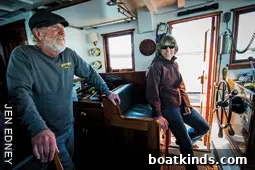
Underway, Petrel cruises comfortably at 7 to 8 knots. She has been repowered several times since her original Atlas Imperial 3-cylinder 30-hp diesel; today a 100-hp 371 Detroit Diesel sits under the wheelhouse, accessed through a hatch in the sole. It burns about 2 gallons per hour at cruising speed and brings a workboat soundtrack to her passage-making. The helm sits to port in the wheelhouse, but large windows provide wide visibility and doors on both sides open out to the side decks — a layout inherited from her fishing days and designed for quick communication and crew movement.
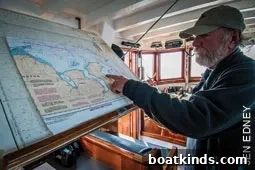
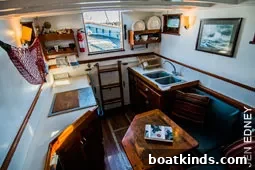
Below, accommodations are functional and reflect her working-boat heritage. Access is by steep ladders that lead either forward to the crew quarters with two bunks and a standing desk, or aft into the former fish hold where the galley and dinette are located. There is no sprawling saloon, bow thruster or joystick; the head and shower are aft in the wheelhouse to port. Practical touches remain everywhere, like the drop-down chart board fastened to the overhead — a small detail Grace enjoys showing visitors.
Grace is hands-on with maintenance and enjoys the work of sanding and varnishing. Ted Pike, a Pacific Northwest wood supplier and fellow boater, notes that although Petrel’s layout is borrows from a workboat and can feel awkward for leisure cruising, her motion underway is reassuring and comfortable. For added stability at anchor, Grace lowers the long trolling poles to 40–50 degrees and suspends stabilizers from each pole to ride 10–15 feet below the surface, effectively increasing the boat’s beam and reducing roll.
When she worked as a salmon troller, those stabilizers would ride closer in to the hull to accommodate multiple trolling lines set at different depths, with lead weights and spreaders on each line, and tag lines run aft for hauling in fish. Those days are behind Petrel, though she still carries a workboat permit — useful for privileges such as jumping the line at Ballard Locks during trips to events like the Lake Union Wooden Boat Festival. She’s often a festival fixture and has won awards for her conversion, but what matters most to her owners is cruising: typically 60 to 90 days a year in the Pacific Northwest and British Columbia.
Petrel has seen her share of lively passages. Kathy recalls a rough trip to Friday Harbor when Chris, descending into the forecabin with their Jack Russell terrier Bones in his arms, was thrown by a sudden impact; the pooch was fine, and the skipper, sporting a bandage, turned the episode into a favorite dockside story. Through it all, Petrel remained steady and reliable.
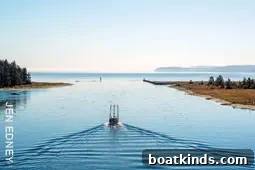
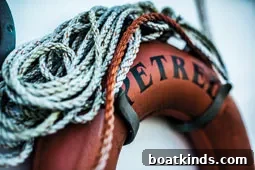
Named for a far-ranging seabird, Petrel is built to chase fish and handle the ocean’s moods. She has also been fortunate to find owners who invested the care needed to keep her sound. At the time of writing she was preparing to move from Port Townsend to Bainbridge Island with a new owner, who plans to keep her. Though she won’t be trolling for salmon anymore, Petrel’s conversion preserved her character. She remains seaworthy, pleasing to enthusiasts and casual onlookers alike, and likely to inspire future generations of boat drawings on plain sheets of paper.
Specifications
LOA: 42 feet
LWL: 38 feet
Beam: 12 feet
Draft: 6 feet
Displacement: 26 tons
Tankage: 550 gallons fuel, 300 gallons water
Propulsion: 100-hp 371 Detroit Diesel
Year built: 1928
Builder: Matt Tolonen / Columbia Boat Building Co., Astoria, Oregon
December 2014 issue