
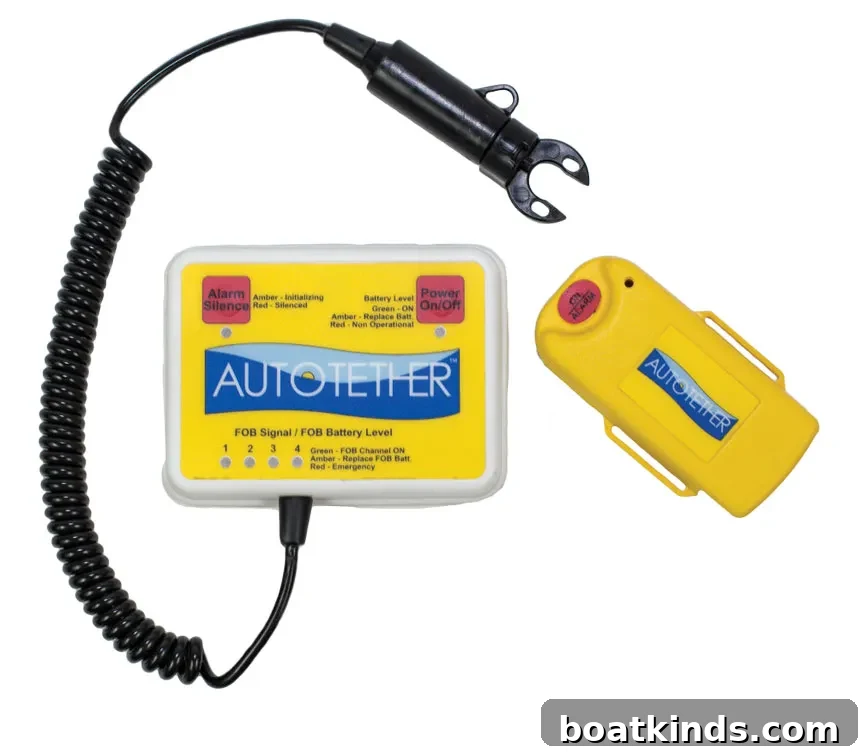
Autotether Marine Wireless Kill Switch for Outboards: Instant Engine Cutoff When the Operator Falls Overboard
Autotether’s marine wireless system is designed to provide a reliable, immediate engine cutoff if the operator falls overboard or becomes separated from the vessel by more than 150 feet. The system replaces the traditional red safety lanyard with a compact host unit mounted to the engine and a wearable remote sensor carried by the operator. When the sensor detects that the operator has fallen overboard or is out of range, the host unit instantly stops the outboard engine, helping prevent the boat from running uncontrolled and reducing the risk of injury or loss.
The Autotether unit is compatible with all major outboard brands, making it a practical retrofit option for many boats. Installation replaces the engine’s conventional kill-switch lanyard and requires mounting the host unit on the engine control box, where it interfaces with the engine’s kill circuit. The wearable sensor is small and unobtrusive, enabling the operator to move about the boat without being tethered by a physical lanyard while still maintaining a wireless safety connection to the engine.
One of the notable safety features of the Autotether system is the ability to add extra sensors. Up to three additional sensors can be paired with a single host unit so that if a guest or another crew member falls overboard, the system will sound an alarm and can be configured to cut the engine. This multi-user capability is useful for family boating, fishing trips, and commercial operations where more than one person may be at risk of going overboard.
The system’s design emphasizes simplicity and reliability. The host unit functions as a direct replacement for the lanyard-based kill switch, preserving the familiar safety behavior while modernizing it with wireless technology. The compact wearable sensor eliminates the need for physical tethers that can restrict movement or become a snagging hazard, yet it still provides a critical safety fail-safe by cutting the engine when separation is detected.
In practical use, Autotether addresses several common man-overboard concerns: it prevents the vessel from continuing under power without the operator, reduces the chance of the operator being struck by a propeller, and removes the need to retrace the boat’s path while the engine is still running. For many boaters, replacing a lanyard with a wireless kill-switch is an attractive upgrade that combines the familiarity of a kill switch with the freedom of hands-free operation.
Price for the Autotether system is listed at $235 for the base unit. Additional wearable sensors are available for $95 each, allowing owners to expand protection to other crew members. The pricing reflects the cost of the wireless host and one wearable sensor; adding extra sensors permits multi-user protection without significant additional installation complexity.
When considering a wireless kill-switch system, boat owners should evaluate compatibility with their specific outboard model, verify proper installation by a qualified technician if necessary, and review the manufacturer’s instructions for pairing sensors and testing the cutoff response. Regular testing and proper maintenance of any safety device are important to ensure it functions correctly when needed.
Autotether’s approach offers a modern alternative to corded lanyards: it maintains the core safety function—stopping the engine if the operator is suddenly absent—while improving convenience and mobility on deck. For recreational boaters, anglers, and operators who prioritize both safety and freedom of movement, a wireless kill-switch system like Autotether presents a compelling safety upgrade.
This article originally appeared in the January 2019 issue.