
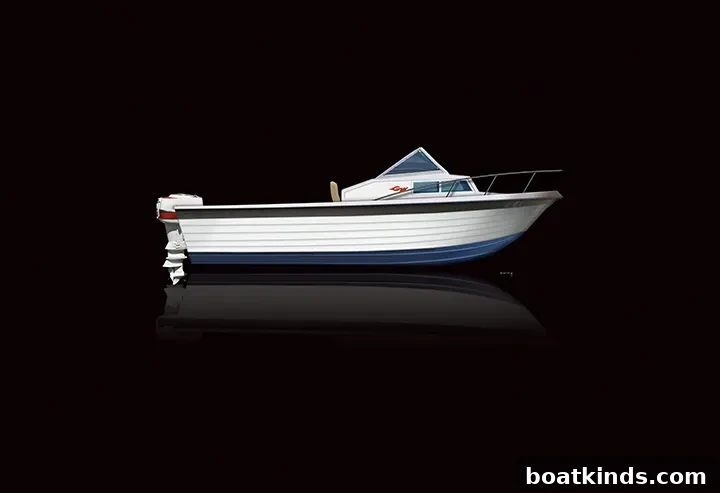
How Grady-White Invented the Walkaround: The Story Behind the 204-C Hatteras Overnighter
In January 1974, at the Chicago Boat and Sports Show, two Grady-White executives noticed a striking new boat design that would change the company’s lineup and influence small-cabin boat design for decades. Eddie Smith, Grady-White’s president, and Wiley Corbett, the general manager, were walking the aisles when they came across a cuddy trihull powerboat with an unusual layout: side decks and a foredeck recessed to form a single-level deck that wrapped around the cabin behind a thigh-high bulwark. The arrangement created unobstructed, safe access around the cabin—a feature the men had not seen before.
From Inspiration to Innovation
On the drive back to Grady-White’s plant in Greenville, North Carolina, Smith and Corbett discussed the design and its potential. Corbett summed up the idea bluntly: “That’s what we need to build.” Smith asked, “What’s that?” and Corbett replied, “That walkaround.” The term would soon become a common way to describe boats with continuous deck walkways surrounding a small cabin or helm.
At the time Grady-White was already known for a range of fishing and sport runabouts—models such as the 17-1/2 Hatteras, the 191 Sportsman and the 212 Chesapeake—as well as midsize cabin boats like the 27-foot Catalina. The company had a track record of innovation, including a successful transition from wooden hulls to fiberglass construction. With that background, Grady-White was well positioned to adapt the walkaround concept to its own production methods and customer base.
The 204-C Hatteras Overnighter
Using an existing hull as a starting point, Grady-White created a version that incorporated the single-level deck around a cuddy cabin and helm station, giving safe, open access all around the boat. The result was the 204-C Hatteras Overnighter, introduced for the 1975 model year. The design preserved the practical features boaters expected from Grady-White while adding the convenience and safety of a continuous deck walkway.
The reaction at boat shows and from buyers confirmed the decision. Smith recalled a couple who had casually dismissed the walkaround at first, only to return two hours later to purchase one. “They got it,” he said. “They understood.” That immediate recognition from consumers helped the model gain traction.
Enduring Appeal and Impact
The 204-C Hatteras Overnighter quickly became an important model for Grady-White. Corbett later described it as “our bread-and-butter boat,” noting that it sold very strongly compared to other models of the era. Beyond its commercial success, the walkaround layout addressed practical concerns for anglers, cruisers and families alike—providing easier movement fore and aft, safer crew transfers on deck, and a sense of continuity around the cabin that many boaters found reassuring.
Walkaround boats have remained a steady seller for Grady-White and many other builders since that mid-1970s breakthrough. The concept continues to influence small-cabin and dayboat design because it combines the protection of a cabin with the freedom of open-deck circulation—a balance that suits a wide range of recreational boating activities.
Legacy
Grady-White’s adoption of the walkaround concept is a clear example of how observation and willingness to innovate can reshape a company’s product line. By taking an existing hull and rethinking the deck plan, the company introduced a practical, well-received model that helped define a category. The 204-C Hatteras Overnighter stands as an early and influential example of that approach.
This article originally appeared in the August 2015 issue.