
New Lattice-Fence Trap Offers Hope for Controlling Invasive Lionfish in the Atlantic
Over the past decade, lionfish have emerged as one of the most serious invasive marine species in the Atlantic. According to NOAA, the first recorded lionfish in Atlantic waters was captured in 1985 and likely originated from an aquarium release. By 2009 the species was well established from North Carolina down to South America, and its range has continued to expand since then.
Lionfish are efficient predators equipped with venomous dorsal spines and a broad, opportunistic appetite. They prey on a wide variety of reef and near-reef fishes—more than 50 species—and compete directly with native predators for food. Female lionfish are also prolific breeders and can produce very large numbers of eggs annually; this high reproductive rate contributes to rapid population growth and makes containment difficult.
The ecological impact of growing lionfish populations can be severe. In many areas they reduce the abundance of juvenile reef fishes and invertebrates, which can alter reef community structure and reduce the resilience of coral and rocky reef ecosystems. These changes threaten native biodiversity and, in some cases, local fisheries that depend on healthy reef populations.
Controlling lionfish is a challenging, labor-intensive task. Shallow-water removals—done by divers using spears or hand nets—are part of many local response efforts, but deep-water populations remain largely unaddressed because conventional methods are impractical at depth. Removing large numbers of lionfish across broad areas requires tools that are both effective and scalable.
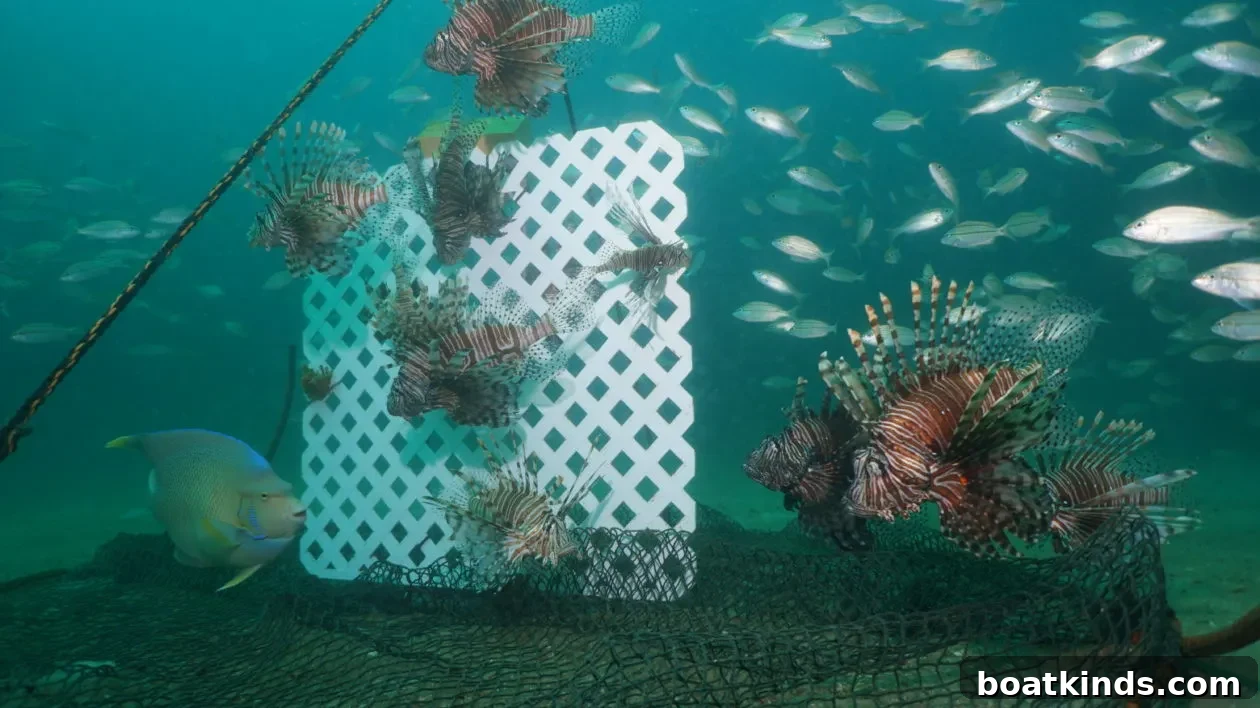
To meet that need, researchers are testing a simple, low-cost innovation: lattice fencing used inside purse-style traps. Steve Gittings, chief scientist for NOAA National Marine Sanctuaries, has been testing lattice panels that appear to strongly attract lionfish. The concept leverages the species’ tendency to seek shelter around structure; even when no bait is used, lionfish investigate and congregate on the lattice. When placed inside a purse trap, the lattice provides an attractive surface that lures lionfish onto the device. The trap lies flat on the seabed and can be triggered to close—much like a coin purse—once fish have gathered on the lattice.
There are several practical advantages to the lattice-and-purse-trap approach. Lattice is inexpensive, widely available, and simple to construct. It is also easy to deploy, retrieve, and replace if damaged. During underwater trials, Gittings reports the traps captured a significant number of lionfish without the need for live bait, demonstrating their promise for passive collection in deeper waters where diver-based removals are not feasible.
While this tool is not a standalone solution, it could become an important part of integrated lionfish management, especially for targeting populations beyond normal diving limits. Deploying traps on deeper reefs and along hard-bottom habitats could help reduce adult densities, decrease local reproductive output, and lower predation pressure on native juveniles. That said, traps must be used carefully to minimize bycatch and habitat impacts; ongoing testing aims to refine designs and deployment strategies to limit unintended captures of non-target species and to ensure traps are safe for retrieval.
Moving forward, continued testing and adaptive management are essential. Researchers will need to determine optimal trap placement, soak times, and retrieval schedules, and assess long-term effects on lionfish populations and reef communities. If lattice-equipped purse traps can be proven effective at scale with acceptable bycatch profiles, they could expand the toolkit available to managers working to protect Atlantic reefs from lionfish impacts.
In summary, the lattice-and-purse-trap concept represents a pragmatic, low-cost tactic that takes advantage of lionfish behavior to improve capture rates in deeper habitats. Combined with ongoing shallow-water removal efforts and public engagement, innovations like this could help slow the spread and ecological effects of this persistent invasive predator.