
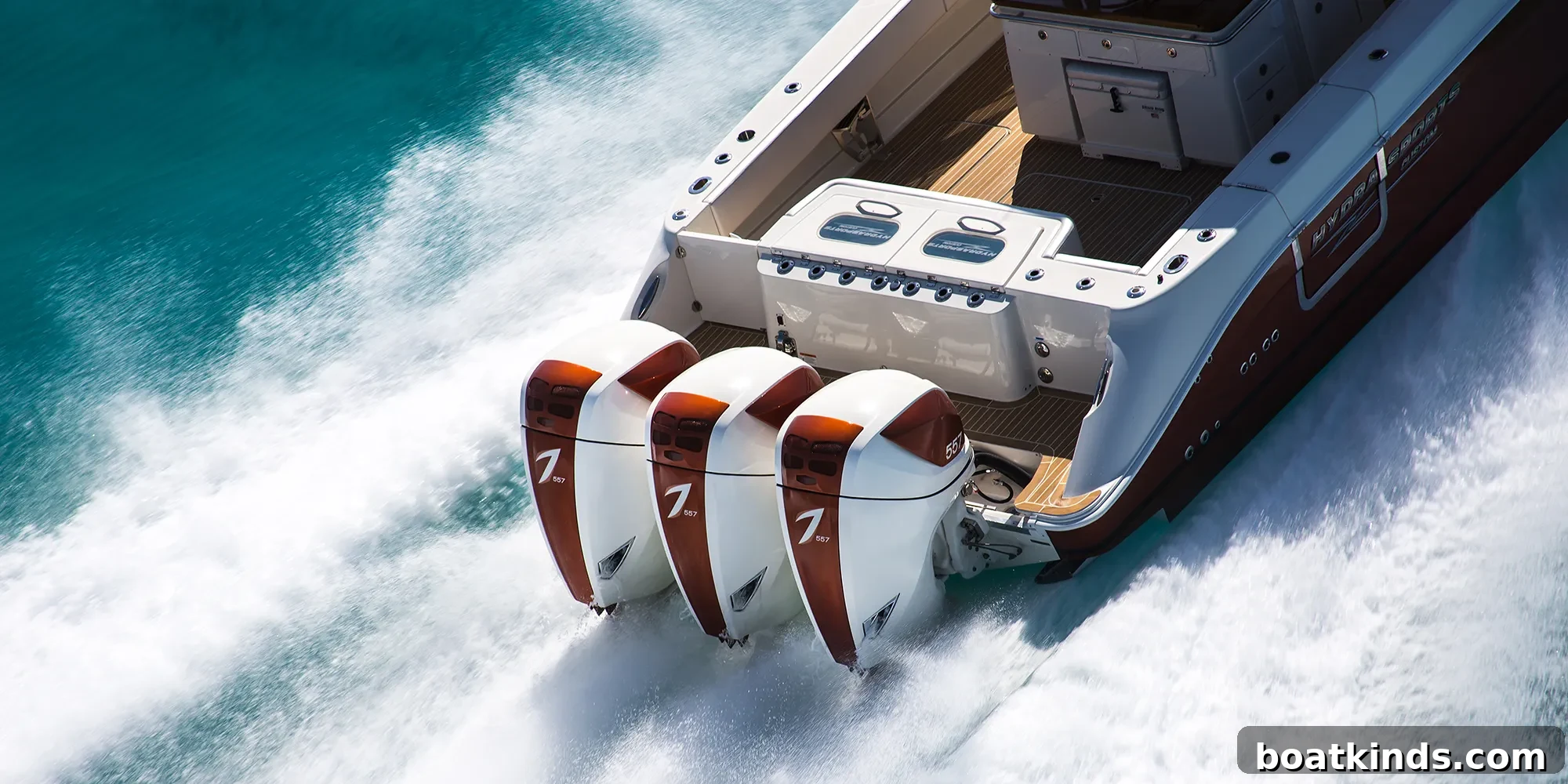
In a surprising move for the marine performance market, Volvo Group — the majority owner of Seven Marine — has announced it will discontinue production of Seven Marine’s high-powered outboard engines. The decision reflects Volvo’s broader climate and technology strategy as the company accelerates its shift toward fossil-free, electric, hybrid and fuel-cell propulsion.
Volvo Group disclosed in a recent press release that it has entered a binding agreement with Daimler Truck AG to collaborate on fuel-cell development as part of its objective to reach net-zero emissions. That long-term commitment to low- and zero-emission technologies has prompted Volvo Penta, Volvo Group’s marine division, to re-evaluate product lines that are inconsistent with the company’s sustainability roadmap.
Seven Marine’s lineup of large, gasoline-powered outboards — including the flagship 627Sv, the most powerful outboard the company built — relies on high-displacement V8 engines, notably the GM LSA-based powerplant that helped the line achieve its reputation for raw horsepower. While those motors appeal to customers who prioritize top-end performance and maximum thrust, Volvo Group has concluded they do not align with the company’s push toward renewable and low-emission propulsion options.
According to Volvo Group, production of Seven Marine’s high-powered outboards will stop once current demand is fulfilled. Volvo has emphasized that existing owners will receive continued support: warranty coverage and parts availability will remain in place to service boats already equipped with these engines. This support commitment aims to reassure dealers and owners that the retirement of the product line does not mean abandonment of existing customers.
Volvo Penta will continue to focus on its core marine offerings, particularly the IPS (Inboard Performance System) and sterndrive lines, which the company describes as central to its business going forward. Those product families are being developed in parallel with efforts to introduce hybrid, electric and fossil-free propulsion alternatives, and are likely to remain the backbone of Volvo Penta’s market presence while the company invests in new zero-emission technologies.
The move has implications across the boating industry. Seven Marine’s high-powered outboards were synonymous with high-horsepower performance and pushed the boundaries of what outboard-driven boats could achieve. Their removal from the market reduces options for buyers seeking maximum outboard horsepower directly from a factory-produced motor. At the same time, the decision signals a broader transition within marine propulsion, where manufacturers are increasingly balancing performance, regulatory pressures and sustainability goals.
Volvo Group acquired a majority stake in Seven Marine in March 2017, and earlier this year the company consolidated outboard production at a Tennessee facility while introducing the latest iteration of the 627 series, the 627Sv. Despite the recent production consolidation and product development, Volvo’s strategic pivot toward net-zero technology ultimately determined the fate of the high-displacement outboards.
Industry observers and boat owners will be watching how Volvo Penta leverages its technical expertise and the Daimler collaboration to develop fuel-cell and other zero-emission marine powertrains. The coming years are likely to see expanded investment in electric and hybrid drives for recreational and commercial craft, along with continued refinement of existing sterndrive and IPS technologies to meet both performance expectations and environmental targets.
This change in direction was reported by industry outlets covering marine business news and reflects a growing trend among OEMs to prioritize sustainability. For owners of Seven Marine outboards, Volvo’s pledge to maintain warranty and parts support provides continuity; for the market at large, the retirement of these high-powered gasoline outboards marks a notable milestone in the industry’s transition toward cleaner propulsion systems.