
Building a powerboat from a kit isn’t for everyone, but for many it’s an excellent way to get exactly the boat they want at a lower cost and with the satisfaction of doing much of the work themselves. Some choose kits because no production boat matches their needs, others because they have time and workshop skills, and some simply prefer a larger boat than they could afford fully finished. Whatever the reason, a kit project requires basic construction knowledge, a stock of appropriate tools, and a healthy dose of persistence.

Before you begin, be realistic about the commitment. Building from a kit is less demanding than laying up a hull from patterns and cutting frames on a strongback, but it still takes time, patience and a willingness to learn systems work and finishing techniques. The most successful amateur builders are methodical, adaptable and willing to tackle or arrange professional help for complex tasks like precise engine alignment.
Choosing the Right Kit Boat Hull
For most do-it-yourselfers, the practical route is to start with a bare fiberglass hull and deck. Many kit boats come from Maine and feature Downeast-style semidisplacement hulls with round bilges and full keels. These hulls offer comfortable motion in a seaway and excel in a 12–22 knot cruising range. While they can be pushed onto plane with enough power, round-bilge hulls are best powered for efficient cruising rather than high-speed runs.
If your goal is efficient 25–30 knot cruising, consider a hard-chine planing hull without a keel, which reduces resistance and improves performance on plane. For many boats larger than about 32 feet, single-diesel propulsion is typically the best choice, with engines mounted low and central in the hull. Some 24–30 foot hulls now adapt well to modern four-stroke outboards; if you choose outboards, ensure the hollow keel is closed during layup to allow proper heeling and reduced drag.
The simplest kit is a solid fiberglass hull with bulkheads and stringers already tabbed in. This gives you a proven structural platform to build from. You can specify construction options in many cases: solid laminate for simplicity and cost savings, or foam- or balsa-cored laminates to reduce weight. Avoid balsa core in the bottom, where water intrusion can cause serious damage; foam cores are a safer light-weight choice when properly used.
Resin choice affects hull longevity and cost. Polyester (orthophthalic) resins are economical and, with proper wet-out and curing, can be durable and blister-resistant. Isophthalic polyester improves on those properties; vinylester offers higher strength, better elongation and superior blister resistance. Many builders offer a vinylester skin coat against the gelcoat as a blister barrier with polyester laminates behind it. Epoxy provides the best performance but is costly and requires specialized skills—typically reserved for high-end builds.
Weight reduction improves fuel economy and performance, so many kit suppliers now offer foam-cored stringers and bulkheads or vacuum-bagged coring to make lighter structures. If you pursue a lighter hull, ensure the topside structures—decks, cabin tops and flybridges—are also built light. Otherwise you risk raising the center of gravity, reducing stability and lengthening the roll period.
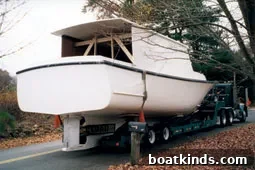
Most kit suppliers mold large parts such as the hull and often a one-piece deck/trunk cabin assembly that includes the forward deck, cabin trunk, windshield area and cockpit washrails. Some components, like pilothouse floors and cockpit decks, are more practically stick-built on site because of mold-release limitations on complex, nested shapes.
Kit boat options
When you order a kit you’ll typically get a hull with bulkheads and stringers to hold its shape, and you can add options such as engine beds, foam-cored structural elements, or a molded superstructure. Engine beds are simply reinforced stringers in the engine room area, and having them installed at the factory saves time.
Many builders offer turnkey options—installing the engine, shafting, propeller, rudder and steering gear—because propulsion alignment and shafting installation are critical and often the most technically demanding parts of the job. Builders can also fit tanks, wiring, plumbing and generators. If you hire this work out, completion goes faster and alignment tolerances are more likely to be correct.
With major systems in place, finishing tasks include installing cockpit decks and hatches, cutting and fitting windows and portlights, installing cabin soles and partitions, and fitting the interior furniture. Having the builder rough out the cabin—installing a true sole and bulkheads or partitions—gives you square, level surfaces to finish against; this is invaluable because raw molded hulls rarely present perfect, straight surfaces for carpentry.
Always level the hull both fore-and-aft and side-to-side before finishing. If the hull sits with even a small list on the building blocks, the interior will end up misaligned and the finished boat will carry that bias into the water.

Well-known kit suppliers include Atlantic Boat Co. of Brooklin, Maine, which offers Spencer Lincoln–designed semidisplacement hulls from 26 to 48 feet. Atlantic’s kits typically include a solid hull, tabbed bulkheads and templates for interior work, and the company estimates six to 18 months of labor for completion, depending on builder experience and available working time. For example, Atlantic’s Duffy 35 kit price for a solid fiberglass hull has been listed in industry publications, with options for vinylester skin coats and molded superstructures available.
SW Boatworks in Lamoine, Maine, builds the Calvin Beal line and the Young Brothers designs as kits. Their pricing and optional upgrades—colored gelcoat, vinylester skin coats, foam-cored bulkheads and molded tops—illustrate how buyers can tailor weight, corrosion resistance and finish level based on budget and intended use. Foam coring and vinylester skin coats are common upgrades worth considering for long-term performance and reduced fuel consumption.

Digging in
Basic tool skills are essential, but many mechanical and electrical tasks can be learned. Practical references such as Nigel Calder’s Boatowner’s Mechanical and Electrical Manual and Dave Gerr’s Boat Mechanical Systems Handbook teach system design and installation through clear explanations and troubleshooting guidance. Fiberglass construction guides—Ken Hankinson’s Fiberglass Boatbuilding for Amateurs and other construction manuals—are useful companions for layup, fairing and repair techniques.
If time or confidence is limited, another option is to buy the hull and deck complete and contract a trusted local shop to finish systems and interiors. Word-of-mouth recommendations and the ability to visit the project frequently are key to a successful partnership.
Expect a kit project to take time. Some builders finish a kit in months; others take several years. For many amateur builders the appeal is not speed but control: you can build the boat to your standards, choose the systems and layout you prefer, and pay as you go. The reward is a well-used, well-loved boat that reflects your choices and labor—and that’s often paid off when completed.
Eric Sorensen is a consultant to builders and government, founding director of the J.D. Power and Associates marine practice, and the author of Sorensen’s Guide to Powerboats: How to Evaluate Design, Construction and Performance. A longtime licensed captain, he can be reached at [email protected].
This article originally appeared in the October 2011 issue.