
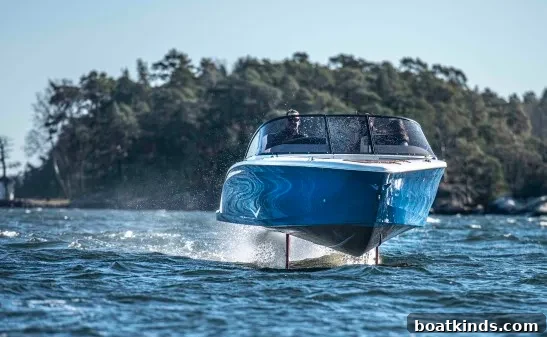
Candela Seven: A Hydrofoiling Electric Production Boat Driving Sustainable Boating
The Swedish company Candela has developed what it describes as the world’s first hydrofoiling electric production boat. The Candela Seven combines hydrofoil technology with electric propulsion to dramatically reduce drag and energy consumption, allowing the 25-foot craft to rise more than three feet above the water and cruise with remarkable efficiency. This innovative approach aims to make recreational and commercial boating cleaner, quieter, and more cost-effective.
How hydrofoils and electric propulsion work together
Hydrofoils are wing-like surfaces mounted under the hull that generate lift as speed increases. By lifting the hull out of the water, hydrofoils reduce the wetted area and the drag that normally slows boats down. Candela applies this principle to an all-electric platform: when the Seven reaches foil-borne mode, the boat “flies” above waves, cutting resistance and smoothing the ride. The result is a substantial reduction in the amount of energy required to maintain cruising speeds compared with conventional displacement or planing hulls.
Performance, range, and operating cost
According to the company, putting the Seven on foils reduces energy use by roughly 80%, enabling real-world performance that was previously unattainable for electric production boats. The Candela Seven is reported to achieve a range of about 50 nautical miles when cruising at 22 knots, with a top speed near 30 knots. This combination of speed and range makes it suitable for coastal day trips, commuter routes, and many nearshore applications where low noise and zero local emissions are desirable.
Beyond range and speed, the Seven’s foil-assisted efficiency also translates into lower operating costs. Candela reports that the vessel is up to 95% cheaper to operate than a comparable traditional gasoline-powered boat, driven by lower energy costs, reduced maintenance for electric motors, and fewer moving parts associated with foil-borne propulsion. Emissions are correspondingly reduced: the company states a 99% reduction in emissions compared with conventional internal-combustion vessels when evaluated on a like-for-like operational basis.
Design and construction
Lightweight construction is central to the Seven’s design philosophy. To achieve foil-borne performance without compromising strength or safety, the hull and deck are manufactured from carbon fiber, providing a high stiffness-to-weight ratio and impact resistance. This composite structure helps keep the boat light enough for efficient foil operation while still durable for regular use in a range of sea conditions. The foils themselves are engineered to cut through waves, delivering a smoother ride than many conventional hull types and reducing slamming and spray for passengers.
Market adoption and deliveries
Since introducing the concept and refining the production design, Candela has been delivering hulls to early customers. As of the most recent reports, the company has delivered 12 hulls to buyers in Sweden, Finland, Austria, the United States, and the British Virgin Islands, with additional deliveries planned. These early sales reflect growing interest in sustainable marine transport solutions from private owners, charter operators, and organizations exploring low-emission waterborne mobility.
Why this matters for sustainable boating
The Candela Seven demonstrates how combining established hydrodynamic concepts with modern electric power can unlock new possibilities for sustainable boating. Reduced fuel and maintenance costs, lower noise, and dramatically cut emissions make hydrofoiling electric boats appealing for operators who prioritize environmental performance as well as long-term operating savings. For coastal communities and marine environments sensitive to pollution and noise, technologies like the Candela Seven represent a meaningful step toward greener water transport.
For readers interested in learning more about the technology and the company’s approach to electric hydrofoiling craft, the manufacturer provides further information through its official materials and product documentation.