
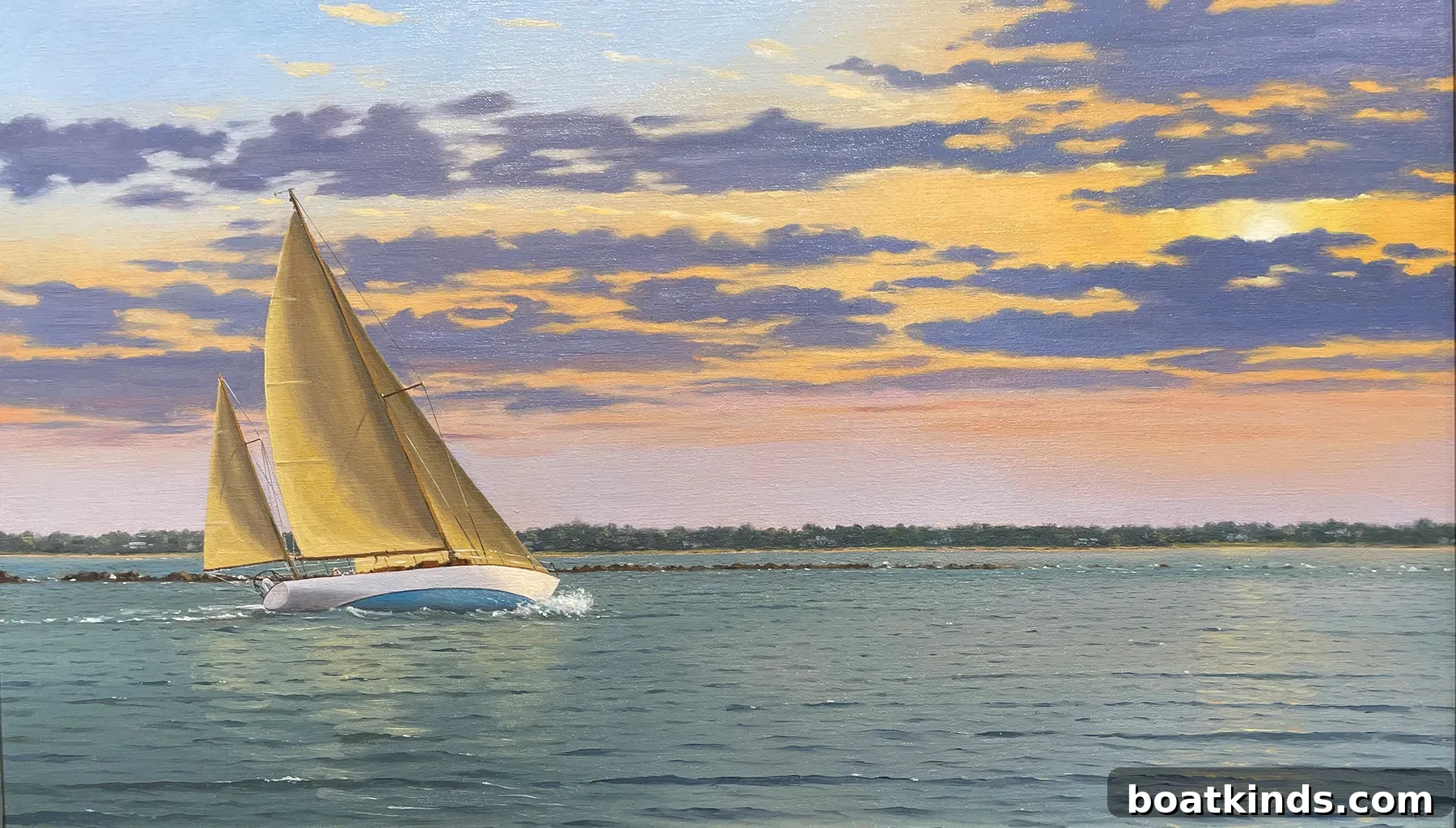
At sunrise along the shores of Nantucket Island, marine artist Sergio Roffo finds the kind of quiet inspiration that shapes his work. In this scene he captured a Concordia yawl, gracefully heeled in an early breeze as it makes its approach for the island’s long-standing Opera House Cup regatta. The composition emphasizes the luminous relationship between sky and sea, the hush of morning light, and the subtle, inevitable motion of a classic wooden yacht under sail.
Roffo achieves that signature luminosity through a careful process of glazing and layered color on oil canvas, a method that echoes techniques used by early American landscape painters. Thin layers of translucent paint build depth, enrich tonal shifts, and allow reflections and atmosphere to emerge slowly and convincingly. The result is a painting that feels both still and alive: the boat’s movement is suggested rather than depicted in motion, conveyed through the proud heel of the hull, the tautness of canvas on the spars, and a white, cradling bow wave that breaks the water’s surface.
“This particular painting came from a wonderful sunrise one morning,” says the 68-year-old Roffo. “The Opera House Cup is a cherished tradition on Nantucket. It’s held every August on the island, and it was the first all-wood, single-hulled classic regatta on the East Coast. This regatta is the grand finale of Nantucket Race Week.” Those words reflect not only the subject matter but the deeper connection he maintains with the island—an attachment that has sustained decades of on-location painting.
Born in Italy in 1953 and raised in the United States, Roffo draws inspiration from 19th-century American landscape painters such as George Inness and Albert Bierstadt. His training included honors graduation from the Vesper George School of Art and study with still-life and landscape artists Robert Cormier and Robert Douglas Hunter. Over the years he has developed a personal vocabulary for light and maritime atmosphere, and his work now places him among the practitioners recognized by the American Society of Marine Artists.
Nantucket itself plays a central role in Roffo’s artistic life. “Nantucket is one of the most beautiful places to paint,” he says. “With its pristine coastline and quaint harbors, historical buildings and picturesque trails, the island offers something for everyone. I’ve been painting here for over 30 years, and still I find a challenge every time I set up to paint on location.” That challenge—working quickly when light shifts, simplifying complex coastal arrangements, and translating sea motion into a static medium—is part craft, part discipline, and part ongoing discovery.
In this painting the color relationships are restrained but resonant: pale golds and cool blues merge at the horizon, while subtle green and gray notes describe the sea’s depth. The sailboat’s varnished wood and crisp canvas are rendered with a few deliberate brushstrokes, allowing the viewer’s eye to complete the story. Such restraint underscores Roffo’s belief in painting as an invitation rather than an exhaustive account; he leaves room for imagination so the viewer can sense the salt air, hear the soft slap of waves, and feel the tilt of the deck beneath a watchful crew.
Whether working en plein air on a blustery morning or refining a composition later in the studio, Roffo’s approach balances technical skill with an emotional response to place. His oil-on-canvas pieces marry traditional technique with a contemporary sensibility—recognizable heritage methods like glazing married to a modern painter’s eye for composition and simplification. The painting of the Concordia yawl exemplifies that balance: historically informed technique, local subject matter, and a timeless appreciation for light.
This article was originally published in the June 2021 issue.