
Many anglers talk about dreaming of owning a “Carolina boat,” but what does that phrase really mean? In general it describes a sportfisherman built with the rugged conditions of the Outer Banks in mind—big seas, shifting shoals and unpredictable inlets. A true Carolina-style boat slices through heavy waves, handles tricky entrances, keeps the crew dry and makes efficient passages. Above all, it is seakindly, maneuverable and purpose-built for offshore fishing.
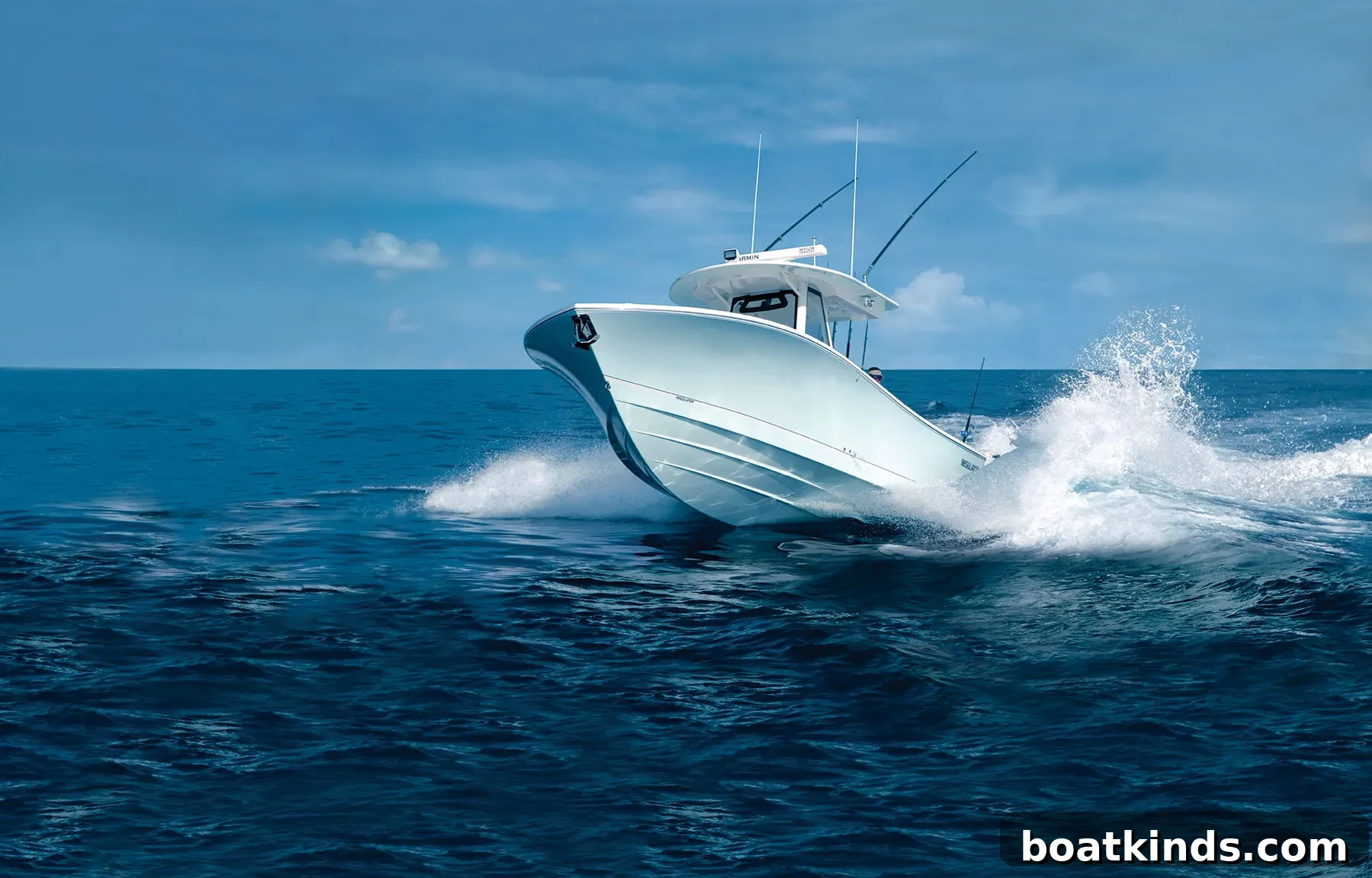
When people picture Carolina boats they often imagine custom builds from renowned yards such as Jarrett Bay, Scarborough and Spencer. But much of the Carolina look and capability has filtered into production models as well. These production boats borrow the region’s distinctive lines—flared bows, high sheer, clean styling—along with strong craftsmanship and offshore-ready hulls. Custom builders defined the archetype, and production builders have refined and broadened it so more anglers can enjoy that seakindly ride.
REGULATOR
A defining visual of the Carolina boat is that pronounced, flared bow designed to cut through and knock down seas commonly found around places like Oregon Inlet, says Joan Maxwell, president and cofounder of Regulator Marine in Edenton, North Carolina. That dramatic flare and the high sheer at the bow keep the boat from looking flat and are instantly recognizable features in classic Outer Banks designs.
Maxwell credits custom designers like Omie Tillet for popularizing the bow flare and notes that Buddy Davis played a pivotal role in adapting the look for production building. When Joan and her husband Owen started Regulator in 1988—hatching their plans from an old grocery store—they set out to translate that Carolina aesthetic into a smaller center-console format. Their first Regulator, a 26-footer launched in 1990, married pronounced bow flare with practical outboard power, giving anglers the ride and seaworthiness they wanted in a production boat.
Underwater, production Regulators differ from the big custom convertibles of the past. Early custom sportfishers often had little deadrise in the stern, whereas smaller production boats need a deeper V for seakeeping. Regulator worked with naval architect Lou Codega to design hulls for its 23- to 41-foot models, including the newer 37 center console. Over time construction evolved too: where older models were solid fiberglass, modern hulls use coring to reduce weight and improve speed while maintaining a stable, comfortable ride.
Historically, classic Carolina boats prioritized efficiency over outright speed because fishing grounds near the Outer Banks were relatively close. As demand grew in regions with longer runs to productive grounds, builders increased horsepower and trimmed weight to raise cruise speed. Composite materials and technology like gyrostabilizers (Regulator offers a Seakeeper 5 on its 37) now appear on production boats without sacrificing the ride quality that Carolina designs are known for.
Durability is also central to Regulator’s reputation. A striking example: the Regulator 26 Queen Bee, lost off Nantucket in 2008 after two men were swept overboard, was discovered more than 3,000 miles away off Spain three-and-a-half years later. Aside from damage sustained in a collision, the hull remained seaworthy and the engines intact—an anecdote Maxwell uses to underscore the toughness and craftsmanship common to Carolina-built boats.
GRADY-WHITE
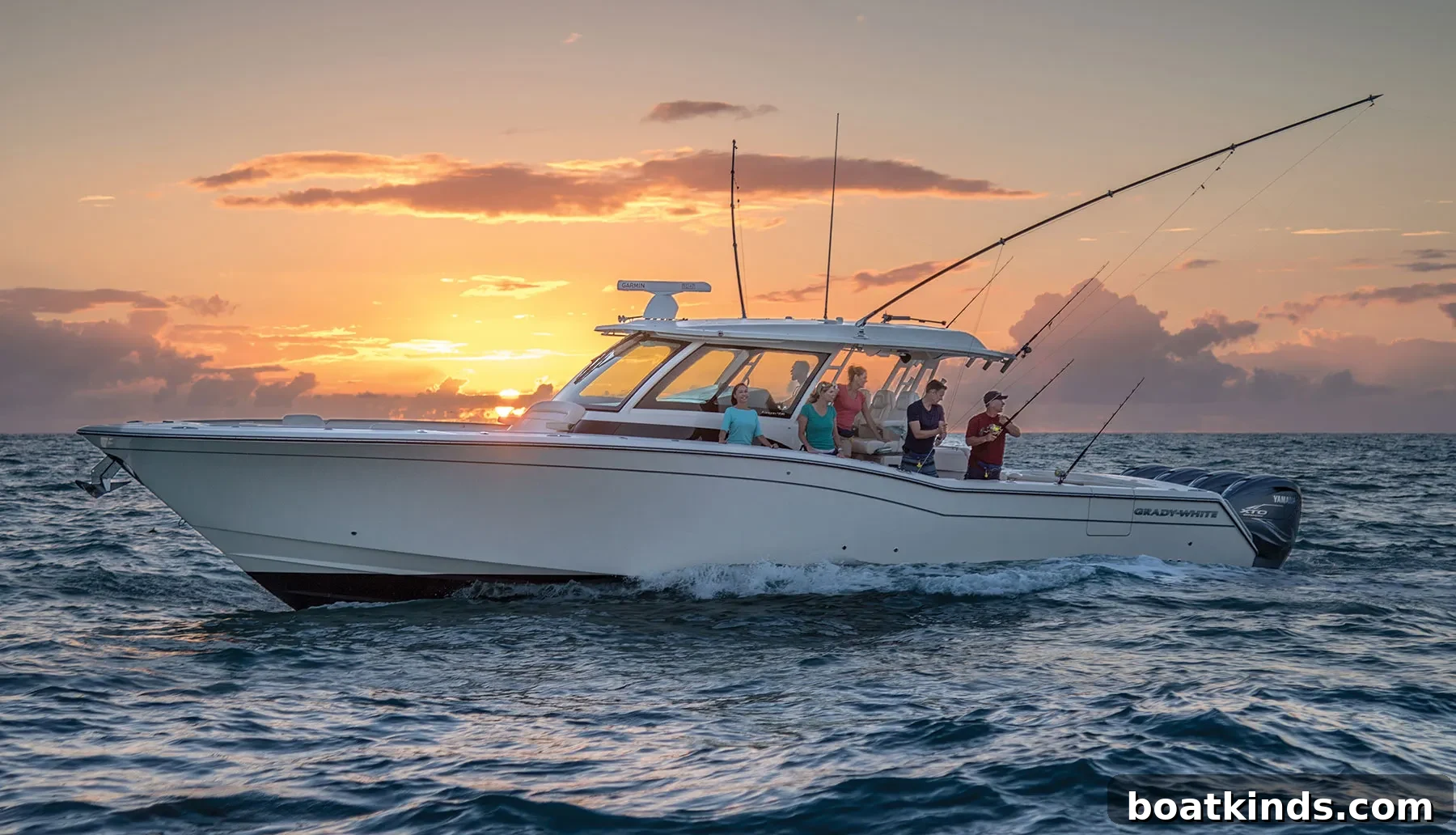
The Carolina boat tradition grew from saltwater fishing culture and from builders who were often working fishermen. Omie Tillet is a classic example: he designed boats he used for charters, blending utility with distinctive styling. Grady-White, based in Greenville, North Carolina, is a major name in production offshore boats, building models from 18 to 45 feet that carry forward that fishing-first ethos.
Grady-White’s evolution illustrates how production builders adapted Carolina principles for broader markets. Founded in 1959 making clinker-built skiffs, the company shifted more directly into saltwater fishing boats with the 25 Kingfish in 1977. That model’s flared hull and dropped sheer introduced the profile that today defines Grady-White. Owner Eddie Smith and his team actively fished tournaments to learn what serious anglers needed, proving that a well-built production boat could go offshore and perform beside custom boats.
While many Grady-White customers fish hard, the brand has also emphasized family comfort. Christian Carraway, the company’s head of product design, explains that Grady-White gradually reduced extreme bow flare to gain interior space while preserving spray control and seaworthiness. The balance enhances on-water comfort without giving up fishability.
Toughness comes through the SeaV2 deep-V hull design, and craftsmanship remains a hallmark: Grady-White hand-lays fiberglass for optimal glass-to-resin ratios rather than relying solely on bulk chopping methods. Automation is used where it improves consistency, but key structural and finishing work remains in the hands of skilled builders—delivering the solid, battlewagon feel offshore anglers expect.
ALBEMARLE
Albemarle Boats in Edenton, North Carolina, also embraces classic Carolina traits—bow flare, dropped sheerline and clean, rounded styling. “Our boats have all the elements of a classic Carolina build,” says Burch Perry, general manager. Albemarle’s lineup, which ranges from 25 to 41 feet, is designed to fish first, though owners use their boats for a variety of offshore and cruising purposes.
While the appearance and core mission of Carolina boats have stayed consistent over the decades, speed and technology continue to advance. Albemarle’s new 30 Express, for example, is a high-speed model that can reach 52 knots with triple outboards—an evolution not common five years ago. Modern production models routinely incorporate Seakeeper stabilizers, touchscreen electronics and advanced lighting systems, reflecting the steady influx of new marine technology.
Perry highlights the collaborative spirit among Carolina builders, many of whom learned their trade as commercial fishermen and shared practical knowledge. That spirit led Albemarle to partner with a custom yard when customers asked for a true, authentic 50-foot-plus Carolina convertible. The resulting Albemarle 53 Spencer Edition—a fiberglass composite convertible developed in consultation with Paul Spencer—was planned to launch in spring 2022 and aims to combine classic Outer Banks styling with modern performance, expected to cruise in the mid-40-knot range on twin Caterpillar diesels.
Albemarle intends to sea-trial the new model in the challenging waters near the factory, on Albemarle Sound, where short, square chop and brisk winds provide a demanding proving ground. That testing environment reflects the hard conditions these boats were designed to handle, a reminder that Carolina boats are born from the necessity of fishing in rough, unpredictable water.
This article was originally published in the May 2021 issue.