
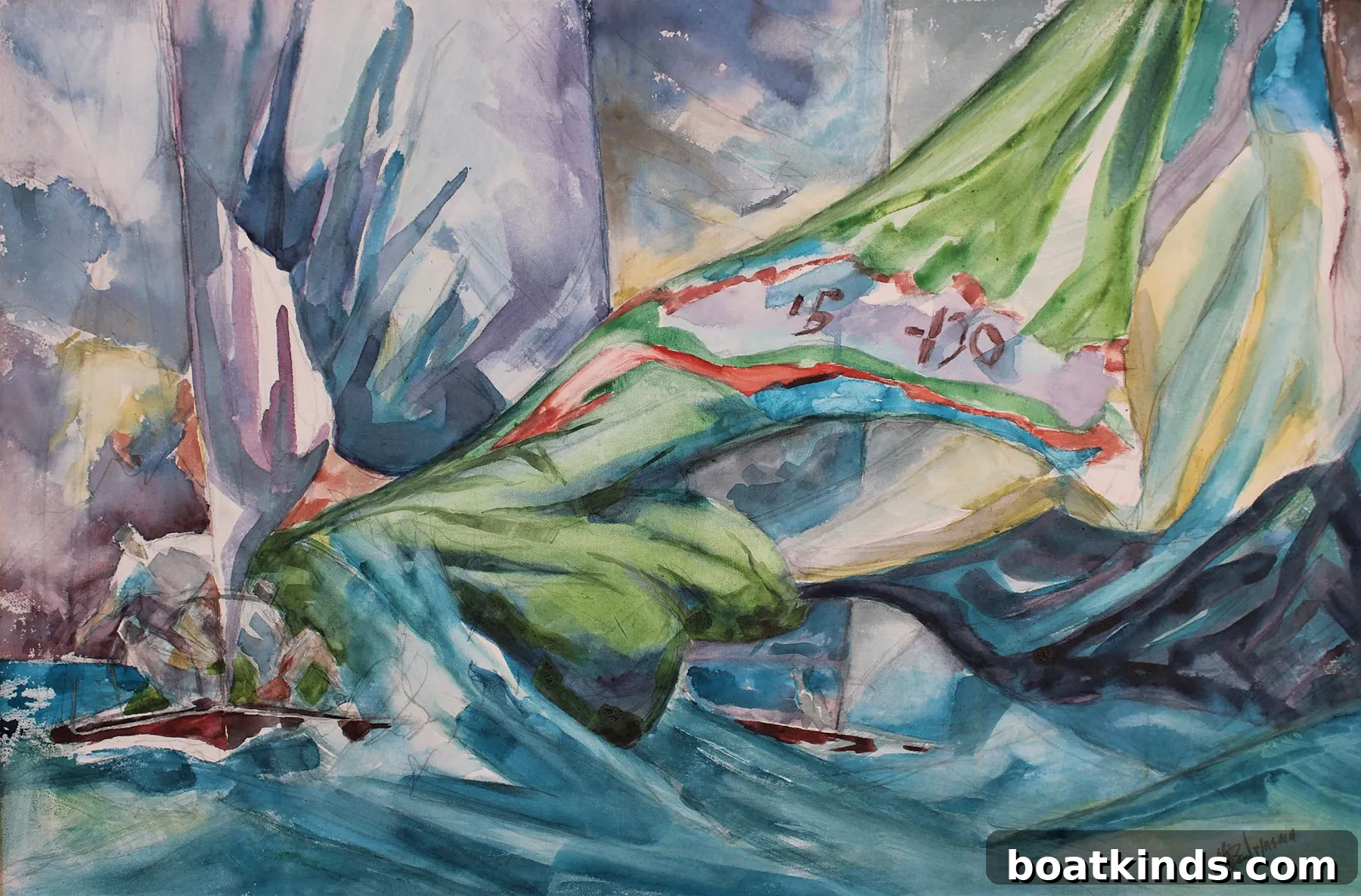
Any sailor who has dropped a spinnaker in a close race—whether sailing a small Blue Jay or a grand J-boat—recognizes the electric moment captured in Willard Bond’s watercolor painting “The Drop.” It is the instant when the cockpit and foredeck synchronize, when sheets and guys are handled in a blur, and the helmsman weaves through traffic while crew members shout “Starboard!” and “Hold your course!” Bond’s 32 x 44-inch watercolor brings that precise intensity to life, using bold color and decisive brushwork to convey the speed, tension, and drama of rounding a leeward mark.
Willard Bond, a Signature Artist and Fellow Emeritus of The American Society of Marine Artists who died in 2012 at age 85, devoted much of his career to painting sailing action and the personalities that populate it. His work stood out for its energetic compositions and vivid palette, qualities that are particularly apparent in “The Drop.” The painting does more than illustrate a scene: it communicates the sensory experience of racing—the gusting wind, flapping canvas, spray of water, and the concentrated motion of a crew working in unison.
Bond’s artistic evolution was shaped by both place and opportunity. In 1976, while living in New York, he accepted the position of night Pier Master at the historic South Street Seaport during the U.S. Bicentennial. There he painted large-format watercolors of the tall ships that visited the piers. That proximity to classic sailing vessels and maritime activity sparked a deeper fascination with yachts and racing boats.
His involvement in the America’s Cup scene followed soon after. Bond’s timing coincided with the 1977 Cup races in Newport, Rhode Island, where Ted Turner’s Courageous defeated Australia. Those events, part spectacle and part athletic contest, reinforced his passion for depicting the 12 Meter Class yachts and the human drama aboard them. Bond saw crews as modern-day heroes—agile, focused, and integral to the machines they sailed—and he translated that admiration into dynamic visual storytelling.
Known for his outgoing personality and curiosity, Bond spent time aboard racing yachts during practice sessions whenever possible. Boarding competing boats allowed him to absorb authentic sensations of speed and teamwork. He also worked closely with photographers and collected hundreds of reference images, using photos as a foundation from which to build more expressive compositions. Rather than creating exact photographic reproductions, Bond combined documentary material with his own imaginative interpretation to heighten the sense of motion and power in each scene.
Critics and collectors alike have noted Bond’s ability to capture the essence of a race rather than only its appearance. His technique emphasized the interplay of wind and water, the sweep of canvas, and the kinetic energy of crew members as they trimmed, tacked, and prepared to drop a spinnaker. In paintings like “The Drop,” viewers can feel the wind tugging at sails and see the coordinated urgency that defines competitive sailing. His strong color choices, confident strokes, and large-format watercolors create a cinematic feel that draws the observer directly into the fray.
Beyond the technical and compositional strengths, Bond’s work resonates because it celebrates the culture of sailing: the teamwork, the skill, and the boldness required to race at close quarters. His paintings honor both the vessels—sleek, powerful machines designed for speed—and the people who make them perform. Bond’s scenes often frame yachts not as static trophies but as active participants in a constantly changing marine environment.
For sailors and art lovers alike, “The Drop” serves as a vivid reminder of why racing matters: it is a test of coordination, strategy, and nerve, condensed into a handful of decisive seconds at a mark. Willard Bond’s life and art were intertwined with those moments, and his watercolors remain valued for their authenticity, energy, and the respect they show for maritime tradition.
This article was originally published in the August 2021 issue.