
Fly Fisher 22 Saltwater Center Consoles Built by Wood Composites Students
This year, students in a Wood Composites program completed three examples of the Fly Fisher 22, a saltwater center-console skiff designed by Michael Berryer of Van Dam Custom Boats in Boyne City, Michigan. The design emphasizes practical inshore performance and classic aesthetics: moderate freeboard and moderate deadrise make the hull well suited to comfortable work in a 1- to 2-foot chop, while the clean lines and fine finish give the boats an appearance more commonly associated with handcrafted wooden workboats.
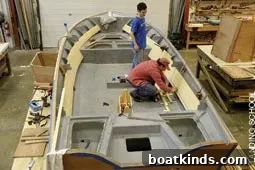
These Fly Fisher 22s are typically equipped to accept an outboard in the neighborhood of 150 horsepower—commonly a Yamaha four-stroke or an Evinrude E-TEC two-stroke—making them versatile for days on the water that require both economy and reliable power. Visually they stand out: varnished mahogany transoms combined with Sipo (a durable tropical hardwood) coamings and toe rails give each hull a collector-quality finish. The attention to joinery and finish elevates the boats beyond standard production craft while still offering a competitive price point—the completed boats can be purchased for roughly $48,500, about half what a comparable handbuilt commission might command.
Construction follows a proven cold-molded methodology. Each hull is built from four layers of Alaskan yellow cedar, chosen for its strength-to-weight ratio and stability. The bottom skins are 3/4 inch thick while the topsides are 1/2 inch, providing a robust structure without excessive weight. After assembly, the hull and deck are sheathed with fiberglass cloth wet out in epoxy to increase abrasion resistance and long-term durability; the exterior finish is sprayed in Awlgrip to achieve a high-quality, durable paint surface that resembles a molded fiberglass boat.
Non-structural components are designed with weight reduction and durability in mind. The console and leaning post use Divinycell foam-cored fiberglass panels, a lightweight sandwich construction that offers stiffness and a clean finished appearance without adding unnecessary mass to the center of the boat. This approach keeps the center of gravity sensible while maintaining a finished look that matches the hull.
Several thoughtful details throughout the design clearly reflect a focus on practical use by anglers. Scupper design, for example, incorporates a pair of high-capacity rectangular scuppers with conduits that route water a short distance from the aft cockpit into the transom area. This arrangement helps manage cockpit drainage while keeping discharge points clear of livewells and deck workspaces. The deck itself features a subtle reverse camber: the outer thirds slope slightly toward the hulls while the center third remains flat. This geometry allows a standing angler to remain level on the outer deck even when the boat heels a few degrees under the load of a fish, an advantage during angling and when hauling gear aboard.
Build quality shows in the small things as well. The gunwale installation, for instance, uses oversize pilot holes that are filled with epoxy, allowed to harden, then re-drilled to accept fasteners for the stainless-steel rubrail. This sequence ensures a solid, water-resistant fastening and prevents future loosening or water intrusion around the rail fasteners. Such methods are common in higher-end wooden boatbuilding and reflect a curriculum that teaches both traditional technique and modern materials science.
Because they combine classic wooden construction, modern composites, and practical detailing for fishing and general inshore use, these Fly Fisher 22s appeal to owners who want a boat that looks like a classic while offering contemporary durability and serviceability. The varnished wood accents—mahogany transom, Sipo coamings and toe rails—make each boat visually striking and give them an heirloom quality that collectors and owners who value craftsmanship will appreciate.
These three Fly Fisher 22 center consoles are the result of a hands-on educational program that blends traditional boatbuilding skills with contemporary materials and finishes. The project provides students with experience in cold-molded construction, epoxy-based fiberglass sheathing, and high-quality finishing work, while producing boats that perform well for inshore anglers and recreational boaters.
See related articles:
- Where Tradition Meets Technology
- Fostering a Sense of Fulfillment, Passion
This article originally appeared in the August 2010 issue.