
Cornelis “Conny” van Rietschoten, known as the “Flying Dutchman,” was the only skipper to win the Whitbread Round the World Race twice. He reshaped ocean racing from a romantic, unpredictable adventure into a professional, businesslike endeavor and mentored a generation of sailors who went on to prominent careers, including America’s Cup veteran Grant Dalton, photographer Onne van der Wal, and ocean racer and weather router Bill Biewenga.
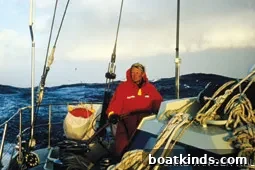
Van Rietschoten died Dec. 17 at his home in the Algarve, Portugal. He was 87 and had suffered a stroke.
“He ran [his campaign] like a business,” says Onne van der Wal, who sailed as engineer aboard van Rietschoten’s Flyer II when the boat took line honors and overall victory in the 1981-82 Whitbread. “He ran it like a business but in military fashion.”
Van Rietschoten’s campaigns were defined by strict, clear rules. There was no swearing on board and no discussion of religion or politics. Crew members were expected to accept the ship’s provisions without complaint. English was the working language to prevent misunderstandings and suspicion. Visitors were permitted only after meeting van Rietschoten, and watchstanders had to arrive on deck fully dressed and exactly on time—never late and never carrying a cup of coffee. To control odors in the living spaces, everyone used a head rigged off the stern; even female reporters who boarded complied. Daily bulletins kept the team informed, down to port-event dress codes—usually blazers, ties and shoes.
“He was relentless in his respect for the rules,” Biewenga says. The discipline wasn’t arbitrary; it fostered mutual respect, preserved morale and maximized efficiency. The rules applied to everyone, including van Rietschoten himself.
Many hopefuls abandoned the campaign when confronted with that level of discipline. Those who remained found the regimen rewarding. Van Rietschoten ran a tight, purpose-driven operation that was all about winning—and he had a proven formula for doing it. Under his leadership Flyer won the 27,000-mile Whitbread twice, in 1978-79 and again in 1981-82.
“The race is won long before the starting gun sounds,” says Biewenga. Van Rietschoten prepared his boat and crew with meticulous planning and exhaustive trials so that little would be left to chance once the race began.
For his first campaign he commissioned Olin and Rod Stephens to design Flyer, a refined take on the Swan 65 Sayula II, the class winner in the 1973-74 Whitbread. Built of aluminum by the Dutch Royal Huisman Shipyard, Flyer kept a ketch rig like Sayula but had greater sail area and a longer waterline. Van Rietschoten sailed Flyer extensively while training his crew—an approach that is now standard in round-the-world campaigns but was innovative at the time. He logged some 10,000 miles with the boat before the race, crossed the Atlantic twice, cycled through a number of crew changes and made more than 100 modifications to Flyer, according to a biography on the Conny Rietschoten Trophy website (vanrietschotentrofee.nl), which honors the best Dutch sailor each year.
Born into a prosperous Dutch maritime family, van Rietschoten grew up amid the hardships of World War II. Two older brothers died fighting with the Dutch resistance, and young Conny spent long periods hidden in an attic, often without food. He learned to sail with his father, Jan Jacob, aboard the family’s 12-Meter Copeja from the age of three and raced out of the Royal Maas Yacht Club in Rotterdam. After the war he studied engineering in England, and at 22 he and a friend bought a Dragon one-design with winnings from a football pool. They sailed it from Cowes to Arendal, Norway, to contest the 1948 Dragon Gold Cup. The trip left their boat and themselves badly battered; they won no races, but were awarded a special prize by Crown Prince Olaf of Norway for their navigation and for traveling the greatest distance to compete.
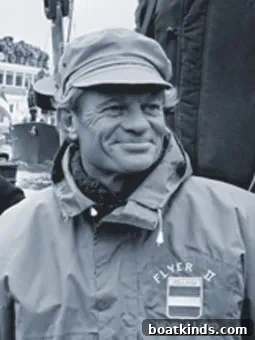
Van Rietschoten ran the family firm, Van Rietschoten & Houwens, which engineered automatic systems for ships and other transport, until he sold the business at 45 and turned his focus more fully to ocean racing. He applied the same intensity, organization and business acumen to the Whitbread campaigns that had made his company successful. “He was a master of preparation—logistics, organization, crew training,” Biewenga remembers.
He selected sailors with care, listened closely and forged teams that were both compatible and competitive. Biewenga recalls that van Rietschoten emphasized mutual respect, teamwork and sincere effort; he urged crew members to help one another and to ask for help when needed during the long, demanding months at sea. “This was sport as it’s supposed to be,” Biewenga says. “It’s a metaphor for life. In its purest form you’re supposed to learn lessons.” Van Rietschoten taught many such lessons to the men who sailed with him.
Grant Dalton, now manager of Team New Zealand, remembers van Rietschoten’s impact on his career. “The Flyer crew are saddened to hear of the passing of our great friend Conny,” he says. “Nearly all of us can track our careers to Conny. We were all young, restless, most of us totally unproven, and yet Conny took a chance on us. He allowed us to be ourselves, sometimes guiding us, sometimes coming down hard on us. He taught us how it was going to be done in the future, and he introduced a professional business approach to offshore sailing.” Dalton calls van Rietschoten a pioneer and a game-changer.
Flyer’s 1978-79 victory came on handicap, with Kings Legend—a Swan 65 skippered by American Skip Novak—among the chief rivals. Kings Legend suffered a setback in the third leg when it broached and lost radio contact, cutting off weather updates. The closer of the Flyer campaign involved a tense series of sail changes that kept the yacht from being driven ashore by a sudden 55-knot squall just 200 yards from the finish.
At 55, van Rietschoten sought an even higher standard for the 1981-82 race, commissioning a 72-foot maxi, Flyer II, from designer Germán Frers and again building the yacht at Huisman. Flyer II campaigned heavily before the Whitbread—racing transatlantic events, the Newport-Annapolis race and the Fastnet—so the team and boat were tested long before the start. Their main rival proved to be the 68-foot Farr New Zealand Ceramco, skippered by Sir Peter Blake. Despite Ceramco’s dismasting on the first leg, the competition remained fierce.
Van Rietschoten’s resolve was tested during the Southern Ocean leg from Cape Town to Auckland when he suffered a heart attack but continued to press on. The seas and winds were enormous, and he felt the weight of responsibility for his 16 crewmembers as he balanced the need for speed with protecting Flyer’s rig from Ceramco’s relentless pursuit. Onne van der Wal recalls the doctor alerting the crew and the skipper’s insistence that news of his condition remain confidential so Blake could not use it to his advantage. Eventually van Rietschoten ceded more duties to his watch captains and spent much of the remainder of the race seated at the stern. “He said, ‘If I die, just throw me over the side. Don’t divert. Keep racing,’” van der Wal recalls.
Flyer II won both the leg and the overall Whitbread, taking line honors and triumphing on handicap. The boat set records for fastest noon-to-noon run (327 miles) and for the fastest circumnavigation at that time (120 days), nearly two weeks quicker than the previous best.
Those who sailed with him remember van Rietschoten as singular and influential. “He was a unique and special guy,” Biewenga says. “He influenced all of our lives.” His disciplined, professional approach left a lasting legacy in offshore racing and in the careers of those he mentored.
April 2014 issue