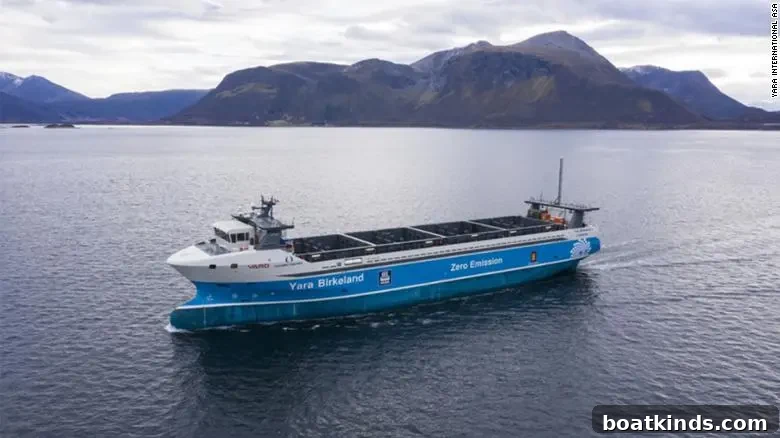
Yara Birkeland: A Zero-Emission, Autonomous Cargo Ship Poised for Coastal Service
The Yara Birkeland, developed by Norwegian chemical company Yara in collaboration with Kongsberg Maritime and shipbuilder Vard, is presented as the world’s first zero-emission, autonomous cargo vessel. Built to serve short coastal routes, the vessel is designed to cut local air pollution and reduce greenhouse gas emissions by shifting freight from road to sea. Its planned initial service is between two Norwegian ports, and the project team aims to commence operations before the end of the year.
Design and propulsion
The ship is fully electric and runs on a large battery system. With a 7-MWh battery pack, the Yara Birkeland’s onboard energy storage is roughly 1,000 times the capacity of a typical electric car battery. This energy capacity enables the ship to carry up to 103 containers and reach a top speed of approximately 13 knots. The electric propulsion system eliminates direct emissions of nitrogen oxides (NOx) and carbon dioxide (CO2) during operation, which is a central goal for the project.
Autonomy and operational concept
Autonomy is a key element of the vessel’s concept. The ship is equipped with systems intended to allow remotely supervised or autonomous operation for routine coastal runs. By reducing or removing the need for onboard crew on short routes, the project hopes to demonstrate improved safety, lower operational costs, and more efficient scheduling. The developers describe the ship as a testbed for integrating autonomy with fully electric propulsion in practical commercial shipping tasks.
Environmental and logistical benefits
Yara has stated that the vessel could significantly reduce road traffic by replacing truck journeys with maritime transport. According to Jon Sletten, plant manager at Yara’s Porsgrunn facility, the Yara Birkeland is expected to replace up to 40,000 truck trips per year on the route it serves. This modal shift can reduce congestion, lower wear on road infrastructure, and cut local emissions associated with diesel-powered road haulage. For ports and coastal communities, zero-emission shipping offers the potential for cleaner air and quieter operations.
Development timeline and delays
The project initially targeted an earlier entry into service, with the vessel intended to be operational in 2020. However, the COVID-19 pandemic and other logistical and regulatory complexities delayed the ship’s maiden voyage. Work continued through the subsequent years on systems integration, testing, and ensuring the vessel meets safety and operational requirements. Project partners have since resumed final preparations and aim to begin transporting containers on a short coastal route between Herøya and Brevik before the end of the current year.
Challenges and broader implications
Introducing a battery-electric, autonomous cargo vessel presents a combination of technical, regulatory, and infrastructure challenges. Shore charging facilities, battery maintenance, remote-operation protocols, navigation in coastal waters, and the regulatory framework for unmanned vessels all require coordination among operators, authorities, and suppliers. Success with an operational Yara Birkeland could help clarify these issues and encourage wider adoption of similar vessels on short-sea and feeder routes.
What this means for the future of short-sea shipping
If the Yara Birkeland meets its operational targets, it may serve as a model for coastal logistics that emphasize low emissions and automation. The vessel’s purpose-built design, battery-based propulsion, and autonomous-capable systems make it a notable experiment in reducing the environmental footprint of freight transport. Demonstrating reliable, routine operations would strengthen the case for electrifying and automating parts of the maritime supply chain, particularly for short-haul routes where charging and turnaround can be managed efficiently.
Conclusion
The Yara Birkeland represents a high-profile effort to combine electric propulsion and autonomous technology in a working cargo vessel. Backed by Yara, Kongsberg Maritime, and Vard, the ship aims to prove that moving freight from roads to the sea can be done with zero local emissions and reduced logistics impact. With its large battery pack, capacity for 103 containers, and planned coastal service, the vessel is positioned to begin operational trials before the year’s end, assuming final testing and approvals proceed as expected.