John Mecray’s Stonington Waterfront: The Passenger Steamer New Hampshire
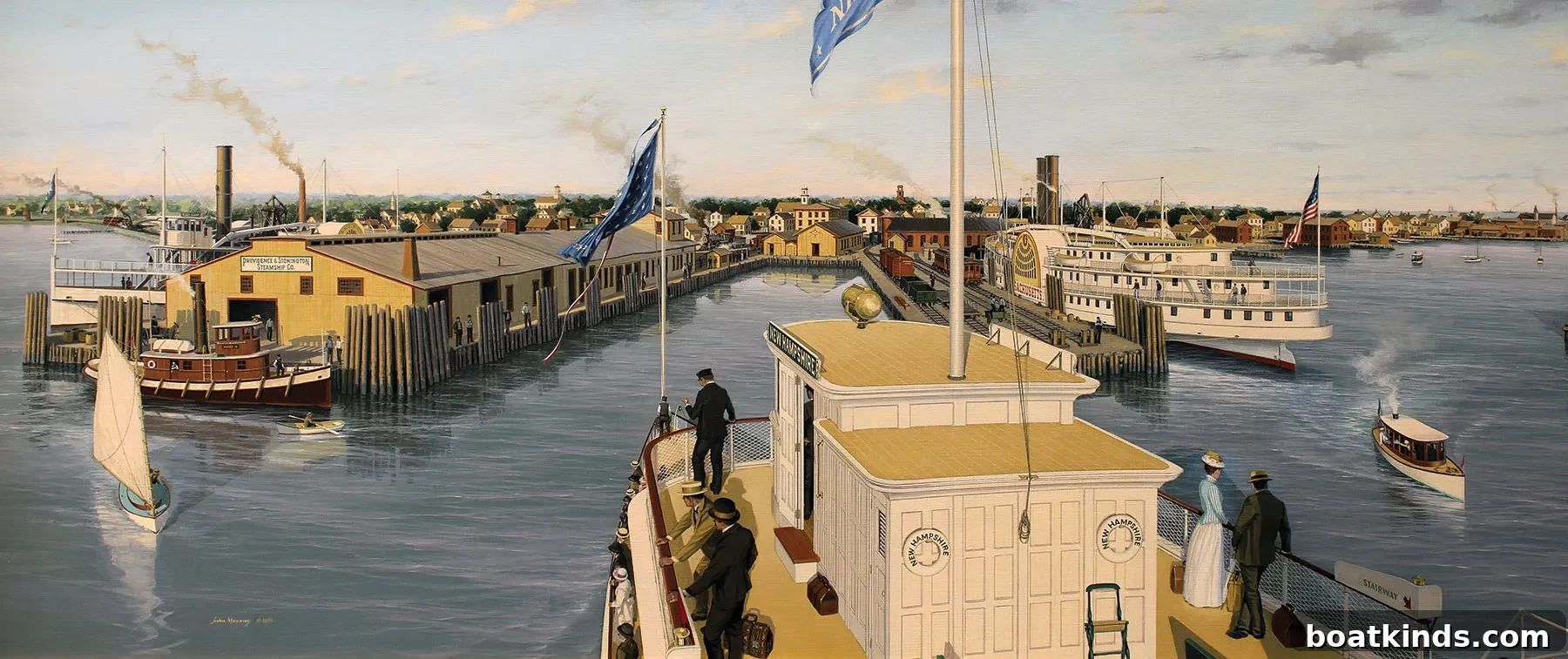
On a bustling day at the Stonington waterfront in Connecticut, the passenger steamer New Hampshire arrives at the Providence & Stonington Steamship Company in a finely detailed 19th-century scene by marine artist John Mecray. The painting captures a moment when steamship travel connected coastal towns to major railroad lines, illustrating both the movement of people and the economic ties that linked New York, Providence and Stonington. The Providence & Stonington Steamship Company, founded through consolidation in 1875 and operating until 1896, ran five steamers on these passenger routes, an important regional link to the era’s expanding rail network.
Mecray’s depiction emphasizes the order and refinement of coastal life in that period. Well-dressed passengers step aboard and disembark, reflecting Stonington’s prosperity and its long-standing maritime traditions. The background shows handsome waterfront homes, indicating the prosperity of a community rooted in shipbuilding, whaling and coastal commerce. The painting expresses both the routine of daily travel and the civic pride of a seaport town whose history stretches back to the mid-17th century.
John Mecray’s own life and career brought him close to the subjects he painted. A graduate of the Philadelphia College of Art, Mecray began as a book and magazine illustrator before an early 1970s sailing trip transformed his focus. After crewing a 40-foot sailboat to St. Thomas in the U.S. Virgin Islands in 1972 he was immediately drawn to the sea. Subsequent trips convinced him to relocate his family to Newport, Rhode Island, where he devoted himself fully to marine painting. That shift from illustration to marine art helped him develop a style grounded in careful observation and technical knowledge of vessels and sailing—qualities evident in his harbor scenes and historical recreations.
Mecray’s firsthand experience at sea—taking part in offshore yacht deliveries and competing in numerous races—gave him a practical understanding of yacht design, rigging and the behavior of vessels underway. That practical background informed the authoritative racing-boat portraits and historical maritime scenes that made him notable in the marine art world. Beyond painting, Mecray was also an active steward of maritime heritage: he co-founded the Museum of Yachting and played a key role in establishing the International Yacht Restoration School. Those efforts helped preserve both the craft and the history of yacht building and restoration, extending Mecray’s influence beyond the canvas to institutions that sustain maritime culture and education.
The Stonington scene demonstrates Mecray’s dual strengths as a painter and historian. He did more than recreate a picturesque shoreline; he conveyed social context and the infrastructure of travel—steamers tied to railroad connections, passengers in period dress, and the built environment of a coastal community shaped by shipbuilding and whaling. The painting’s composition, attention to period detail and atmospheric handling of light all work together to evoke the rhythms of 19th-century coastal life while remaining true to known historical elements.
John Mecray passed away in 2017 at the age of 80. In recognition of his contributions to maritime art and preservation, the Restoration Hall at the International Yacht Restoration School was renamed in his honor. His paintings, like this rendering of the New Hampshire at Stonington, continue to be valued both for their artistic quality and for their careful documentation of nautical history.
This article was originally published in the November 2021 issue.