
Sara Faulkner likes to call herself a “real-life Valley Girl from L.A.,” but her résumé tells a much more complex story. During Hurricane Katrina she and her aircrew rescued 48 people in a single night. She was also the first woman to graduate from the U.S. Coast Guard’s Rescue Swimmer School and was nominated by the International Maritime Organization for its “Exceptional Bravery at Sea” award after rescuing three people from a sailboat in 45-knot winds and 15-foot seas. In that operation a wave lifted the sailboat’s stern and swept her underneath; the 63-foot vessel came down on top of her twice while she was trapped between the rudder and the propeller. She survived, and she got the three people into a helicopter.
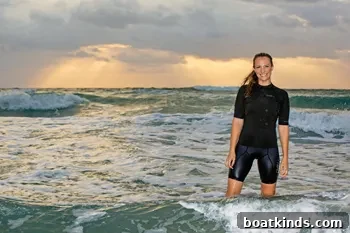
Faulkner retired after a long and distinguished career and now lives in Palm Beach, Florida, with her boyfriend, Mark Sargent, who is also a retired rescue swimmer. After enduring a Rescue Swimmer School with an attrition rate above 50 percent and performing demanding work that requires flexibility, strength, endurance and the ability to operate in heavy seas for extended periods, her next chapter is likely to be just as interesting.
First memory of being on a boat: My earliest boating memory goes back to Kelowna, British Columbia, where my family moved from Los Angeles when I was a baby. I was three when we went fishing in a canoe. My dad had just bought fancy fishing gear and was very proud of it. My twin brother and I had crude sticks with line and a hook. I felt a tug and it kept getting stronger until I couldn’t hold on, so my mom grabbed the line and called to my dad to bring the net. When the catch came in, we were all surprised: a huge brown trout on my little stick. My dad was a bit annoyed that my simple setup beat his expensive rod and reel, but I was thrilled.
First boat you owned or crewed: I never owned a boat, but soon after joining the Coast Guard in 1996 I served as a crewman for two years on several vessels. I crewed the 52-foot Motor Lifeboat Victory, multiple 44-foot Motor Lifeboats, a 36-foot surf rescue boat and a number of rigid-hull inflatables while stationed at the Motor Lifeboat stations in Yaquina Bay and Depoe Bay, Oregon.
Favorite boat you’ve crewed: The larger Motor Lifeboats were my favorite. They’re built to be incredibly strong and to take on surf lines to rescue vessels trying to cross breaking bars. Those boats can right themselves if they capsize or pitchpole, which is reassuring when you’re operating in the surf. The coxswains who pilot these boats hold a special qualification — they’re called Surfmen — and training often meant intentionally taking the boat into the surf. We clipped ourselves to the boat so we wouldn’t go overboard. It was terrifying and exhilarating at the same time.
Your dream boat: After spending 16 of my 20 Coast Guard years flying on helicopters, my perspective on boats changed. I’ve hoisted people off ships and from the water when their vessels were lost to emergencies, so I’m cautious about heading far offshore unless you know exactly what you’re doing and are fully prepared for sudden changes in weather.
Most rewarding professional experience: The rescues during Hurricane Katrina stand out. One night in particular my aircrew and I evacuated 48 people. The city was submerged and parts of it were burning—an almost post-apocalyptic scene. Race and socioeconomic status didn’t matter; we were focused on saving as many lives as quickly as possible. Seeing fellow Americans in that kind of danger was heartbreaking but also reaffirmed the purpose of our work.
Most memorable experience: Serving aboard the USCGC Polar Star on a deployment to Antarctica was unforgettable. After months at sea we began to see slushy ice turning into larger floes and eventually icebergs. Then we spotted penguins on the ice. Everyone rushed to the bow—seeing those animals amid the vast, icy landscape was unexpectedly emotional. Their presence was both endearing and awe-inspiring.
Longest time you’ve spent on board: During the 2003–04 deployment to McMurdo Station, Antarctica, we were at sea for six months. We sailed from Seattle to Honolulu, Sydney, Hobart and then to Ross Island. We spent two months operating around McMurdo while the icebreaker cut channels for supply ships. Our helicopters carried scientists for research missions, counted penguins at rookeries, helped retrieve ice core samples from remote sites and even landed on icebergs.
Favorite destination so far: Antarctica. The combination of raw beauty, scientific purpose and extreme conditions made it the most compelling place I’ve visited.
Favorite nautical book: Adrift: Seventy-six Days Lost at Sea by Steven Callahan. It’s a gripping account of survival that resonates with anyone who spends time on open water.
Favorite nautical cause you support: The U.S. Naval Sea Cadet Corps. I was a Sea Cadet in the Betsy Ross Division in high school — our unit was the only all-female Sea Cadet unit in the country at the time. The program gave me early exposure to naval life: sailing on the USS Kitty Hawk, working on a naval tug and a dive boat, and attending a two-week boot camp at the Marine Corps Recruit Depot in San Diego. Most influential was training with Coast Guard rescue swimmers in Humboldt, California, where I even got to fly as co-pilot in an HH-65 Dolphin helicopter. The Sea Cadets are a great resource for young people considering military service.
Favorite quote about the sea: There’s a Coast Guard saying that has always stuck with me: “Most can’t, many won’t, we do.” It sums up the commitment and professionalism required by rescue work.
This article originally appeared in the July 2016 issue.