
Custom Boats, Craftsmanship, and the Allure of a One‑of‑a‑Kind Design
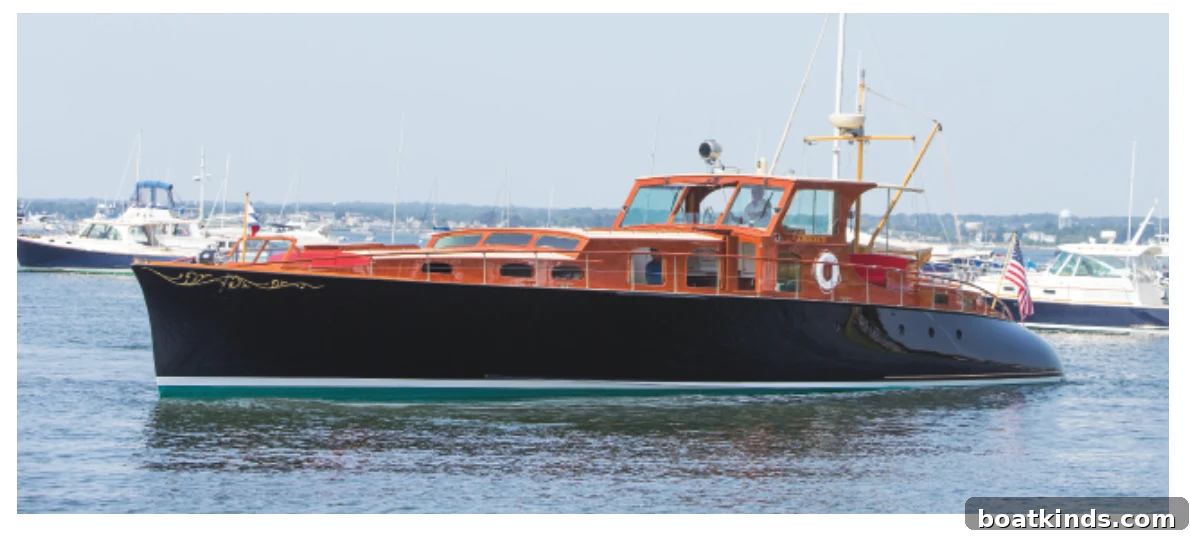
My experience has been with production boats — reliable, well‑made vessels that meet my family’s needs without necessarily stealing the spotlight in every anchorage. Still, whenever a truly special custom boat slips into view, everyone on deck stands up for a better look. We all remember the first time we saw Aphrodite in Watch Hill Harbor, Rhode Island: a 74‑foot commuter yacht originally built by The Purdy Company in 1937 and restored at Brooklin Boat Yard in 2003. She stopped people in their tracks.
Brooklin Boat Yard: Tradition, Skill, and Creative Problem‑Solving
For this issue I spoke with Steve White, president of Brooklin Boat Yard in Maine. Steve started at the yard as a teenager and never expected boatbuilding to become his life’s work — until it did. When he took over management from his father, the yard had just four full‑time employees. Today, Brooklin’s payroll includes more than 60 craftsmen, and the company is widely known for producing exceptional custom boats. Talking with Steve highlights how much imagination and technical skill go into each project. Owners bring ideas; good builders transform those ideas into seaworthy reality. That transformation requires design sense, engineering, and the hands‑on talent to execute every detail.
The Spectrum of Custom Work: From Semi‑Custom to Fully Bespoke
Not all custom boats are created equal. Some builders offer semi‑custom options that allow meaningful owner input while relying on established platforms and engineering. Others create fully bespoke vessels, tailored from the keel up. In our feature “Hook, Line & Sinker,” we talk to an owner who collaborated closely with HCB Yachts to realize a 53‑foot fishing boat that deviates from standard layouts. One of his requests required a completely different bow arrangement, a change that compelled HCB to perform new engineering and structural analysis. That kind of investment — in time, design, and testing — illustrates the lengths some builders will go to deliver a dream boat.
Whether semi‑custom or fully custom, these projects share common traits: clear communication between owner and builder, an iterative design process, and a willingness to solve unusual challenges. When an owner has a strong vision and a builder has the expertise to back it up, the result can be something truly singular on the water.
Designers Who Build for Themselves: TugZilla 26
Designer Sam Devlin of Olympia, Washington, is another example of how personal vision can lead to distinctive craft. Rather than buying an existing workboat, he drew his own design: the TugZilla 26, a hybrid that blends tug‑boat styling with recreational cruising capabilities. Designs like TugZilla 26 remind us that some of the most interesting boats are born from an owner or designer’s desire for a very specific combination of function and character. Spotting a unique boat like that from your cockpit is a reminder of how varied and individual the world of boatbuilding can be.
Why Custom Boats Capture Our Attention
Custom boats attract attention because they reflect choices that prioritize personality, utility, or aesthetics over mass production. They often carry the imprint of an owner’s lifestyle — a fishing layout optimized for long days at sea, a family cruiser with unconventional living spaces, or a restored classic that pays homage to a bygone era. The collaboration between owner, designer, and builder is part negotiation, part creative partnership, and part engineering challenge. When it comes together, the finished boat often looks and performs like nothing else at anchor.
For anyone who enjoys watching boats pass by, these custom projects are a reminder that great boatbuilding is both an art and a craft. It requires experience, patience, and a willingness to experiment. Whether you favor production models for their predictability or chase the appeal of a custom build, there’s no denying the special feeling that comes from seeing a one‑off boat make its way through a harbor.
Jeanne Craig
This article was originally published in the February 2021 issue.