
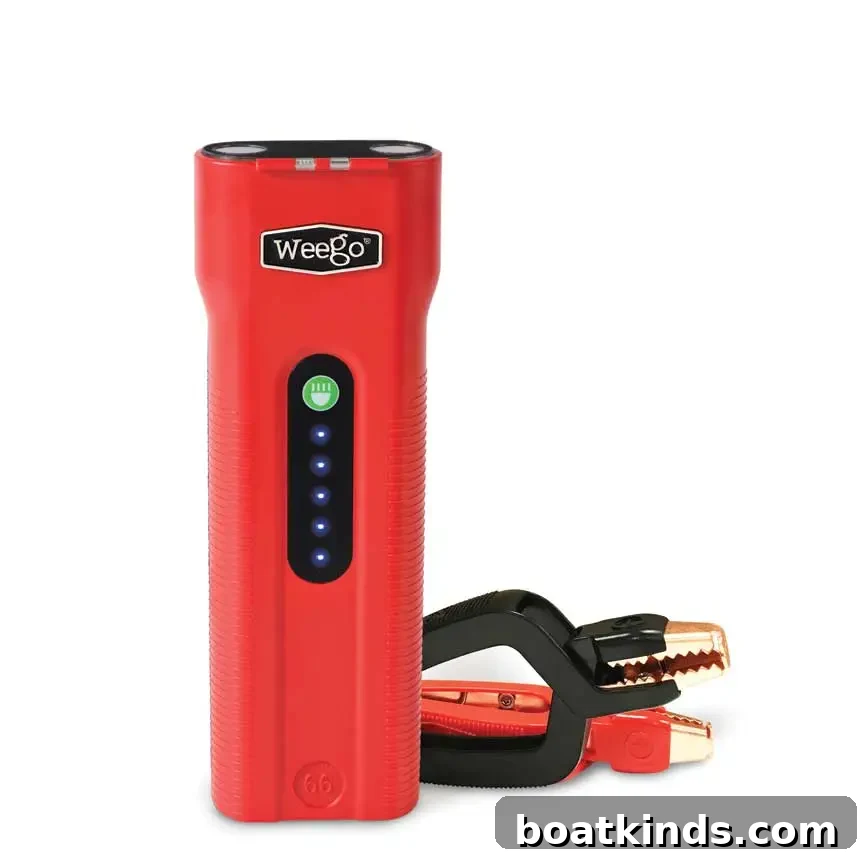
Weego Portable Jump Starters: Compact Power for Boats and Vehicles
When a dead battery leaves you stranded on the water, a compact portable jump starter can be the difference between a long wait and getting back underway quickly. Weego Portable Power offers a line of four compact lithium-polymer jump starter batteries designed for boats, cars and other 12-volt systems. These units combine lightweight portability with multi-function features built for emergency starts and everyday charging needs.
Models and Key Specifications
Weego’s smallest model measures 5.5 by 3 by 0.675 inches, weighs just over half a pound, and will retain a charge for up to one year when stored properly. Larger models in the range hold a charge for up to two years and add several useful features, including high-lumen LED flashlights, strobe functions and an SOS mode for emergencies. The largest model in the family, the Weego 66.1, measures 9.25 by 3.25 by 1.5 inches, weighs approximately 2.5 pounds, and is powerful enough to restart all gasoline engines and diesel engines of 5 liters or more.
Charging and Durability
All Weego units recharge quickly—most models can be fully recharged in under three hours—so they are ready to go after use. The internal lithium-polymer chemistry supports long-term use, with ratings that allow for up to 1,000 charge cycles before significant capacity loss. The larger models are built to withstand the elements commonly encountered around boats: they are water-, dust- and dirt-resistant, making them suitable for marine and outdoor environments.
Multi-Function Utility
Beyond jump-starting batteries, Weego jump starters act as portable power banks. They include USB ports for charging phones, tablets and other USB-powered devices, and many models can power laptops and other 12-volt accessories. The integrated LED lights provide hands-free illumination for night-time repairs, signaling or emergency situations. Strobe and SOS modes are particularly useful when visibility is low or when you need to attract attention.
Practical Use Aboard a Boat
For boaters, a portable jump starter offers several advantages over traditional jumper cables. The Weego units eliminate the need for another running vessel to provide a jump, reducing dependency on others and minimizing the risk of engine damage from incorrect connections. Their compact size makes storage in a glovebox, locker or small compartment simple, and the long standby charge life means they remain ready through the season.
When using a jump starter on a boat, follow common safety steps: ensure the device is fully charged before heading out, connect clamps only to clean, designated battery terminals, keep clamps away from moving parts, and follow the manufacturer’s instructions for safe operation. Use the built-in flashlight to work safely at night and use the SOS or strobe feature if you need to signal for assistance.
Maintenance and Lifespan
To maximize lifespan, store the jump starter in a cool, dry place and recharge it periodically according to the manufacturer’s recommendations. While Weego units are rated for up to 1,000 cycles, real-world lifespan depends on usage patterns, storage conditions and how often the battery is discharged to low levels. The company backs its products with an 18-month warranty, providing added confidence for boaters and drivers who rely on these devices for emergency starts and routine charging.
Buying Considerations
When choosing a Weego model, consider the size and displacement of the engines you expect to start, how frequently you will use the unit, and whether you need additional features like laptop charging or built-in lighting. The smallest units are excellent for compact personal watercraft and smaller outboards, while the largest Weego 66.1 is suited to larger outboard motors, inboard gas engines and diesel engines up to and beyond 5 liters.
Price: $70 to $200 depending on the model and features.
This article originally appeared in the February 2019 issue.