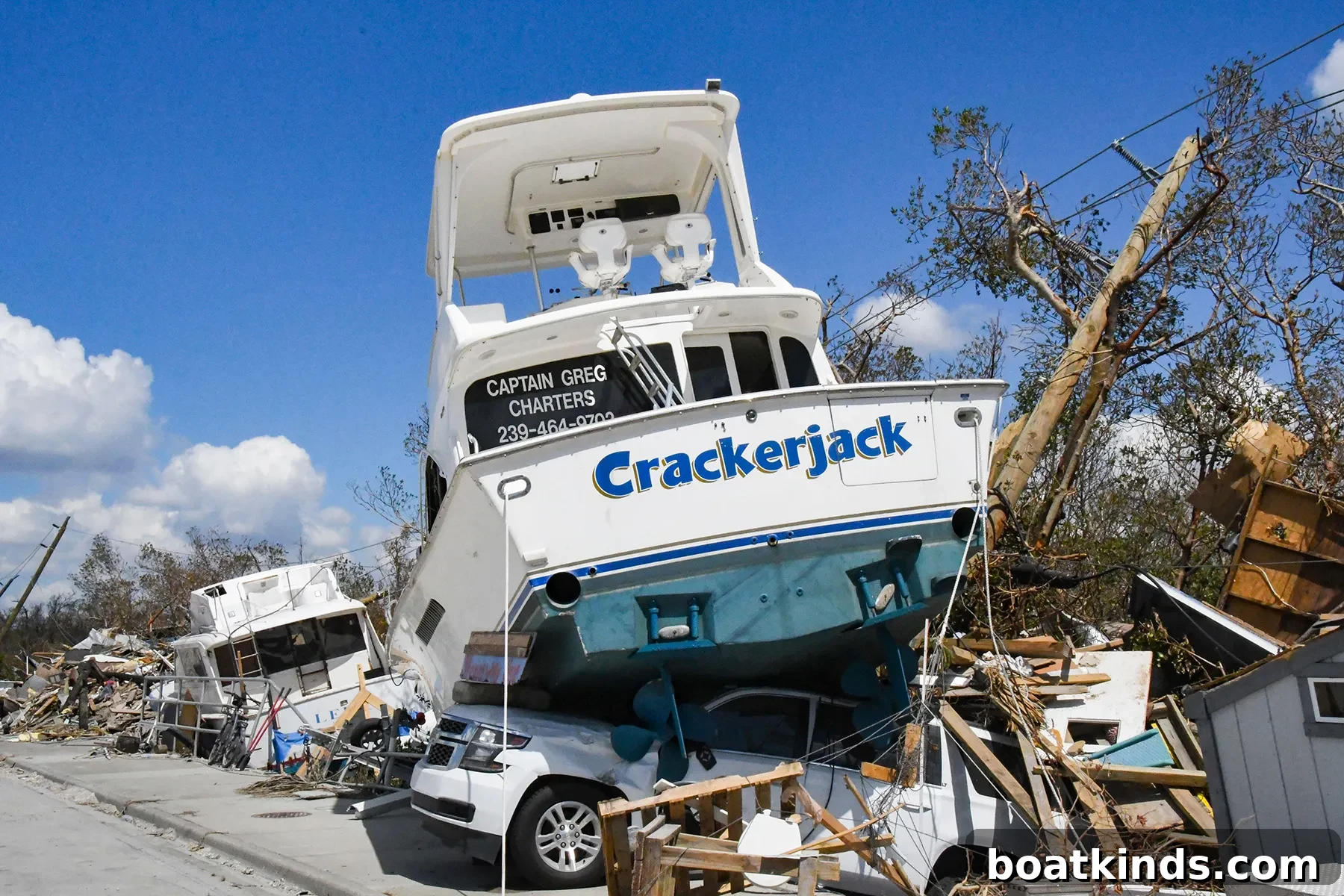
Standing in Fort Myers, Florida, Mike Root took in a scene that made little sense at first glance: a 40-foot boat swept roughly 100 yards inland by Hurricane Ian, now lodged between a private home and a large tree. The boat’s precarious position raised immediate, complex questions about recovery and liability.
“What do you do with that?” Root asks. Root is assistant vice president of claims for GEICO Marine Insurance, which serves BoatUS members. “You can’t damage the house further, you don’t want to take down a tree on someone else’s property, and you don’t want to damage the boat. A storm of this magnitude creates challenges far beyond typical post-storm recoveries.”
Hurricane Ian was one of the most powerful storms to hit the contiguous United States in recent history. It made landfall on Cayo Costa Island in southwest Florida on September 28 as a high-end Category 4 storm with sustained winds of 155 mph. The storm produced devastating wind and storm surge, with reports of extreme gusts and localized impacts that far exceeded normal expectations for the region.
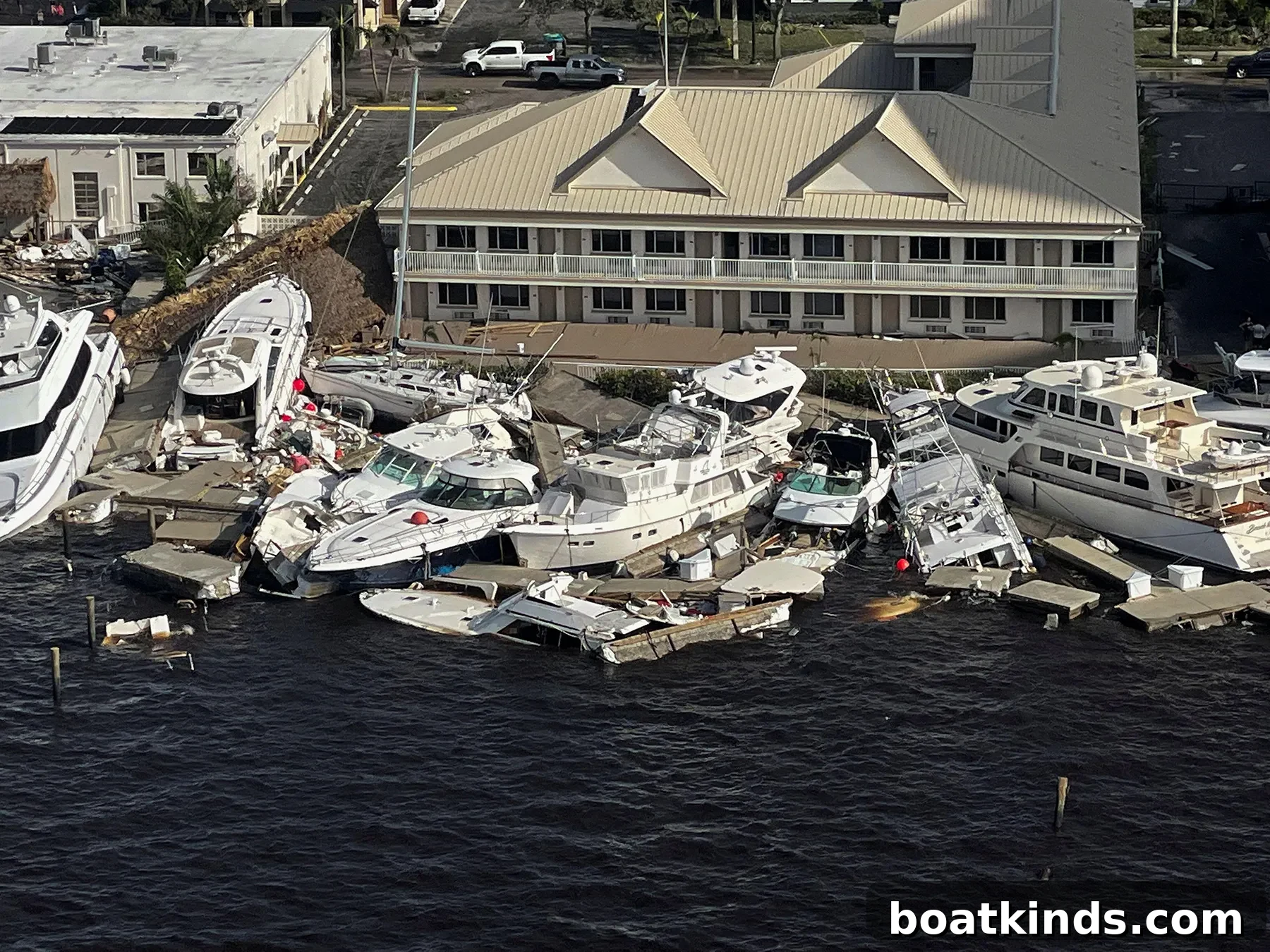
Storm surge pushed water inland as much as 15 feet in some locations, flooding first and second floors of homes and sweeping vessels far from their moorings. The Florida Medical Examiners Commission reported more than 100 fatalities, including some people who were killed while preparing for or cleaning up after the storm.
The boating community bore major losses. Thousands of recreational and commercial vessels were displaced, sunk, crushed or carried ashore. Root says GEICO is still finalizing a full count but estimates the cost to the boating industry is in the hundreds of millions of dollars, with total economic impacts likely reaching into the billion-dollar range.
Recovering and removing this many boats will take months. In places like Cape Coral, where miles of residential canals connect backyards to open water, crews face tight, maze-like waterways that are ill-suited for large salvage operations. Boats are often piled on top of one another in narrow canals, forcing responders to use specially configured barges and precise techniques to avoid further damage.
Not all marine facilities fared poorly. Baxter Underwood, CEO of Safe Harbor Marinas, reported that several regional locations—including Colusa Isle, Burnt Store and Cape Harbour—sustained only minimal damage. Underwood attributes much of that resilience to modern building codes and improved construction techniques.
“I expected the buildings would be worse, given the size of the storm,” Underwood says. “But building codes have evolved, and many structures held up better than I anticipated.” He contrasted the scene in Florida with the catastrophic destruction he witnessed in the Bahamas after Hurricane Dorian in 2019, noting that updated codes and stronger windows made a material difference in West Florida.
MarineMax, another major operator in the region, reported that team members and their families were safe and that many locations were already organizing repairs, supplies and food. By mid-October, several MarineMax locations had reopened or were actively working toward reopening, while service and parts operations continued where possible during facility repairs.
Post-storm recovery faces further complications: a high water table, widespread power outages, sewage backups, fuel shortages and constrained access for heavy equipment. Construction materials and skilled labor are scarce nationwide due to lingering supply-chain constraints and the huge demand for rebuilding across affected communities.
Safe Harbor is mobilizing personnel and equipment from other regions to assist with cleanup and salvage. “There are so many boats affected around Fort Myers,” Underwood says. “Boaters will be stranded for some time. We’re bringing teams from as far away as New England and setting up temporary housing and logistics to help where we can.”
Insurance and claims processes are still unfolding. Root says hundreds of boats remain unaccounted for, and many wrecks are fragmented—parts ashore that may or may not belong to a single vessel—making accurate tallies difficult. Scott Croft, vice president of public affairs for BoatUS, estimates it will be at least mid-November before a reliable count of damaged and lost boats is available. He also warns that additional claims will likely emerge as power and living conditions stabilize and owners discover previously unrecognized damage.
BoatUS is advising boat owners, marina operators and other waterfront property holders to follow established storm-preparation best practices and to document any damage thoroughly when it’s safe to do so. Boat owners shopping for used boats in the months after Ian are urged to exercise caution: vessels damaged in the storm may surface on the market. Croft recommends a thorough, independent survey for any used purchase, noting that salvaged boats can be a source of usable parts if a vessel is determined to be a total loss.
The road to recovery for Fort Myers and surrounding coastal communities will be long. Salvage operations, insurance settlements, infrastructure repairs and the return of marina and boating services will take time, but coordinated efforts among insurers, marina operators and volunteer teams are already underway to restore access and support the boating community through cleanup and rebuilding.
This article was originally published in the December 2022 issue.