
Illustration by Jim Ewing
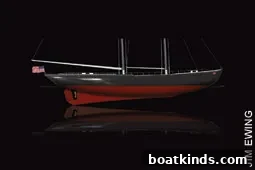
Schooner Adventure — A Grand Banks Fishing Schooner and a Living Piece of Maritime History
No sailing vessel captures the imagination quite like a Grand Banks fishing schooner, and the schooner Adventure is one of the finest surviving examples. With a history rooted in the demanding North Atlantic fisheries, Adventure evokes scenes of weather-beaten crews, fog-bound dories, and voyages to rich but perilous grounds. She stands today not only as an iconic schooner but as a tangible connection to the fishing heritage of New England.
Launched in 1926, Adventure was designed by Thomas F. McManus of Boston, a name synonymous with the development of the New England schooner. Built as a “knockabout,” she reflects a safety-focused evolution in schooner design: the knockabout carries no bowsprit, which removed the need for crew to handle headsails on a pitching spar and reduced the risk of men being swept overboard. Constructed of white oak and yellow pine at John F. James & Son yard in Essex, Massachusetts, Adventure measures 122 feet overall with a 25-foot beam and a 14-foot draft—dimensions that balanced cargo capacity, seaworthiness, and the ability to handle the tough conditions of the Grand Banks fishery.
For 28 years Adventure worked the Atlantic, carrying a crew of 27 and operating with 14 dories to catch cod, haddock, and halibut. Under the long command of Capt. Leo Hynes—nicknamed “In-and-Out” for his relentless schedule—Adventure became known as a highliner, a highly productive and profitable vessel. During Hynes’s two decades at the helm, she made as many as 48 runs in a single year, moving between the rich northern Banks and the southern grounds near Nantucket Shoals and Cape Cod. By the time she retired from the fishing trade in 1954, Adventure had contributed roughly $4 million in earnings to her owners—a testament to her success and the economic importance of the Grand Banks fishery in that era.
In her working days Adventure’s deck plan reflected the practical demands of the fishery: a doghouse aft and two stacks of dories stowed between her masts enabled efficient handling of gear and quick deployment of dory crews. Those features, paired with her sturdy construction, made her both a reliable platform for line and dory fishing and a durable survivor of harsh seasons at sea.
After years in the Maine windjammer fleet, the Gloucester-based nonprofit The Gloucester Adventure Inc. acquired the vessel in the late 1980s. Since 1990 she has been undergoing a progressive restoration, a careful and ongoing project intended to preserve her original character while stabilizing the hull and rig for public display and educational use. Berthed in Gloucester, Massachusetts, Adventure currently holds Coast Guard certification as a Moored Attraction Vessel. When restoration work is completed, she is planned to return to sailing as a living platform for maritime education, public programming, and as a memorial to the more than 5,000 fishermen who sailed from Gloucester and never returned.
Marine historian Howard I. Chapelle praised Adventure as the “acme in the long evolution of the New England fishing schooner,” and for many supporters she remains an irreplaceable artifact from a pivotal period in American maritime history. As both an example of McManus’s design legacy and a survivor of the Grand Banks fishery, Adventure helps tell the story of coastal communities, the men who fished them, and the innovations born of necessity and hard work.
To learn more about the schooner Adventure and the ongoing restoration efforts, see: www.schooner-adventure.org
September 2013 issue