He had enormous hands, fingers as thick as quarters: scarred, scratched, calloused and rough. A handshake felt like grabbing a catcher’s mitt. Yet with those hands he could tie intricate fishing knots, repair almost anything, and drive whatever vehicle was in front of him—whether it flew, floated or rolled.
He opened an autobody shop when he was 16 and kept it running for decades, building tow trucks and dump trucks and fixing vehicles until he passed away last November at 78. He tried his hand at real estate and restaurants, served for decades as a volunteer firefighter and fished harder than anyone I knew growing up. For 35 years he lived with my mother. They never formally married, but to me he was my stepdad.
Stepparent relationships can go many ways; I was fortunate. His name was Oliver Helmrich, but everyone called him Corky—a childhood nickname that stuck. He was a hardworking, straightforward man who was anything but simple-minded. He wore the same uniform most days: a blue polo with a chest pocket for glasses or his phone, khaki shorts and stretched-out boat shoes. He rarely wore socks unless the ground was frozen.
In his prime he was a powerful man, much like the trucks he built. I once watched him pick a car transmission up over his shoulder and walk across the yard beside his shop without a flinch. He had a soft side, too, always taking in outcasts and people the world had given up on. He would employ them, lend them money and try to steer them toward a better path. Countless people have told me stories of times Corky helped them, no strings attached. I’m one of those people.
After he died I drove from my home in Florida to Connecticut to help my mother. Those days were dark; she needed a sympathetic ear and a strong back. My main task became organizing his mountain of fishing tackle, piled on top of an oak rolltop desk tucked in a corner of the den beside a wood stove. The desk saw little light—buried beneath boxes of tackle, giant spools of monofilament, plastic bags with shark hooks on wire, shoeboxes of bank statements, charts marked for future trips, a decade of photos and stacks of fishing magazines.
The drawers revealed the makings of his life: a knife, a manual from an outboard motor he’d sold years earlier, loose ammunition, a handwritten note from my sister, an envelope of cash, broken sunglasses, tools and heavy circle hooks. Finding a stack of magazines he had saved for nearly 20 years made me choke up—dog-eared to stories I had written. He even kept a 2007 calendar that printed some of my photos. “He always bragged about you to his fishing buddies,” my mother said; I never believed it until I opened that drawer.
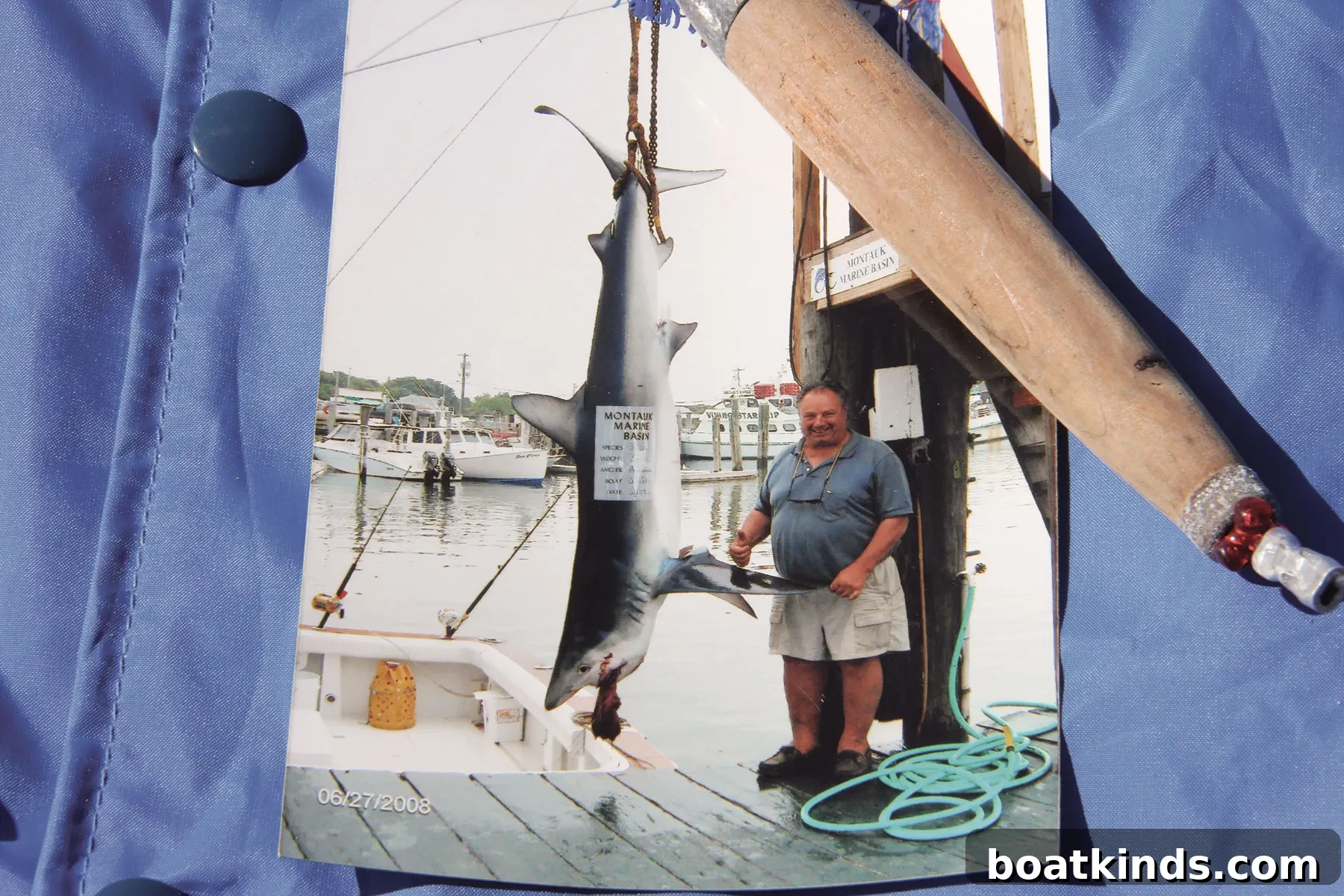
Corky loved fishing for everything, but sharks, tuna and billfish were his greatest passions. He took marathon canyon trips—leaving Friday after work and returning Sunday night—sunburned and smiling, carrying bags of mako fillets, swordfish steaks or tuna loins. He was never one to boast; when I asked “How was the fishing?” he’d offer a simple “Good” or “Not so good,” light the grill and collapse into a chair. Later, his friends would trade tales that made him sound larger than life: the blue marlin he hand-lined after a rod broke, the engine problems where Corky was the first into the bilge and often the last man out.
When I was a teenager he helped me out with cars and bailed me out of a few scrapes. Once, after an officer pulled me over for rolling through a stop sign with alcohol on my breath, the cop—who knew Corky—followed me home instead of hauling me in, to be sure I made it back safely. Corky laughed when he later mentioned it, and I was grateful he hadn’t told my mother.
When I worked as an editor at Marlin magazine I invited Corky on a trip to Ecuador and he didn’t hesitate. He packed a small duffel for a weeklong trip; he always traveled light. From Salinas we fished out of Manta for tuna and marlin. He coached me in the fighting chair, let me wind on the big fish and helped rig baits and set the spread. I landed a monster wahoo that needed two of us to hold it and my first Pacific blue marlin. We dined with wealthy men in a mansion that felt like another world—gloved butlers and a fishing-library worthy of envy—but Corky was unfazed. He was himself in every setting, charming men in blue blazers with stories of giant tuna and an uncanny knowledge of marine diesel engines.
Corky wasn’t fond of doctors or medicine. He broke his leg in a motorcycle accident in his 20s and never had a cast; he worked with a cane for a while. Decades of hard living accumulated into chronic pain in his knees and shoulders. He spent more time at his desk making shark rigs and fixing old spinning reels to give away to neighborhood kids. My parents lived on a small lake thick with bass and pickerel; Corky once drove to a nearby state reservoir, caught bass and moved them into our lake to bolster the population—another example of the odd ways he cared for people and places he loved.
When my sons were young we spent summers at my parents’ house, playing in the lake as I had as a child. Corky would sit and watch with a smile, telling a story or nudging my boys to dig for worms. He wasn’t the kind to hand out big hugs, but his affection came in other forms: a tear at my wedding, a few bills tucked into my pocket when I was home from college, a home-cooked lobster dinner waiting whenever I visited. If Corky liked you, he would cook for you—big rib roasts, stuffed shrimp—and you felt cared for in a quiet, steady way.
With the rods stowed and tackle sorted into labeled boxes, the corner of my parents’ house changed. I polished the rolltop and fixed a broken drawer pull. The desk, once a workbench strewn with epoxy and marker ink, had become a keeper of memories. The rigs and reels he left behind will go to his old fishing buddies, as he would have wanted. As I stood there looking at the cleaned desk, his absence finally felt real: a space full of stories, hands that could fix anything and a life lived around fishing, work and generosity.
This story first appeared in a 2021 issue of Angler’s Journal.