
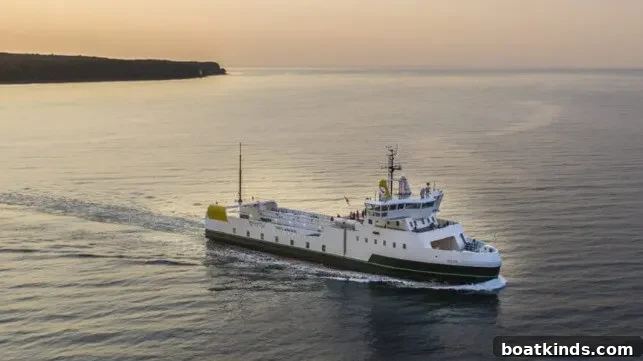
Ellen: Record-Breaking Electric Ferry Demonstrates Viability of Battery-Powered Shipping
A fully electric ferry designed to showcase the potential of battery propulsion has set a new distance record for a single charge. Finnish supplier Danfoss Editron, which provided the electric drivetrains and propulsion motors, reports that the ferry Ellen completed a special voyage that established the longest distance sailed on one battery charge for a ship of its kind.
Record Voyage and Context
The ferry, which normally serves a 22-nautical-mile route among Denmark’s southern islands, made a special trip to appear at the 7th Annual Global Conference on Energy Efficiency organized by the International Energy Agency (IEA). On the return leg from the conference, Ellen sailed 50 nautical miles on a single battery charge, a distance Danfoss plans to submit for recognition to the Guinness World Records.
Project Background and Cost
Ellen was developed under E-Ferry, an initiative supported by the European Union. The project’s development cost was approximately €21.3 million. While the initial construction cost of Ellen is about 40 percent higher than that of a comparable conventional vessel, the operating costs are substantially lower—reported to be roughly 75 percent less—making the electric approach economically attractive over time.
Construction, Design and Materials
The hull of Ellen was fabricated in sections in Szczecin, Poland. In September 2016, 22 prefabricated sections were welded together and the hull was towed to Denmark for final outfitting. Launched in 2019, the ferry was purpose-built to be as light and efficient as possible. The hull is steel while the wheelhouse and upper structures use aluminum to reduce weight. To further lower mass and environmental impact, interior deck furniture is made from recycled paper rather than wood. The resulting vessel has a total displacement of about 650 tons.
Capacity, Crew and Operations
Ellen can carry up to 30 vehicles and 200 passengers. The vessel is operated by a crew of three and typically sails at a service speed of approximately 12 knots. During its first ten months in operation, Ellen completed roughly 1,000 round trips on its regular route, demonstrating practical, day-to-day reliability for short-sea ferry services.
Battery System and Charging
The ship’s battery system was developed by Leclanché of Switzerland and is reported to use Lithium Nickel Manganese Cobalt Oxide chemistry. The battery pack is split between two rooms below deck and has a total capacity of 4.3 MWh. Ellen is notable for operating without an onboard emergency generator; instead, a shore-based charging arm allows rapid recharging while vehicles and passengers are loaded. Typical charging time is about 20 minutes, enabling quick turnaround between crossings.
Efficiency and Environmental Benefits
Danfoss states that Ellen achieves approximately 87 percent energy efficiency from the power grid to the propeller. Compared with a conventional ferry, Ellen consumes roughly half the energy per trip and operates at about 24 percent lower cost than a new diesel-powered ferry, according to the supplier’s figures. The project estimates that Ellen will reduce carbon dioxide emissions by approximately 2,000 tons per year. Danfoss also believes there is potential to replace up to 900 ferries across Europe with similar e-ferry solutions, which would significantly cut emissions and operating expenses in short-distance maritime transport.
Industry Perspective
“Ellen is an excellent example of the future for electric transport. It’s cleaner, greener, and more efficient than her fossil-fuel competitors,” said Kimmo Rauma, vice president of Danfoss’ Editron division. “Electrifying maritime transport is a clear-cut way to reduce greenhouse gas emissions.”