
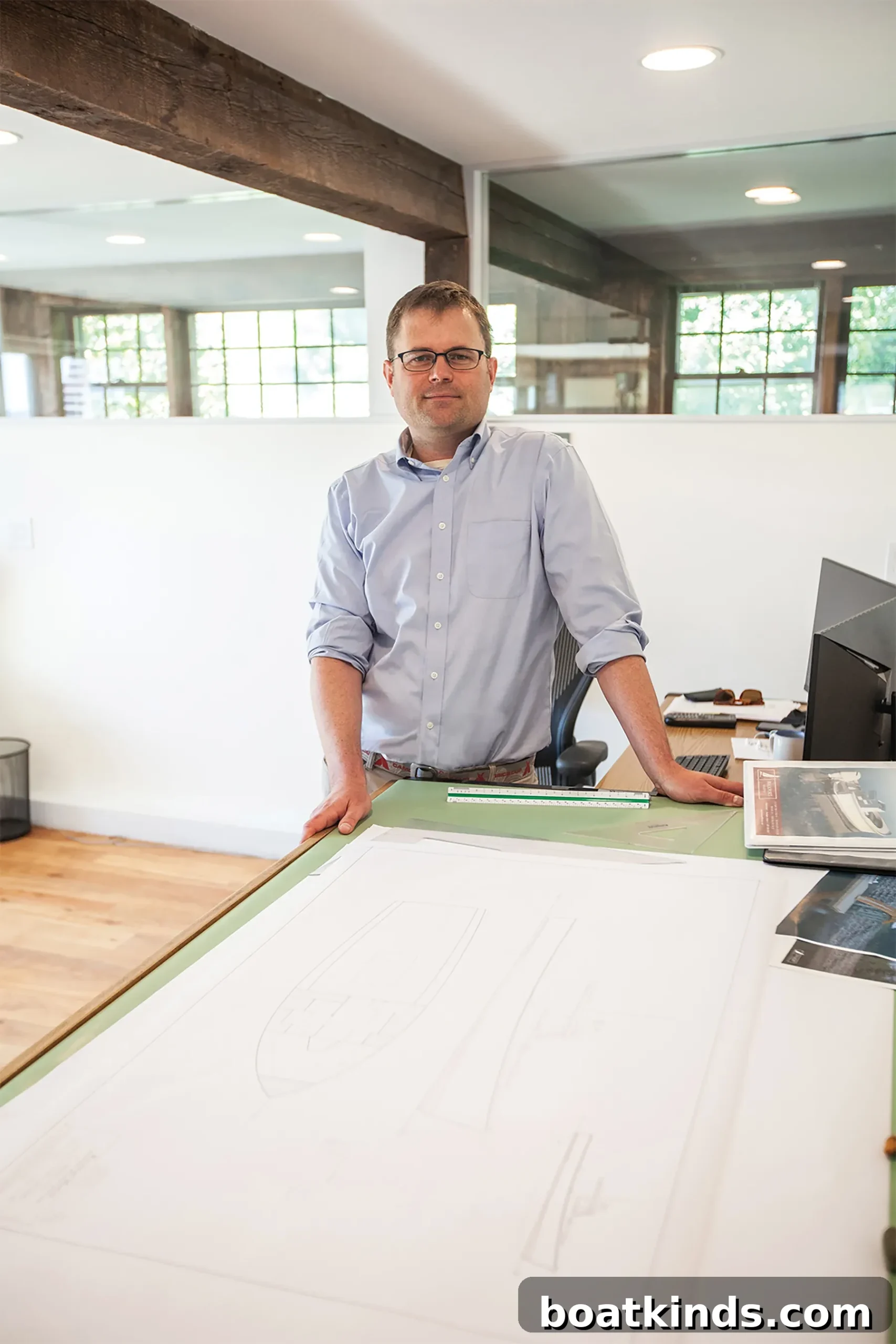
Sam Chamberlin has spent 14 years designing boats for Rockport Marine, a custom wooden boatbuilding and yacht restoration yard in Rockport, Maine. Before that he worked four years building and designing boats for Brion Rieff in Brooklin, Maine. Chamberlin’s work ranges from Downeast cruisers and center consoles to sailing yachts, and his role centers on collaborating with clients to fulfill custom design briefs. We spoke with him to learn about his career and recent projects.
When did you become interested in boat design?
I grew up outside Boston in Massachusetts, surrounded by families who lived and worked on the water. As a child I spent summers on Isle au Haut in Penobscot Bay, Maine—an isolated island that required constant trips to the mainland—so small, open outboard boats were a part of daily life. In high school we had a small production cruising sailboat, and I spent a lot of time around bays and shorelines. That upbringing sparked an early fascination with boat design. After high school I spent a gap year at The Landing School of Boat Building and Design in Arundel, Maine, and later studied physics at Bates College before committing to a full-time career in boats.
You’ve been at Rockport Marine for 14 years. What drew you to a career in wooden boat design rather than fiberglass production designs?
The decision came down to place and community. I wanted to live and work in this part of Maine among people deeply involved in the wooden boat scene. Early on I imagined a more conventional industry path, but as I chose where to live and work, the wooden-boat community here became the natural fit. Beyond the location, there’s a genuine pleasure in working with wood—the craft and the hands-on process have been enormously rewarding.
Were you mentored by anyone in the industry?
I didn’t train under a single established designer or come up in a large design office; I’ve shaped my own path. That said, Rockport Marine’s mix of restoration and new construction has been an informal education in itself. Working on and studying classic designs by Sparkman & Stephens, Herreshoff, and William Fife provided a deep, ongoing mentorship through close study. Additionally, collaborating with experienced builders early in my career taught me practical lessons about how boats are put together and how design translates into construction.
What do you strive to accomplish with the boats you design?
I aim to design honest, well-balanced boats—nothing showy for its own sake, but finely resolved compromises that work well, look right, and are economical to build. I try to avoid flash and focus on utility, beauty, and long-term satisfaction. My goal is to create boats that perform their intended role cleanly and reliably, with thoughtful details rather than excessive ornamentation.
What is your design process?
We use CAD in both 2D and 3D, but I move fluidly between the computer and hand-drawn sketches. There’s a creative spark you can only get with pencil and paper, so many designs go through numerous cycles: model in the computer, print, sketch changes by hand, then refine digitally. Boats designed entirely inside a computer can sometimes feel mechanical; hand sketching injects a human quality and a fluid aesthetic that’s hard to replicate otherwise.
What are you working on at the moment?
Right now we have three builds in the shop that reflect our approach: a 20-foot center console, a 37-foot lobster-style yacht, and a 38-foot daysailer. None are sensational showpieces, but each is well-made, grounded in classic yacht forms, and thoroughly modern in performance and systems. Together they express the identity of Rockport Marine—rooted in tradition but built for contemporary use on this coast of Maine.
Tell me more about one of those designs.
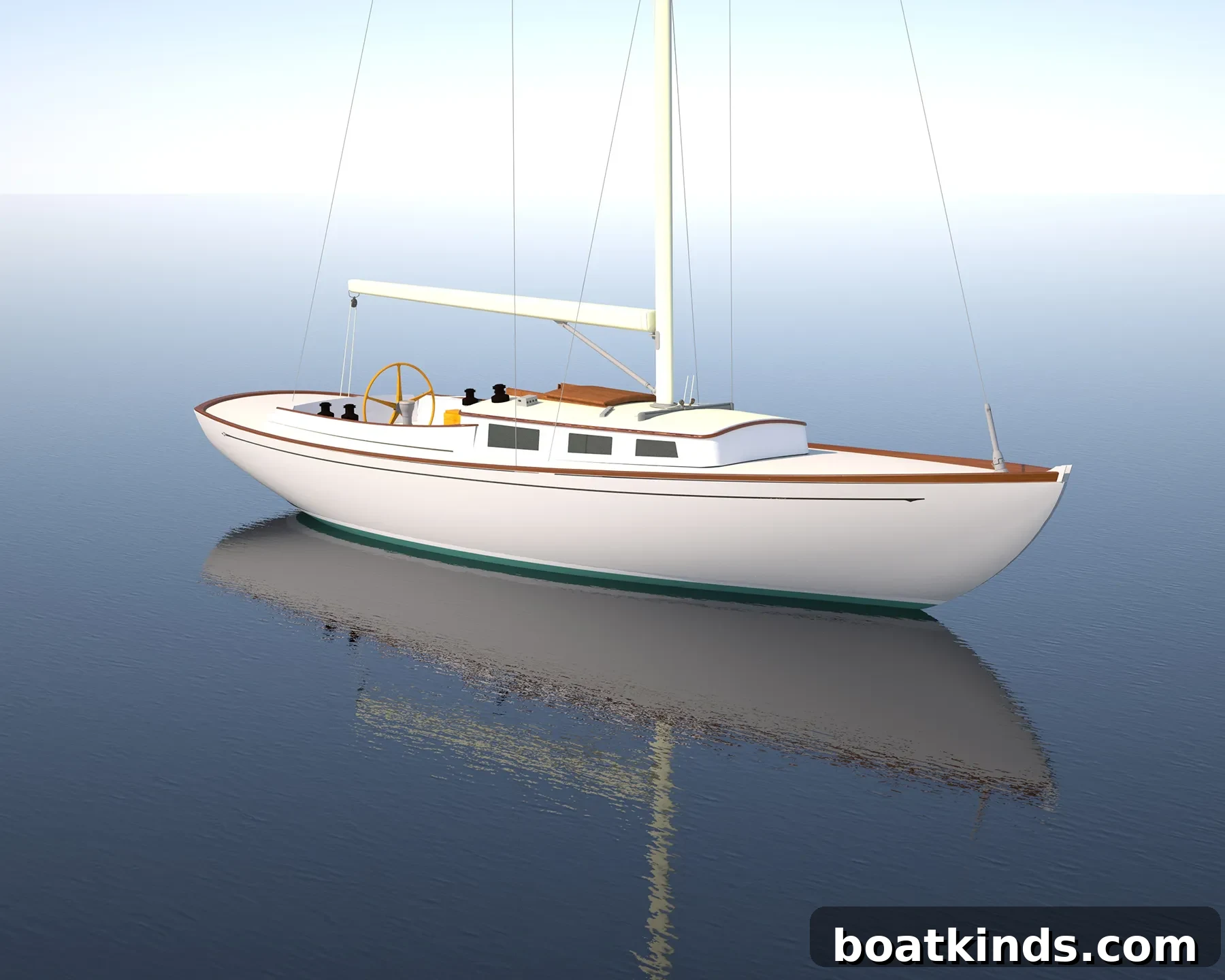
The LW38 is a shoal-draft daysailer/weekender designed for a client whose dock has limited depth at low tide. The brief called for a classic look—long overhangs, a graceful sheer, and traditional joinery in the deck and cockpit—while delivering modern performance for comfortable cruising and daysailing. We opted for a 3.5-foot draft to maximize interior volume and comfort while allowing the boat to sit on the owner’s dock at low water.
The LW38 uses a full, long, shallow fin keel—a high-aspect fin bolted to the hull—to improve upwind performance while keeping draft minimal. That configuration also allowed us to house the centerboard trunk within the ballast keel so it doesn’t intrude into the cabin volume. The result is a classic-looking boat with contemporary handling and cruising capability.
Your job requires designing both powerboats and sailboats. Can you tell me about a powerboat you enjoyed designing?
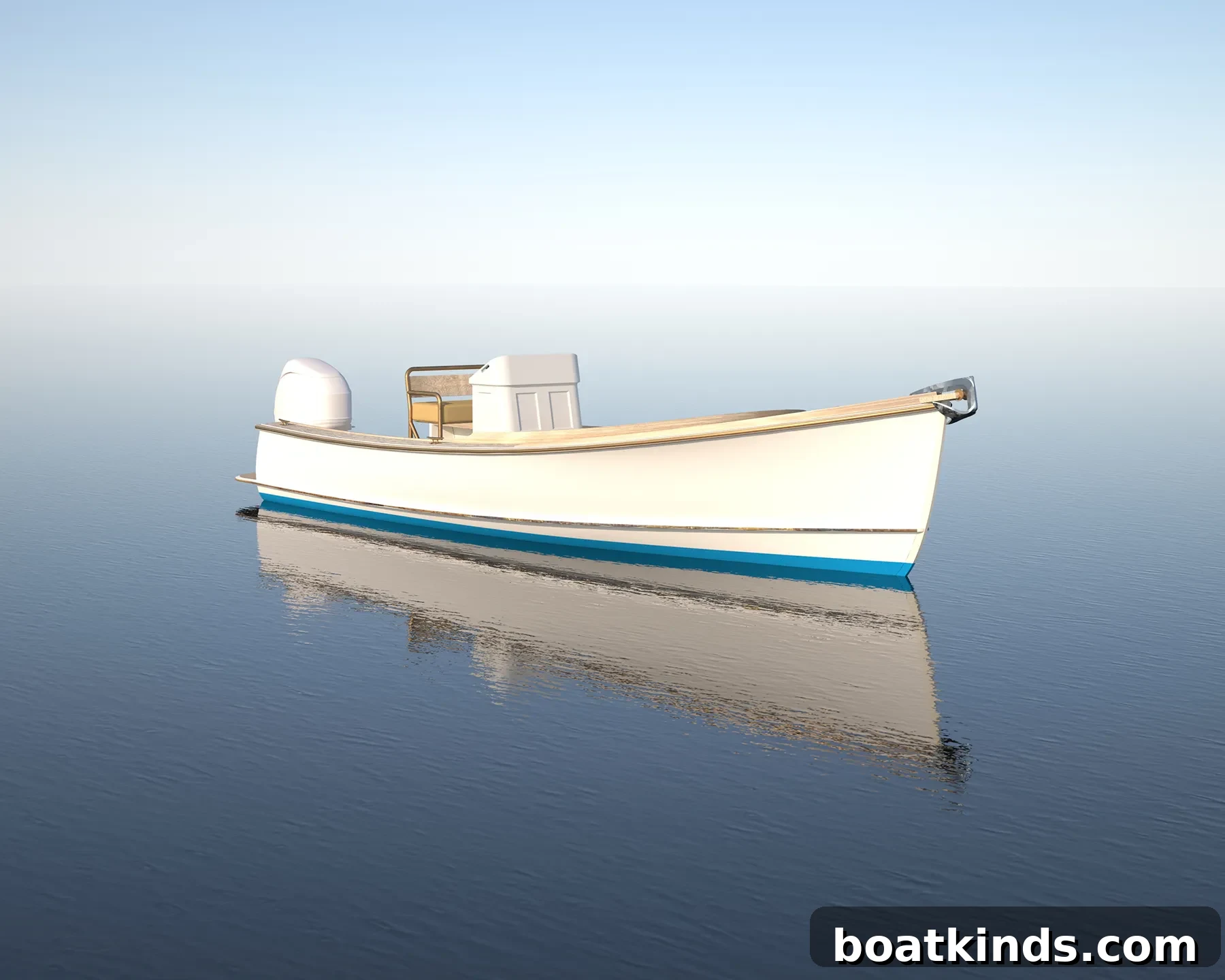
Eloise is a 26-foot length-on-deck center console fitted with a Yamaha 300-hp outboard that I designed four or five years ago. The owners had extensive yachting experience and wanted a bespoke boat with a high level of finish but lower ongoing maintenance than a varnished wooden yacht. They planned to use the boat primarily in the Bahamas and needed durable finishes that wouldn’t require annual yard work.
To meet that brief we used two-part paint throughout with selective bare teak trim to retain the feel of a custom wooden yacht without the upkeep of varnish. The hull draws on round-bilge designs—similar in spirit to Albury Brothers runabouts we’d built—married to the classic Maine Downeast lobster skiff tradition. The hull balances efficient performance across speeds and economical construction via cold-molded techniques. An open transom was included to suit life and boarding in the Bahamas. Eloise blends the elegance of wooden yachts with practical, low-maintenance materials suited to tropical use.
Do you have a favorite boat that you have designed?
I tend to look forward to the next design more than dwell on favorites. The process of creating and refining keeps me motivated—there’s always something new to explore. That said, the three boats currently in the shop are projects I’m particularly proud of; they represent well-considered compromises between tradition, performance, and buildability.
What would you say to someone interested in becoming a yacht designer?
Yacht design is incredibly rewarding. It blends creative problem-solving with hands-on craft, and for me it has fused work and personal passion—my office is full of boats and the things that inspire me on holiday. The work can be challenging, but it’s satisfying to wake up excited about new commissions and to continually refine ideas. For anyone drawn to boats, beautiful craftsmanship, and design thinking, it’s a fulfilling career path.
This article was originally published in the August 2022 issue.