
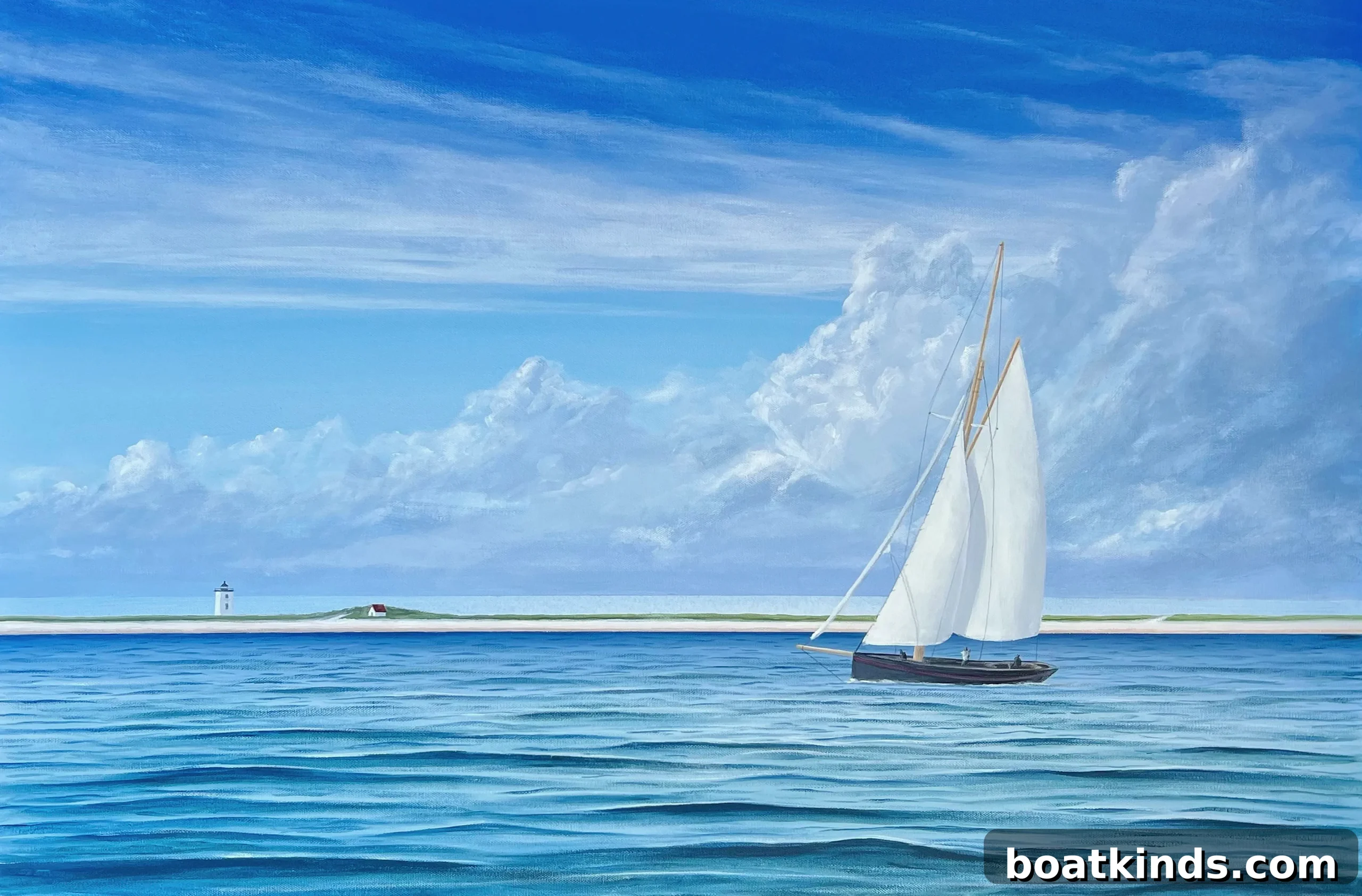
In Derek Macara’s painting titled Bloodhound, the cutter glides across the clear blue waters off Provincetown, Massachusetts. The composition places Long Point Lighthouse and a small, solitary beach cottage on an otherwise empty shoreline, evoking the quiet charm of Cape Cod’s outer coast. Broad, confidently applied strokes form cirrus and cumulus clouds against a bright sky, suggesting a gentle breeze and ideal sailing conditions that invite the viewer to imagine the sound of waves and wind in the rigging.
The vessel depicted has a layered history. Originally built in 1874 for the Scottish Marquess of Ailsa, the original Bloodhound was a 70-foot cutter designed by William Fife II. The cutter shown in Macara’s work is a modern replica constructed in the 1990s in Del Rey, California. Once a racing yacht, Bloodhound now serves primarily as a cruising vessel: she features a 22-foot retractable bowsprit and carries approximately 3,500 square feet of sail. Based in Provincetown and owned by Hindu Charters, she regularly operates short Cape cruises and can carry up to 34 passengers, making her a familiar and much-loved sight in local waters.
Macara, who was raised in Provincetown and comes from several generations of local families, draws deeply from that maritime environment. At 36, he grew up sailing and absorbed the region’s long tradition of seafaring and artistic practice. He studied at the Cape Cod School of Art in Provincetown, and the landscape and light of the Cape have provided constant inspiration. Though surrounded daily by scenes of coastline, boats, and changing weather, Macara primarily works from photographs—many of them his own. He has photographed Bloodhound hundreds of times over the years, capturing the cutter under varied light and sea conditions so he can translate those moments into paint.
Macara’s approach is rooted in observation and memory. He often combines elements from multiple photos to build a single cohesive scene, arranging sky, water, and shoreline to achieve the mood he wants on the canvas. The bold cloud forms and the clear delineation of the hull in Bloodhound demonstrate a confident handling of brushwork and composition: the painting balances realism with a painterly energy that emphasizes atmosphere as much as detail.
Before he committed to painting full time, Macara worked on the water. He helped with a family-run dragger and worked as a scallop fisherman, raking the seabed for shellfish and spending long hours at sea. Those years gave him an intimate familiarity with vessels, rigging, and the way light plays across open water—knowledge that informs his art. Being part of an artist community in Provincetown also helped normalize the idea that painting could be a viable career. After turning to art professionally, he has continued to paint scenes of the coast, boats, and daily life by the sea.
Now painting full time for six years, Macara describes his situation with gratitude. “I feel really lucky that I can do something that I enjoy for a living,” he says. He plans to continue as long as possible, sustained by the endless visual material his home region provides and by the steady interest of collectors and local supporters.
Bloodhound, as an image, captures more than a single boat: it references a long maritime tradition, the interplay of past and present embodied by a historic hull recreated for modern use, and the relationship between a place and its artists. Long Point Lighthouse, the small cottage, and the spare shoreline act as quiet counterpoints to the cutter’s presence, grounding the scene in a specific coastal identity while allowing the viewer to focus on the light and movement that define the painting.
This article was originally published in the September 2023 issue.