Gar Wood and the Albany–New York Speed Run: The Story of Baby Gar IV and V
In the early decades of the 20th century, motorboat technology and public fascination with speed advanced together. American entrepreneur Garfield “Gar” Wood emerged as one of the sport’s most influential figures, staging headline-making runs that showed how far engineering and courage had come.
Rise of Motorboat Racing and Gar Wood’s Ambition
Motorboat racing first captured public attention in the early 1900s, with the inaugural race taking place in 1903. As engine technology improved, builders and pilots pushed hulls and propellers to higher speeds. Among competitors, Gar Wood became synonymous with ambition and daring. He was the first person to exceed 100 mph on water and held the world water speed record multiple times during his racing career. His achievements and public demonstrations helped shape the popular image of the speedboat as both a technological marvel and a symbol of modernity.
Following his early success on the race circuit, Wood turned his attention to manufacturing. In 1921 he began producing boats under the Gar Wood name through Garwood Industries. The company’s craft combined innovative design with powerful engines, and Wood frequently staged public stunts to demonstrate the capabilities of his boats and to promote the brand.
The Albany to New York City Run, May 1925
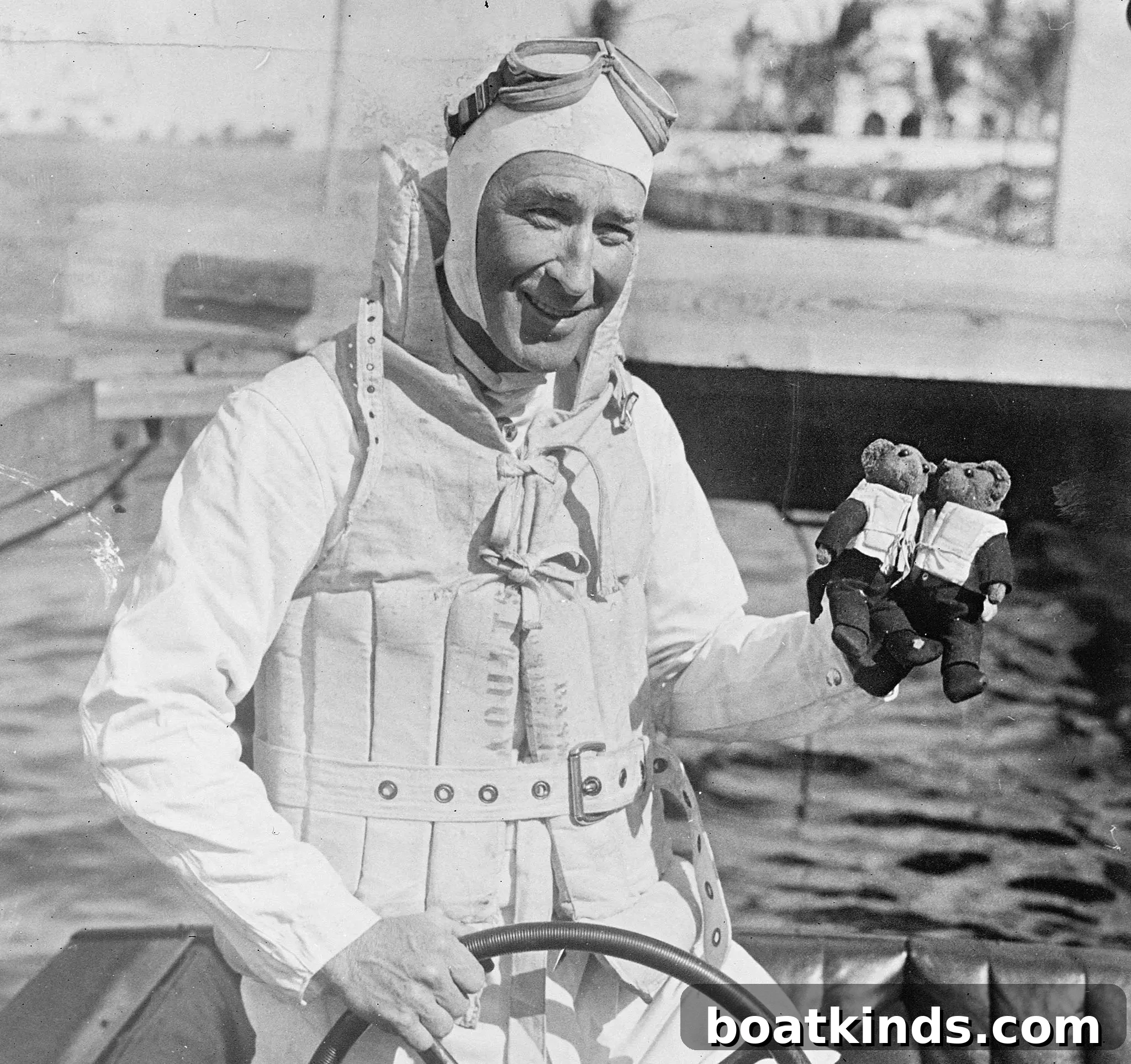
One of Wood’s most dramatic demonstrations occurred in May 1925, when he challenged the speed of the Twentieth Century Limited, then the fastest train in the United States. The image above shows Wood aboard Baby Gar IV, a 33-foot runabout with a 7-foot, 6-inch beam powered by a Liberty V-12 aircraft engine. Accompanying him in the photograph are Motor Boating editor Charles F. Chapman, mechanic Orlin Johnson, and R. R. Batson.
The event was more a public time trial than a head-to-head contest with the train—rail authorities did not alter the train’s scheduled speed. Nonetheless, the challenge captured national attention and presented a vivid contrast between water and rail transportation. Earlier attempts on the same course had already shown what the new generation of powerboats could do. Six days before Wood’s run, R. F. Hoyt had piloted Teaser, a 40-foot Sweep Stakes Runabout designed by George Crouch and powered by a 600-hp Wright-Typhoon engine, completing the trip up the Hudson in 2 hours and 40 minutes. That time beat the train’s 3 hours and 13 minutes.
A Public Spectacle with High Drama
Wood arrived in Albany shortly after Hoyt’s victory, reportedly offering to bet Hoyt $25,000—or “any other sporty amount”—that he could best Teaser over the same course. Hoyt refused the wager. Undeterred, Wood entered both Baby Gar IV and Baby Gar V in a highly publicized run that drew thousands of spectators. Airplanes followed the boats and helped broadcast the spectacle, underscoring the modernity and theatricality of the occasion.
As the run progressed, Baby Gar V initially appeared to have the advantage and pulled ahead by the time the race reached Hudson, New York. Wood signaled his brother George, who was captaining Baby Gar V, to slow down; the crews were swapped so Gar Wood could be aboard the leading boat. Near Poughkeepsie, however, Baby Gar V experienced mechanical trouble when a valve tappet spring broke and the engine began missing on a cylinder. After another crew swap, Baby Gar V was forced to withdraw from the run.
Outcome and Legacy
Despite the crew changes and the mechanical setback for Baby Gar V, Baby Gar IV completed the Albany–New York run in 2 hours and 58 minutes, averaging 46.5 mph and beating the Twentieth Century Limited’s scheduled time. While Wood did not surpass Teaser’s faster 2 hours and 40 minutes, his run nevertheless made a powerful public statement about the speed, endurance, and growing dependability of motorboats.
The event helped cement Gar Wood’s reputation as a pioneer of high-speed boating and as a showman who understood the promotional value of bold feats. Today Gar Wood boats are among the most sought-after classic craft, prized for their design, historical importance, and the engineering innovations they represented. The Baby Gar series, especially Baby Gar IV, remains one of the best-known models associated with Wood’s name and legacy.