
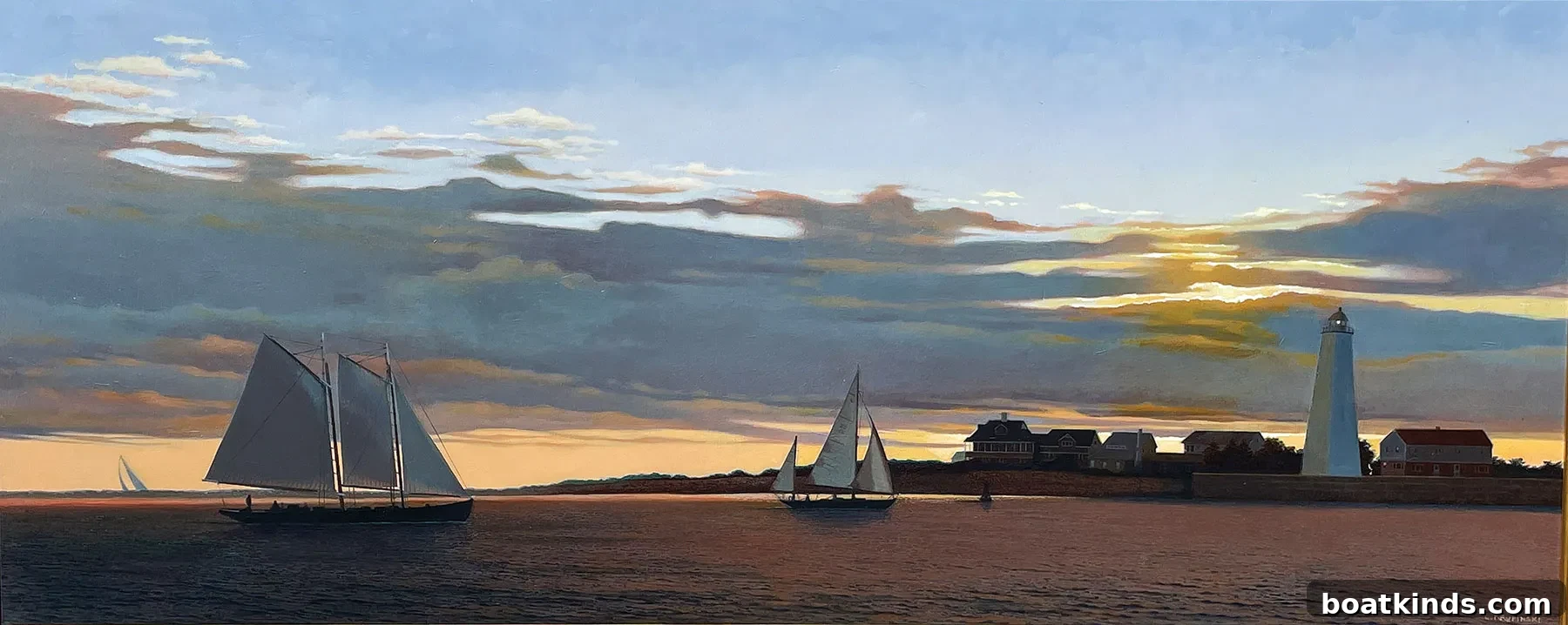
Saybrook Point Lighthouse: A Sail at Sunset Captured by Loretta Krupinski Bailey
In the painting titled “Saybrook Point Lighthouse,” maritime artist Loretta Krupinski Bailey captures a tranquil moment as the sun sinks below the horizon. A schooner and a yawl sail through the last warm light of the day across Long Island Sound, approaching the lighthouse that marks Lynde Point in Saybrook, Connecticut. This scene is not imagined—it is a faithful recreation of the view Bailey experienced while sailing from Mystic Seaport to Essex aboard the Sylvina W. Beal, known as the oldest surviving auxiliary knockabout fishing schooner in North America.
Bailey’s work often begins with photography taken while she is at sea. On that particular evening she carried her camera aboard the schooner and photographed the approach to the lighthouse during the glow of sunset. Those photographs became the reference for the painting, enabling her to translate fleeting coastal light and the interplay of sails and water into a finished canvas.
Born and raised on Long Island, New York, Bailey has always lived with the water as a backdrop. Her earliest boating memories go back to time spent on her father’s Lyman runabout. Later, after moving to Old Lyme, Connecticut, she and her husband kept a catboat and routinely navigated the Sound, often passing the lighthouse that appears in this work. Those years of hands-on sailing informed her eye for line, rigging and the small but telling signs of wind and tide—details that add authenticity to her paintings.
After two decades in Old Lyme, Bailey relocated to Mid-Coast Maine, where the maritime landscape and working waterfronts offered new inspiration. The coast there is populated with lobster boats and other working craft rather than the classic wooden yachts she had painted earlier, prompting her to study local maritime history. Working from archival black-and-white images at institutions such as the Maine Maritime Museum and the Penobscot Marine Museum, she began reconstructing historical scenes in color. Her research and paintings eventually contributed to the book Looking Astern: An Artist’s View of Maine’s Historic Working Waterfronts, which presents a visual record of the region’s seafaring past.
When Bailey creates historical compositions, her direct sailing experience becomes an important resource. Early photographs and archival material often lack the kind of detail needed to depict rigging, the motion of water, or the way sails respond to wind. Her time on deck allows her to infer those missing elements accurately—how a sheet runs, how a hull trims, how light sculpts a wake—so she can restore depth and realism to images that were once only monochrome records. The result is history rendered not just in black and white, but in vivid, lived-in color.
Though Bailey and her husband no longer own the catboat that was once central to their days on the Sound, the sea remains integral to her life and work. She lives on a saltwater cove, where lighthouses, working boats and changing light continue to draw her attention and inform her paintings. Her ongoing fascination with coastal scenes, traditional vessels and maritime heritage keeps her connected to places like Saybrook Point and the broader seafaring communities of New England and Maine.
The painting of Saybrook Point Lighthouse is a good example of how the artist blends memory, direct observation and photographic reference to create evocative, accurate maritime scenes. Viewers familiar with Long Island Sound will recognize the familiar rhythms of sail and tide; those new to the subject can still appreciate the composition’s warm light, authentic details and the calm narrative of a day closing on the water.
This article was originally published in the January 2022 issue.