
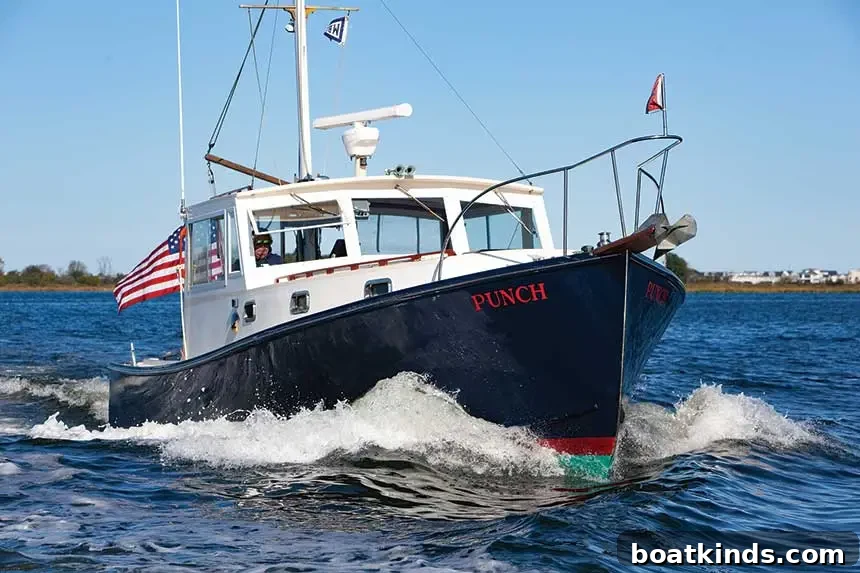
Lance Cunningham’s connection to boats began in childhood. Raised in Rumson, New Jersey, near the Navesink River, he remembers being dropped off at church for kindergarten and slipping away to the water instead. Those early days of skipping school to spend time on the river led naturally to summers working at the local boatyard—“Paul’s Boats”—where for a quarter he’d bail out small craft and do odd jobs. That hands-on start shaped a lifetime centered on boats and the sea.
Today Cunningham owns and operates the Carriage House Marina on the Shrewsbury River in Sea Bright, New Jersey, a business he has run since 1985. Over the years he’s collected an eclectic fleet: a modified Roberts 34 he christened Windy II, a cabin-equipped Chesapeake Bay oyster boat that became a favored cocktail cruiser, and a Bertram 28 fitted with heavy-duty commercial Ford engines originally used for commuter runs into Manhattan. Each boat has a story, but none match his current pride—the 1997 Stanley 36.
The Stanley 36 is a classic Downeast-style lobster yacht designed by Lyford Stanley and built by the John Williams Boat Company in Maine. Cunningham first learned of the model through the Maine Boatbuilders Show in Portland. After talking with Jock Williams at the Williams booth and following several months of negotiations, he found a suitable Stanley 36 nearby and purchased it for roughly $130,000. That mid-2000s acquisition has proved to be an ideal match for the varied conditions off New Jersey’s coast.
For Cunningham the Stanley’s blend of form and function is what makes it special. The boat’s traditional Downeast lines—high bow, sweeping sheer and a trunk cabin—are not merely attractive; they deliver seaworthiness suited to local cruising. “We have access to a lot of boating here,” he says. “We can go around Sandy Hook to New York, and that’s a wide-open inlet. It’s a very seaworthy boat. I’ve had it out in the ocean, a lot.” The Stanley 36 is comfortable enough for day cruises and overnight trips yet capable of handling open-water passages when required.
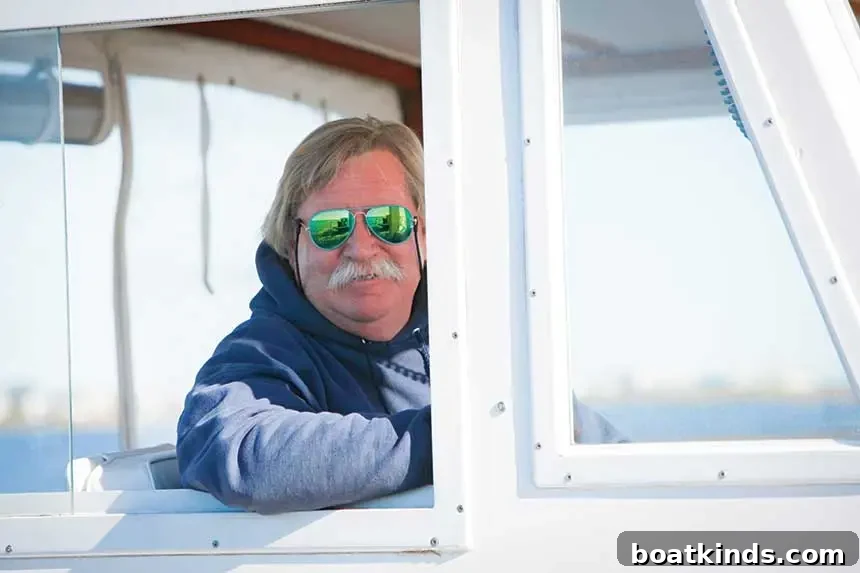
Cunningham praises the boat’s roomy cockpit and comfortable cabin layout. He’s hosted lively gatherings—“I’ve had a dozen people dancing in the cockpit”—and undertaken longer cruises with friends, including runs up the Hudson River and overnight stays ashore. The Stanley 36’s versatility also serves practical pursuits: Cunningham regularly runs local rivers to fish for striped bass when the season is right.
The Stanley 36 was developed for Maine’s coastal fisheries, yet it adapts well to the Jersey shore. Its semi-custom construction allows owners to specify interior arrangements; on Cunningham’s boat the layout includes a generous V-berth with pilot berths above, a compact but functional galley and a full enclosed head. The interior can comfortably accommodate small groups—Cunningham recalls a four-person trip to Florida that worked out without fuss—while amenities such as a portable butane burner make simple cooking easy aboard.
Power on Cunningham’s 23-year-old Stanley comes from the original single 370-hp Yanmar diesel, which has about 2,500 hours on the clock. He reports the engine runs reliably, and at a cruising speed of roughly 17 to 18 knots the boat consumes about 8 gallons per hour. That balance of range, efficiency and sturdiness reinforces why he values this Downeast design.
WALKTHROUGH
The Maine-built Stanley 36 rides on a traditional semi-displacement fiberglass hull with a keel and a protected propeller arrangement. Visually, the boat retains the character of a Maine lobster boat, featuring a high bow, sweeping sheer and an upright wheelhouse with a trunk cabin. The open wheelhouse provides more than 6 feet 6 inches of headroom; the helm sits to starboard behind a three-panel windshield with large side windows that deliver excellent sightlines. Owners can choose side curtains and an aft enclosure for added protection.
Inside, the Stanley 36 can be tailored to owner preferences. Standard configurations often include a forward V-berth, an amidships salon with a folding dining table and opposing settees, plus additional sleeping options such as pilot berths and a pilothouse pull-out berth. Galley choices range from a simple icebox and portable cooking solutions to a three-burner propane stove with oven. The enclosed head offers a marine toilet, sink and optional shower, supported by a 25-gallon waste tank and a macerator if fitted. High-quality joinery—mahogany cockpit steps and trim, Sitka spruce cabin ceilings and teak-and-holly soles—underscores the boat’s attention to traditional craftsmanship.
Beyond performance and utility, Cunningham sums up what keeps him attached to the Stanley 36: its timeless Downeast appearance. “A boat’s worthless if it’s not pretty,” he says, “and this is the prettiest Downeast on the water.” The combination of classic styling, seaworthy design and comfortable accommodations makes the Stanley 36 a fitting choice for someone who grew up on the water and has spent a life maintaining and enjoying boats.
This article originally appeared in the May 2020 issue.