
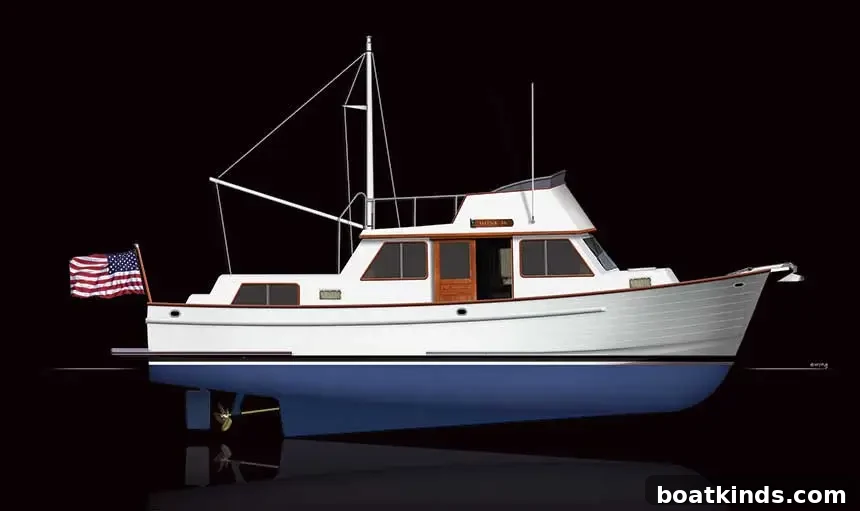
Monk 36: A Cruiser’s Cruiser That Defined the Recreational Trawler
The Monk 36 earned a reputation as a true “cruiser’s cruiser” during the 1980s, helping to transform the recreational trawler from a niche concept into one of America’s most popular boat types. With a classic profile and rugged construction, the Monk 36 offered comfortable liveaboard accommodations, sensible systems, and seakindly handling that appealed to long-range cruisers and coastal voyagers alike.
Design and Hull Characteristics
Measuring just under 40 feet overall with a 13-foot beam, the Monk 36 was built on a semi-displacement hull paired with a full keel. The design prioritized protection and seakeeping: the propeller and rudder were well-protected, the bow was tall and flared to deflect spray, and the hull featured high freeboard and molded-in spray rails. Those features combined to give the Monk 36 steady, predictable handling in a variety of sea conditions, which is one reason owners praised its long-range cruising capability.
Accommodation and Layout
The interior of the Monk 36 was arranged for comfortable cruising. The layout included a master stateroom aft and a V-berth forward, each served by its own head compartment for privacy and convenience. The salon showcased teak furniture and trim, and teak-and-holly soles were used throughout, lending a warm, traditional look. An L-shaped galley featured a refrigerator/freezer arranged much like a small home unit, plus a three-burner stove and an oven—amenities that made extended cruising and provisioning comfortable.
On deck, the Monk 36 offered practical helm arrangements. The lower helm area had a sliding door for easy access and shelter, while a secondary helm station on the flybridge provided an elevated view for close-quarter maneuvering or long passages. Early examples of the model even featured a bathtub in the interior layout, reflecting the boat’s emphasis on comfortable liveaboard accommodations.
Performance and Power
Early Monk 36s were commonly fitted with a single 120- to 135-horsepower diesel engine. Those installations typically produced an economical cruising pace of roughly 7 knots where fuel consumption could be as low as about 5 gallons per hour—an attractive figure for owners focused on range and economy. Later boats were offered with larger power, including a 220-horsepower Cummins diesel that increased comfortable cruise speed into the 9–10 knot range, appealing to those who wanted quicker passages without sacrificing the vessel’s trawler-style seakeeping.
Production History and Legacy
The Monk 36 was first built in Taiwan beginning in 1982, and production later moved to Nova Scotia in 1992. The model remained in production through 2007, with more than 250 hulls delivered to owners during its production run. Across those years the Monk 36 established itself as a practical, well-built choice for cruisers who valued dependable construction, thoughtful layout, and efficient cruising characteristics.
The Designer: Ed Monk Jr.
Designer Ed Monk Jr. carried on a family legacy of naval architecture established by his father, Ed Monk Sr., a noted shipwright and designer. Working together for many years on both recreational and commercial craft, the Monks built a reputation for designing rugged, dependable boats. Ed Monk Jr. in particular became known for hull forms that move smoothly through the water and for practical, seaworthy layouts, earning praise from delivery captains and owners who rely on his designs for serious cruising.
As one veteran Pacific Northwest delivery captain described it: “Ed Monk Jr. designs boats that seem to flow easily through the water. When it comes to performance and seakeeping, his designs are my gold standard.”
This article originally appeared in the April 2020 issue.