
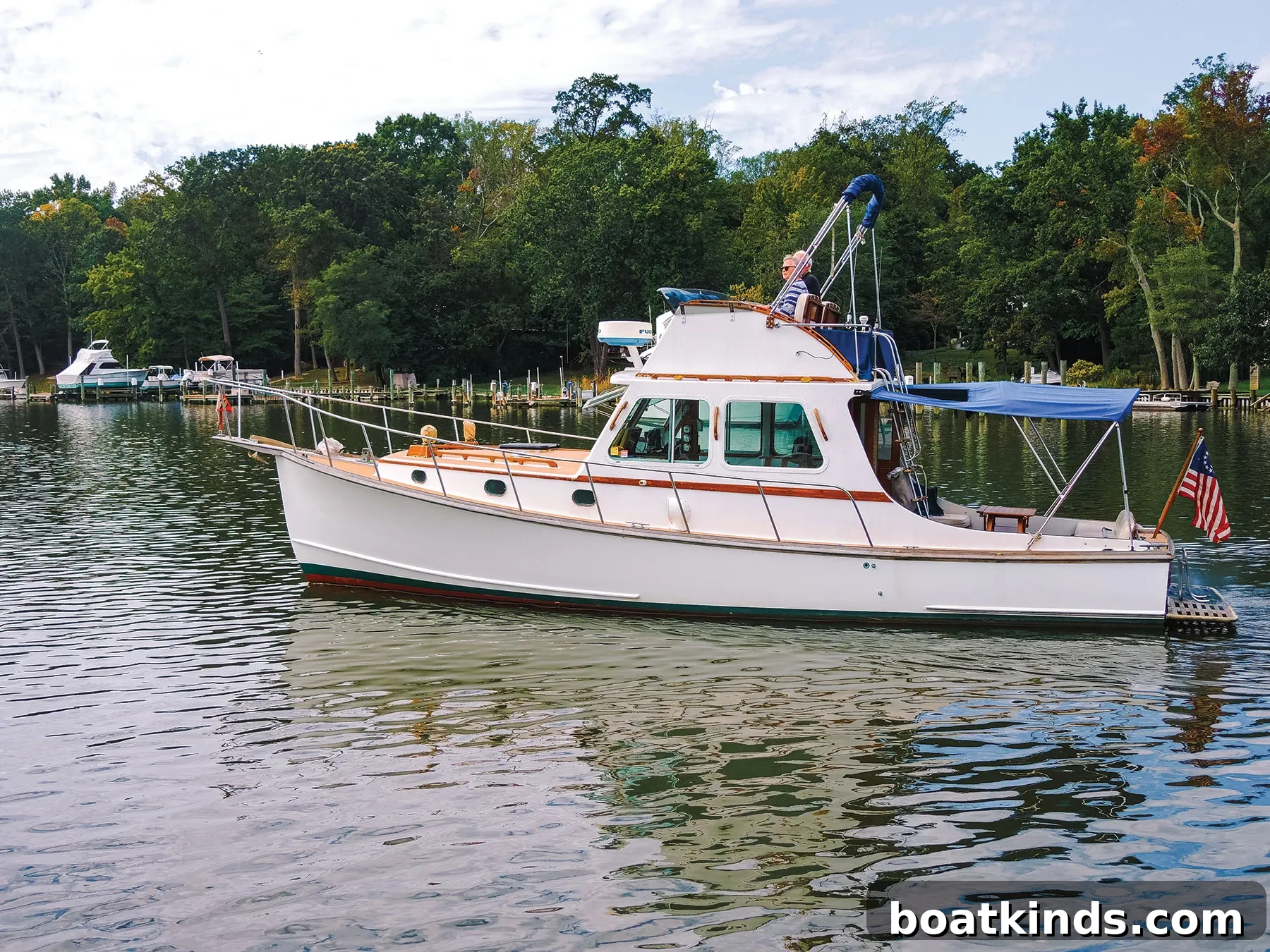
Tom and Carol Donlan discovered Spirit in 2005 after nearly three decades of shared time on the water. Spirit began life as a Ralph Stanley lobster-boat design, with a deck by Jarvis Newman of Southwest Harbor, Maine, and a pilothouse with a flybridge conceived by Lee S. Wilbur. Wilbur finished the vessel as a yacht in 1980, and Tom prefers to call her a Newman 32 to distinguish her from later versions of the design.
The Donlans’ relationship with boats began long before they found Spirit. They met in 1971 as journalists at the Bergen Record in Hackensack, New Jersey, and quickly found common ground in sailing. “Tom and I crewed on a Tartan 34 near Nyack, New York. That’s where our love of boating began,” Carol recalls. Eight weeks after they married, they bought their first boat, a Sandy Douglas–designed Highlander racing dinghy.
Over the years the couple continued racing and upgrading their boats. They sailed a Comet on the Delaware River in Philadelphia, moved up to Lightnings, then to a J-24 after relocating to Washington, D.C., and ultimately raced a J-30 for more than a decade. Summers spent chartering in Maine gave them exposure to Downeast workboat–inspired designs finished as weekend cruisers—an aesthetic that clearly influenced their appreciation for Spirit.
Although Spirit was built in Maine in 1980 and likely first used on Narragansett Bay, she later moved to the Chesapeake Bay. Tom and Carol found her in a Denton, Maryland, boatyard. “When I stepped aboard and into the pilothouse, I knew it was the one,” Carol says. “I could see myself bringing coffee up to the bridge and sharing it with Tom.” The couple bought Spirit after looking at only one other boat—much to the broker’s surprise.
Tom admits the boat isn’t perfect, but he finds her beautiful and consistently attracts attention. “At virtually every marina we’ve visited, people on the dock stop and remark how attractive the design is,” he says. True to its lobster-boat roots, Spirit is powered by a single diesel engine: a 300-hp, six-cylinder Yanmar, which replaced the original powerplant. The Donlans have logged close to 1,000 hours on the engine over 15 years, and it has held up well.
The couple tackled a few significant repairs early in their ownership. During preparation for an Imron coating, their yard found small areas of water intrusion that required attention. Later, leaking windows caused extensive damage to the pilothouse walls, which were replaced by a yard on Virginia’s Northern Neck. “There’s always something to work on,” Tom admits, “but we enjoy visiting the boat regularly, having a bit of lunch and making it more shipshape.” Entertaining family and friends aboard—often including former crew from their J-30—is an important part of the lifestyle Spirit enables.
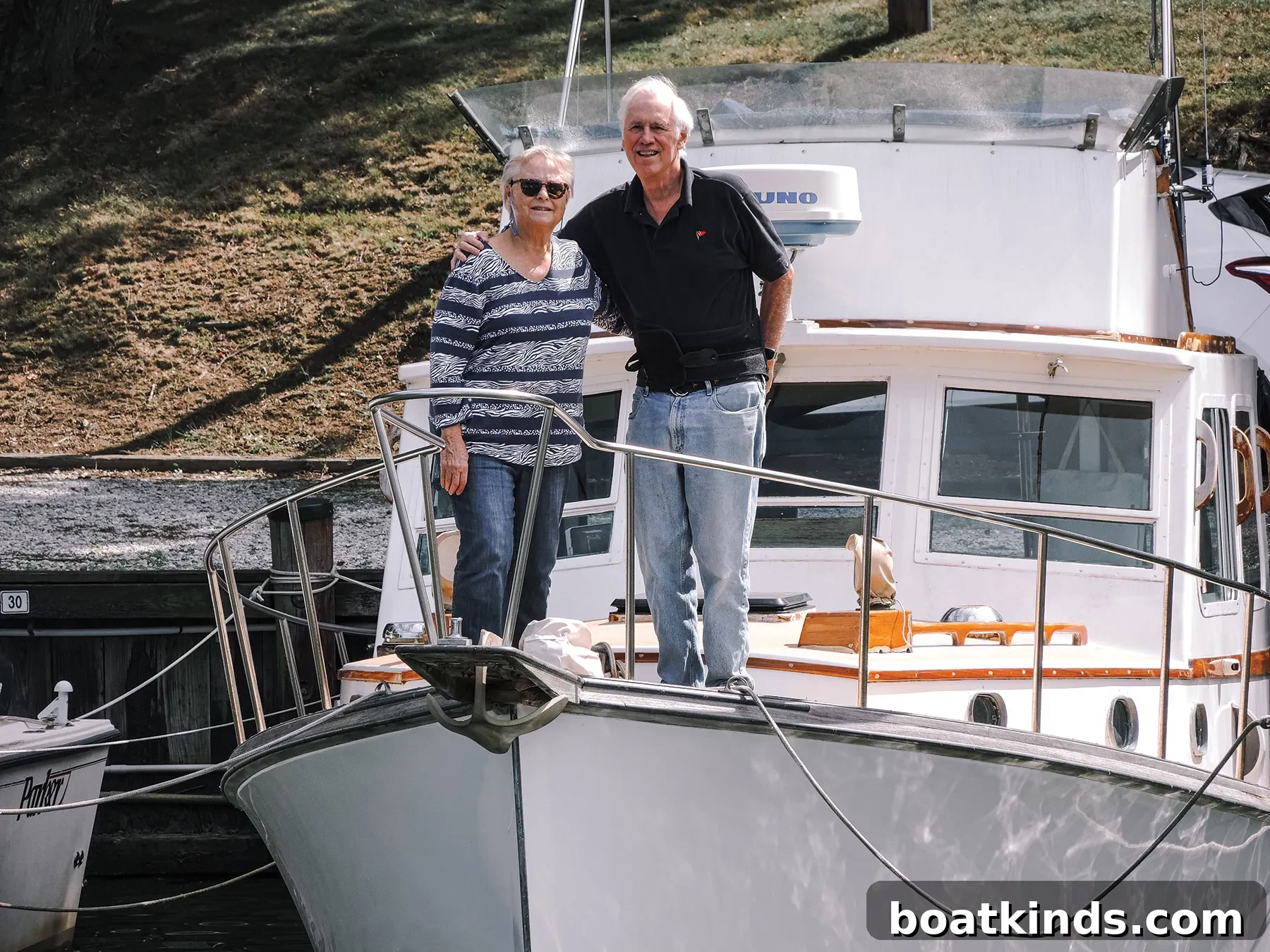
The Donlans cruise exclusively on the Chesapeake Bay, normally staying overnight in marinas and traveling most often as a pair with their Jack Russell Terrier. Their cruising range extends from Havre de Grace to the north down to the Rappahannock River to the south. Carol cites the Wye River for its beauty, St. Michaels for its shops and restaurants, and Oxford for its small-town charm—calling out local spots like Cutts and Case Shipyard, where historic photography adds to the appeal.
Tom also uses Spirit to serve on race committees for regional organizations including the Annapolis Yacht Club, the Severn Sailing Association and the Sailing Club of the Chesapeake. The couple keeps Spirit in the sheltered waters of Whitehall Creek, which Carol describes as a “magic place” with easy access to Annapolis, Kent Island, St. Michaels and Rock Hall.
WALKTHROUGH
Spirit’s hull lines and high bow reveal her design intent: a vessel meant to run dry and stay stable in open water. The gently raked stem flows into a keel section set well forward that continues full length to a point beneath the cockpit, protecting the running gear. Including anchor and swim platforms, the boat measures about 34 feet overall. Side decks between the foredeck and cockpit are somewhat narrow but feature secure handholds on the deckhouse and a stainless-steel bowrail for safety.
The cockpit is broad and deep enough to feel secure, yet shallow enough for landing a fish without difficulty. There is room for a portable table and folding chairs in addition to the bench seat across the transom, making the cockpit a comfortable social space.
A stainless-steel ladder with teak treads to port leads to the flybridge, where two fixed benches seat four people. The helm console is flat and functional: bow-thruster control and twin-lever binnacle sit to starboard, while the port side offers storage space for folded navigation charts.
Access to the cabin is through a door in the aft bulkhead. The pilothouse benefits from ample natural light and ventilation thanks to a combination of fixed and opening windows. A small dining table with fiddle rail sits to port, framed by built-in upholstered benches. The raised helm seat to starboard allows a clear view over the vertical stainless-steel destroyer wheel. Three steps down from the helm lead to a compact galley on the port side, equipped with an icebox, sink and dedicated storage for dinnerware; the private head is to starboard. Forward, a large V-berth provides comfortable overnight accommodations. Throughout both levels of the cabin, Herreshoff-style wood trim against white panels creates a classic, timeless interior.
Specifications:
LOA: 34’0”
Beam: 11’0”
Draft: 3’6”
Displ.: 16,000 lbs.
Power: (1) 300-hp Yanmar diesel
Fuel: 100 gals.
Water: 40 gals.
This article was originally published in the January 2023 issue.