
David Szewczul, 29, is a principal specialist in engineering and finance at Pratt & Whitney in Connecticut, where he manages budgets and financial planning for a team of jet propulsion engineers in both commercial and military aviation. Meticulous and hands-on with numbers, he is also an avid fisherman with a deep passion for tuna fishing. Szewczul (pronounced chef-shul) has chased bluefin off the coast, yellowfin and bigeye in offshore canyons, and has owned several center-console boats, most recently a 41-foot Sea Hunter. His admiration for traditional commercial tuna boats—like those featured on Wicked Tuna—prompted him to sell his production center console and commission a Downeaster-style build. After two years of research, design and disciplined budgeting, his 46-foot Mussel Ridge Disruptor launched last summer and quickly drew attention from tuna anglers up and down the coast.
Born to Boats
“I grew up on boats,” David says. Raised in Old Saybrook, Connecticut, he spent childhood days on the water fishing with his father, Dave. Their early boats were modest—a dinghy and then a 19-foot Aquasport that allowed longer trips into Long Island Sound and out toward Plum Gut near Orient Point. As their ambitions grew they moved to a 23-foot Triton, then a 27-foot Grady White, and ultimately to a triple-engine 40-foot Sea Hunter to reach the canyons off Montauk for yellowfin and bigeye.
Sea Hunters were uncommon in his region, but after seeing one in Montauk David visited the factory in Florida and commissioned a 40, then a 41. While he still appreciates center consoles, he often found himself fishing in conditions that favored a Downeast-style boat—especially when he wanted his father to remain comfortable on longer trips instead of battling waves in an open boat.
The Search Begins
As David considered a move to a cabin-equipped Downeaster, he was influenced by friends who fish commercially on Maine-built boats such as BHM, Northern Bay and Wesmac. He grew to prefer the cruising pace and sociable lifestyle of a Downeaster—spending more time with friends at 14 knots, protected from the elements, and being able to stay offshore for several days.
Cost and efficiency also mattered. Twin-diesel sportfishermen burn more fuel and require greater maintenance than a single-diesel Downeaster. Maine-built Downeasters are known for longevity and straightforward upkeep, factors that appealed to David as he planned a boat he intended to keep for many years.
David visited several Maine builders and learned a variety of production models: some firms deliver finished boats, others supply hull-and-deck shells that owners must have fitted elsewhere. He also discovered long lead times—many builders were two or three years out. Ultimately he learned about a Mussel Ridge bare hull produced by Hutchinson Composites in Clinton, Maine.
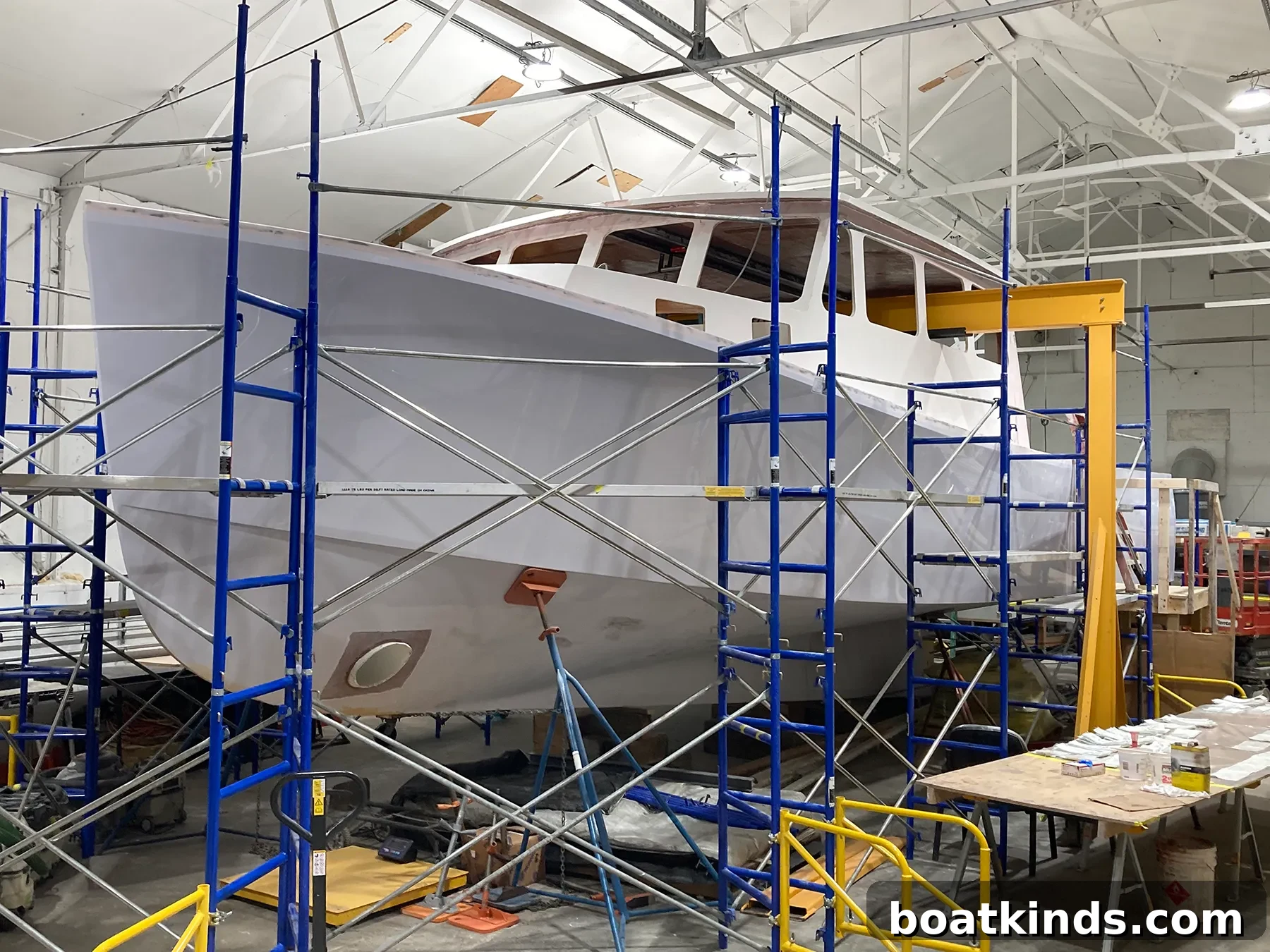
Buying a Mussel Ridge shell required selecting an approved builder to complete the fit-out. David chose Newport Yacht Builders (NYB) in Newport, Rhode Island, near his home in Old Saybrook. NYB had recently finished a Mussel Ridge 54 and agreed to take on a 46-foot hull customized for serious tuna fishing. David put down a deposit and began planning with NYB’s Jim Thompson, Ezra Smith and Ashley Reville Hill.
Birth of a Boat
The project used advanced digital tools from the outset. Before the hull was built, Thompson traveled to Maine and scanned a completed 46-foot hull using a Leica RTC360 industrial laser scanner, capturing millions of data points. Back at NYB, marine architect Ezra Smith imported that data into Rhino 3D software to refine the design. David worked closely with Smith, electrical/electronics designer Jon Aruda and systems engineer Ransom Moorse, coordinating countless meetings—both in person and by Zoom—to finalize systems, layout and equipment.
NYB’s advanced CAD/CAM workflows allowed them to build interior components outside the hull with exceptional precision. Stringers, bulkheads, interior panels and decks were completed and staged for installation by the time Hutchinson delivered the hull and deckhouse to Newport. That front-loaded planning and pre-assembly helped NYB complete the Disruptor in just over a year once the hull arrived.
David’s Downeaster
The original Downeaster design evolved from Maine lobster boats, prized for classic lines, seakeeping and simple, durable layouts. Their narrow entry, soft chines and wider aft sections provide a smooth ride in a head sea, stable tracking in following seas and economical operation—qualities David wanted in his Mussel Ridge.
The Disruptor is a modern interpretation of that classic Downeaster. It combines rugged commercial fishing capability with yacht-quality fit and finish and comfortable accommodations for multi-day trips. Power comes from a single 1,000-hp Scania DI16-007M diesel mated to a Twin Disc transmission at 2:1, turning a Veem Star 36-inch, five-bladed prop. That package delivers a top speed of 21.2 knots and a cruise speed of 14.5 knots at about 23 gallons per hour.
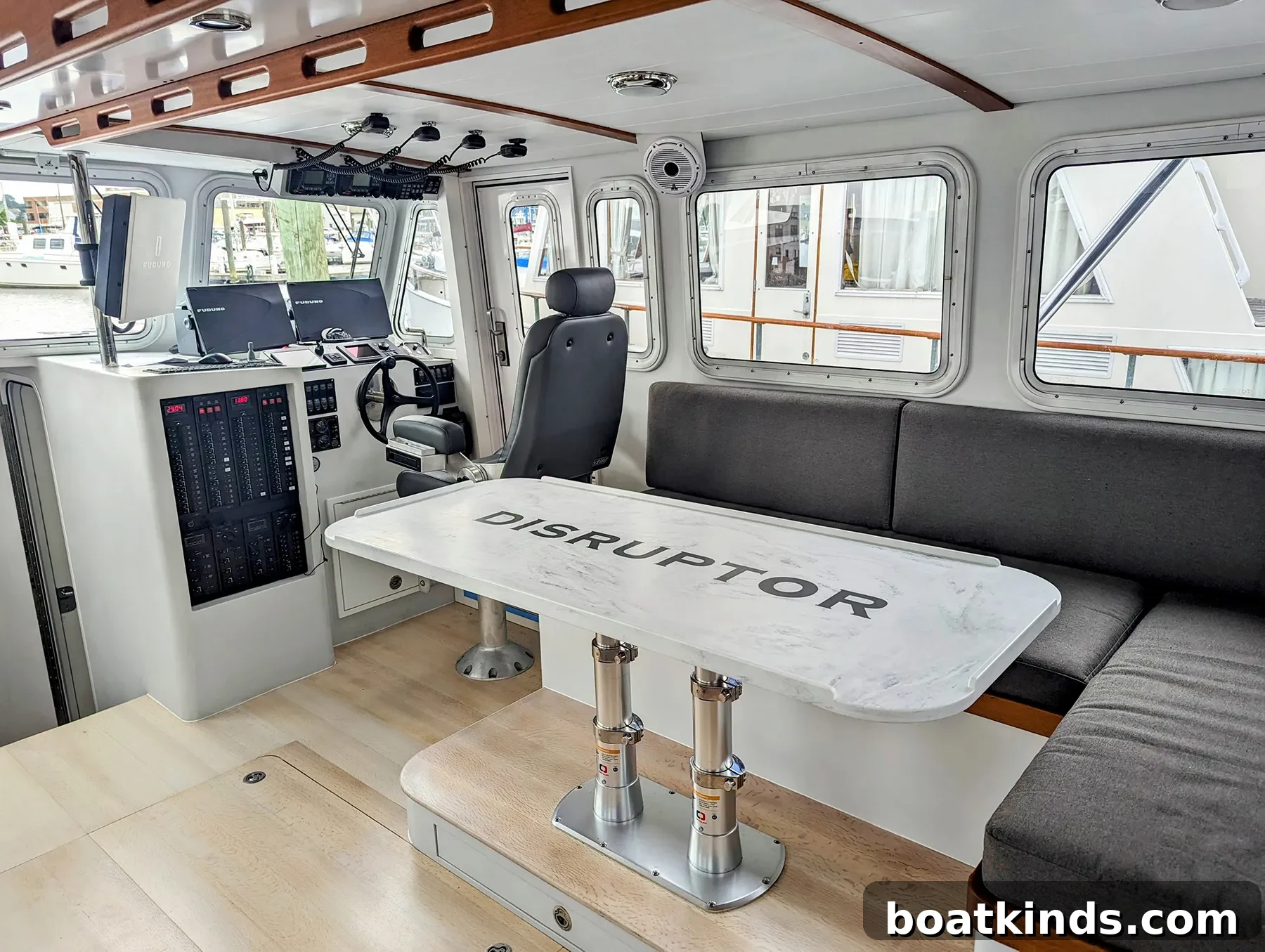
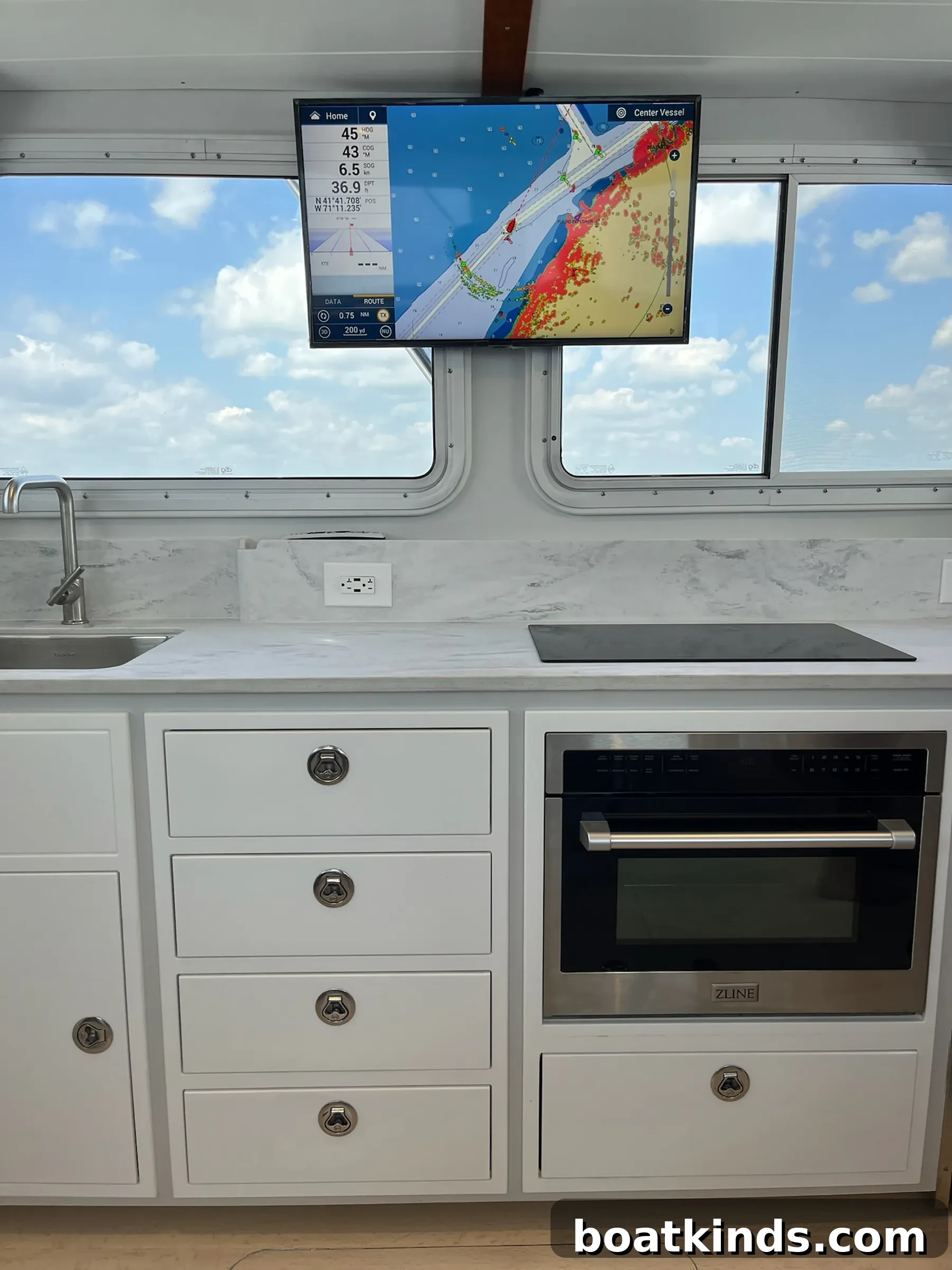
Three helm stations let David operate the boat from the cabin, an aft bulkhead station or a transom-mounted drop-down helm—useful when fighting giant bluefin. The main cabin helm is fitted with a Stidd captain’s chair, Furuno electronics, two multifunction displays and an MU19HD monitor linked to a concealed computer running TimeZero navigation and fishing software.
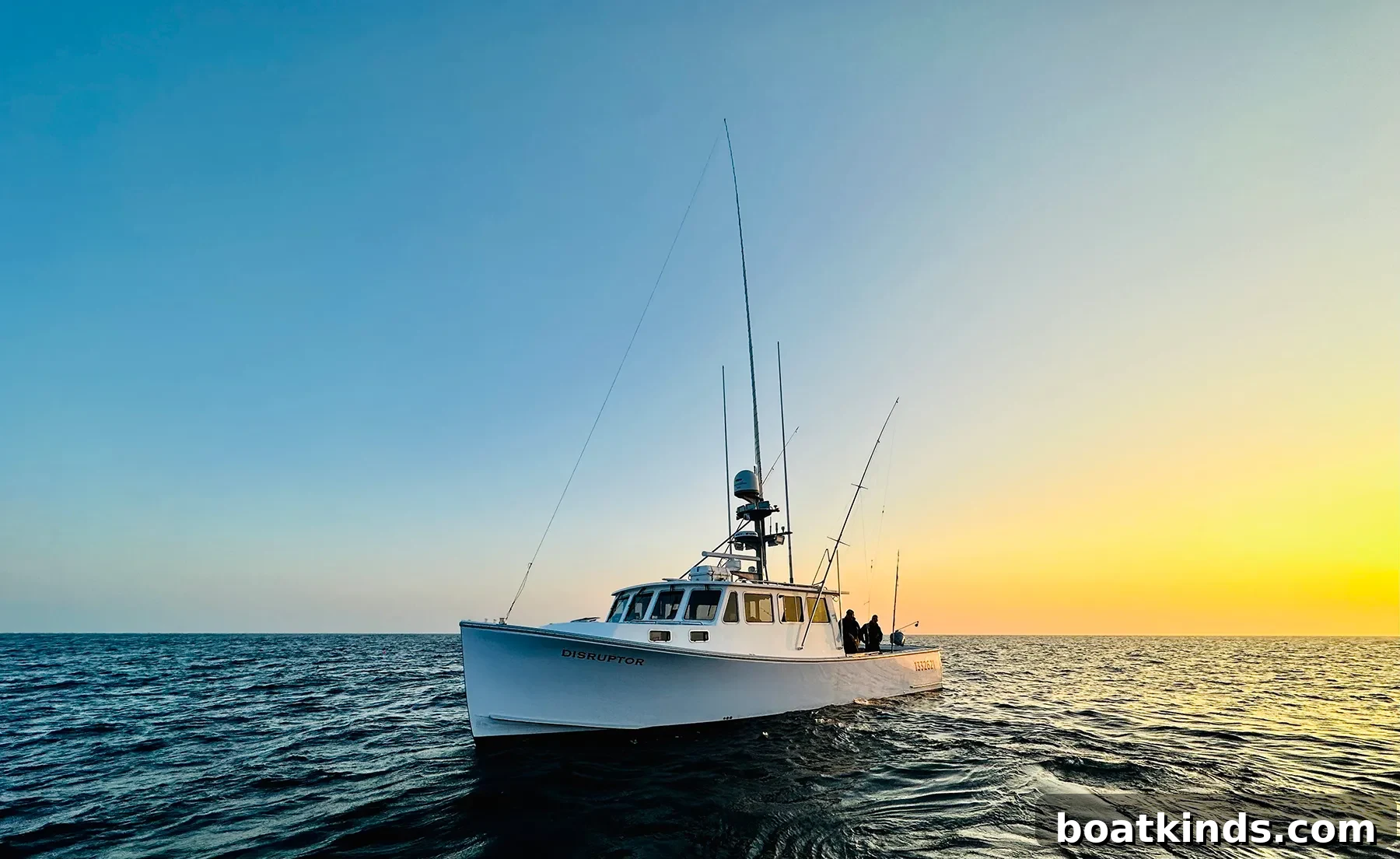
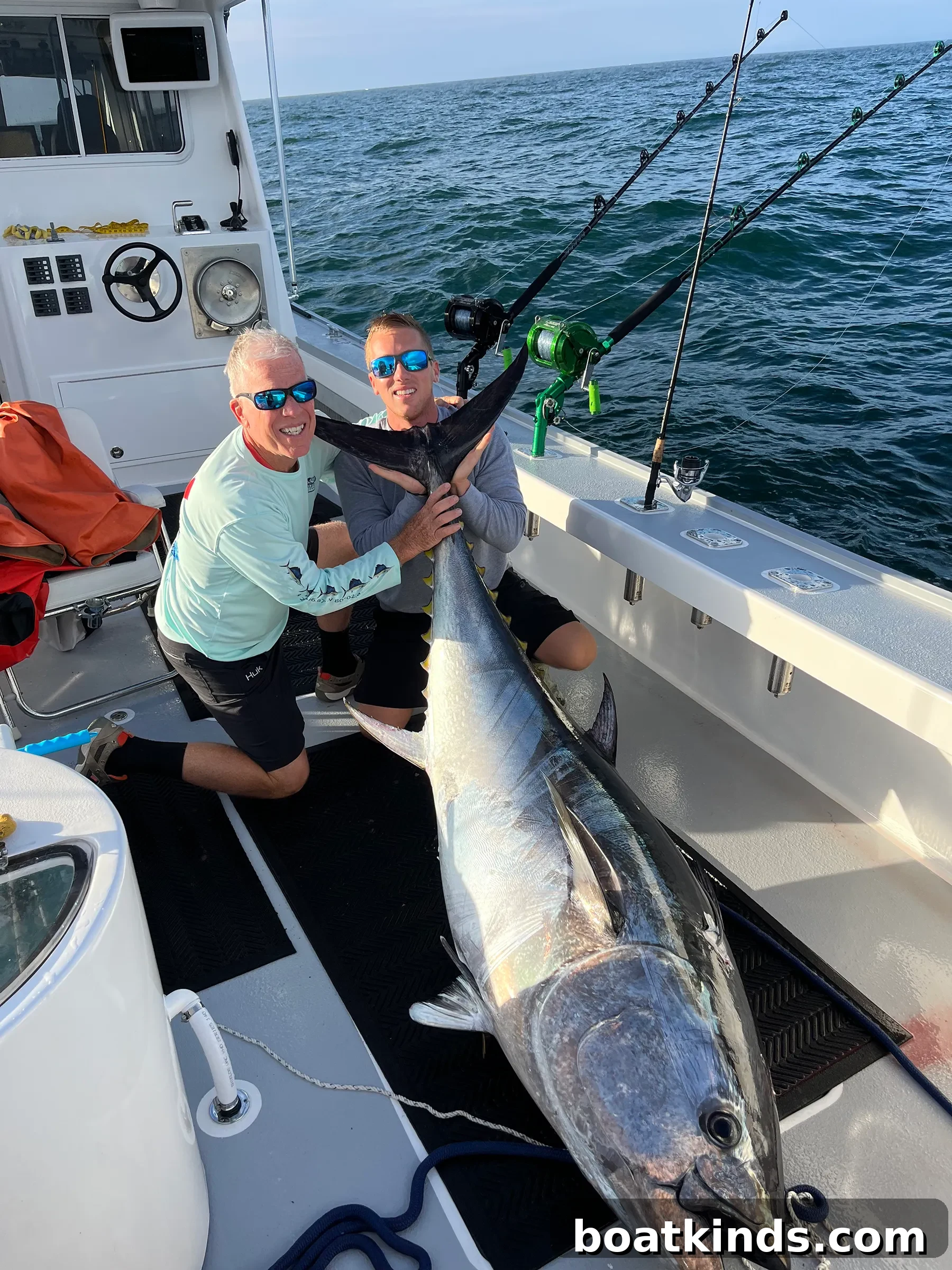
The large cockpit spans roughly a third of the boat’s length and is optimized for commercial-style tuna fishing. An oversized, above-deck livewell provides easy access, gunwales hold swiveling rod holders, and the boat includes outriggers, a green stick, a hydraulic bandit reel for trolling and a ramped transom tuna door for getting big fish aboard.
Below, the cabin layout balances crew comfort and functionality. An L-shaped settee and table sit aft of the helm; to port are two Stidd crew chairs and a galley with sink, twin-burner stove, convection/microwave oven and refrigerator/freezer drawers. Forward, a companionway leads to twin bunks and an enclosed head with shower. The forepeak contains a small owner’s cabin with a raised berth and storage for rods and reels.
The mast above the cabin supports spreader lights, horns, hailer, open-array and radome radar, a KVH TracVision satellite TV system, FLIR, and antennas for GPS, satellite phone and AIS, plus space for the green stick and gin pole.
David prioritized an engine room that is easy to service. The Scania and related systems are arranged for clear access, with filters, strainers and the pacer pump reachable through a day hatch. Electrical systems, battery banks, a Northern Lights 12-kW generator, air conditioning components and other systems are labeled and brightly illuminated. Cameras provide remote monitoring while underway.
He chose the Scania after extensive research: its common-rail design, hard piping, fuel efficiency, quiet operation and strong U.S. parts support made it the right fit for a long-term, owner-operated boat.
Since entering service in summer 2023, the Disruptor has proven capable and dependable. David reports it handles exceptionally well under load—gear, ice, fuel and crew—and performs reliably while trolling the canyons or drifting live bait for bluefin.
He named the boat Disruptor because its construction and configuration depart from conventional lobster/Downeast builds. “The boat disrupts many traditional methods, as much as I hope it will be a disruption on the fishing grounds,” he says.
This article was originally published in the March 2024 issue.