
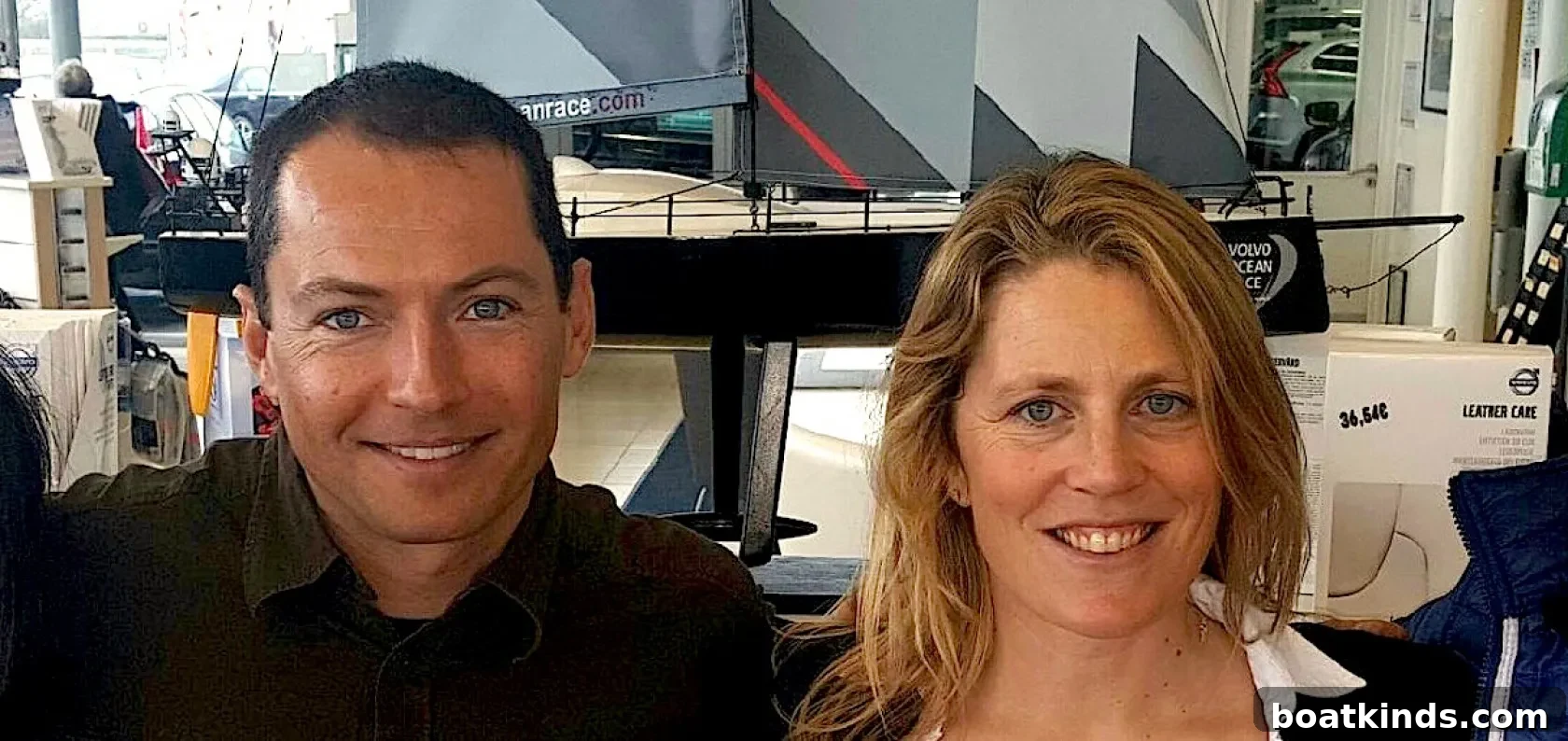
A Sailing Couple in the Vendée Globe
Sam Davies of Great Britain and Romain Attanasio of France balance two demanding lives: they are partners at home, raising a nine-year-old son, and they are solo ocean racers who compete in some of the world’s toughest offshore events. Both are seasoned skippers accustomed to long hours at sea, intense preparation, and the physical and mental demands of singlehanded racing. This year, however, their lives intersect in a rare and complex way: both are entered in the Vendée Globe, the solo, non-stop, around-the-world race.
The Vendée Globe is unique in the sailing world because it requires complete independence at sea. Competitors are alone for weeks or months at a time, with no external assistance permitted. Typically, in families where both partners are sailors, one stays ashore to care for children and manage life on land while the other competes. For Davies and Attanasio, both choosing to race at the same time upends that arrangement and presents logistical, emotional, and practical challenges that few families experience.
On land, they share the responsibilities of parenting and household management. When one of them is racing, the other often takes on the primary caregiving role and provides shore-based support for the skipper at sea. This support can include coordinating shore crews, managing media requests, handling technical updates, and maintaining family routines for their child. With both of them racing, those traditional roles are impossible to divide in the usual way, and the family must rely on an extended support network, careful planning, and creative solutions to ensure their son’s needs are met and their respective campaigns remain professional and safe.
Being a duo of solo sailors competing simultaneously also raises complex emotional dynamics. Each partner faces the same risks inherent to the Vendée Globe: unpredictable weather, equipment failures, isolation, and the stress of making critical decisions alone. At the same time, the couple at home must navigate worry and pride in equal measure, supporting each other’s ambitions while managing the strain of not being able to directly offer care and companionship during the race. The shared experience of singlehanded ocean racing gives both partners a deep empathy for what the other endures, but it does not diminish the practical difficulties of doing so while raising a child together.
Their participation as a couple in this race is significant within the sailing community. They are among the very few partners who have elected to compete against each other in a single edition of the Vendée Globe, a fact that highlights both the global reach of offshore racing and the changing nature of professional sport for families. Their dual campaigns attract media interest not only because of the sporting challenge, but because of the human story behind it: how two elite athletes manage family life, parenting, and the emotional costs of extreme endurance racing.
Preparation for an event like the Vendée Globe is exhaustive and multifaceted. It includes physical training, mental preparation, meticulous boat maintenance and customization, tactical planning, and assembling a reliable shore team. For a family in which both parents are professional skippers, these preparations must be orchestrated to protect stability at home while ensuring each boat and sailor receive the attention necessary for a safe and competitive race. That often means relying on friends, extended family, professional childcare, and trusted shore crews to fill the roles normally performed by a partner who remains on land.
There are also broader implications for the way the sport is perceived. Seeing a couple undertake parallel Vendée Globe campaigns can inspire other sailors and families to rethink what is possible, demonstrating that elite offshore racing and family life can coexist, though not without trade-offs. Their story underscores the need for better support systems for parents in high-performance sports, whether through flexible schedules, improved childcare options, or stronger team networks that can shoulder responsibilities when both parents are committed to the same demanding pursuit.
Ultimately, the situation faced by Sam Davies and Romain Attanasio is a portrait of modern athletic partnership: two committed professionals who share love, family, and passion for sailing while accepting the unique sacrifices that their sport requires. Their dual entry in the Vendée Globe adds a compelling human dimension to the already dramatic narrative of solo ocean racing, and it offers a glimpse of how families involved in elite competition can adapt and find solutions that keep both dreams alive.