
Gar Wood: The Man Behind Miss America and the Golden Age of Water Speed Records
Garfield Arthur Wood—better known to the boating world as Gar Wood—rose from modest beginnings to become one of the most influential figures in early 20th-century powerboat racing and manufacturing. The son of a Minnesota ferryboat operator, Wood learned the rhythms of life on the water at an early age. He combined that hands-on experience with ingenuity and entrepreneurial drive, inventing practical devices such as a hydraulic lift for unloading coal from trucks and then channeling his success into a lifelong pursuit of speed on the water.
From Miss Detroit to a Boat-Building Empire
In 1916 Wood purchased a motorboat named Miss Detroit, and soon after acquired the company that built her. He retained the two brothers who had run the business; one of those brothers, Chris Smith, would later co-found the famous Chris-Craft company. Under Wood’s leadership the firm evolved from small motorboat production into a specialized builder of high-performance racing craft. The company’s crowning achievement in the early years was the creation of Miss America, powered by twin 400-horsepower Liberty V-12 airplane engines that had been marinized for marine use.
Showmanship, Marketing, and a Taste for Records
Wood was not only a gifted designer and pilot but also an astute showman. He used racing victories and daring publicity stunts to promote the Gar Wood brand of pleasure and racing boats, creating a glamorous image that appealed to wealthy buyers and the general public alike. One memorable publicity feat occurred in 1921 when Wood raced the Havana Special train from Miami to New York City. Covering roughly 1,250 miles along the Atlantic coast, he completed the run in 47 hours and 23 minutes—beating the train by 12 minutes and generating headlines that boosted his company’s profile.
The Miss America Series and a Run of Records
Between 1920 and 1933 Wood built a succession of Miss America boats—nine additional versions after the first—and repeatedly raised the world water speed record. His victories attracted international attention, especially as the English challenged him with their own purpose-built racers named Miss England. In the intense rivalry of the late 1920s and early 1930s, Wood and his opponents traded the water speed record multiple times, pushing the limits of hull design, engine power, and piloting skill.
The competition reached its peak when Wood and Irish driver Kaye Don exchanged the world water speed record four times within a little more than a year. In 1931 Wood became the first person to surpass the 100-mph barrier, registering a run of 102.256 mph. Don responded less than a month later with a new mark of 110.223 mph, raising the stakes for both teams.
Miss America IX, Miss America X, and the Battle for Supremacy
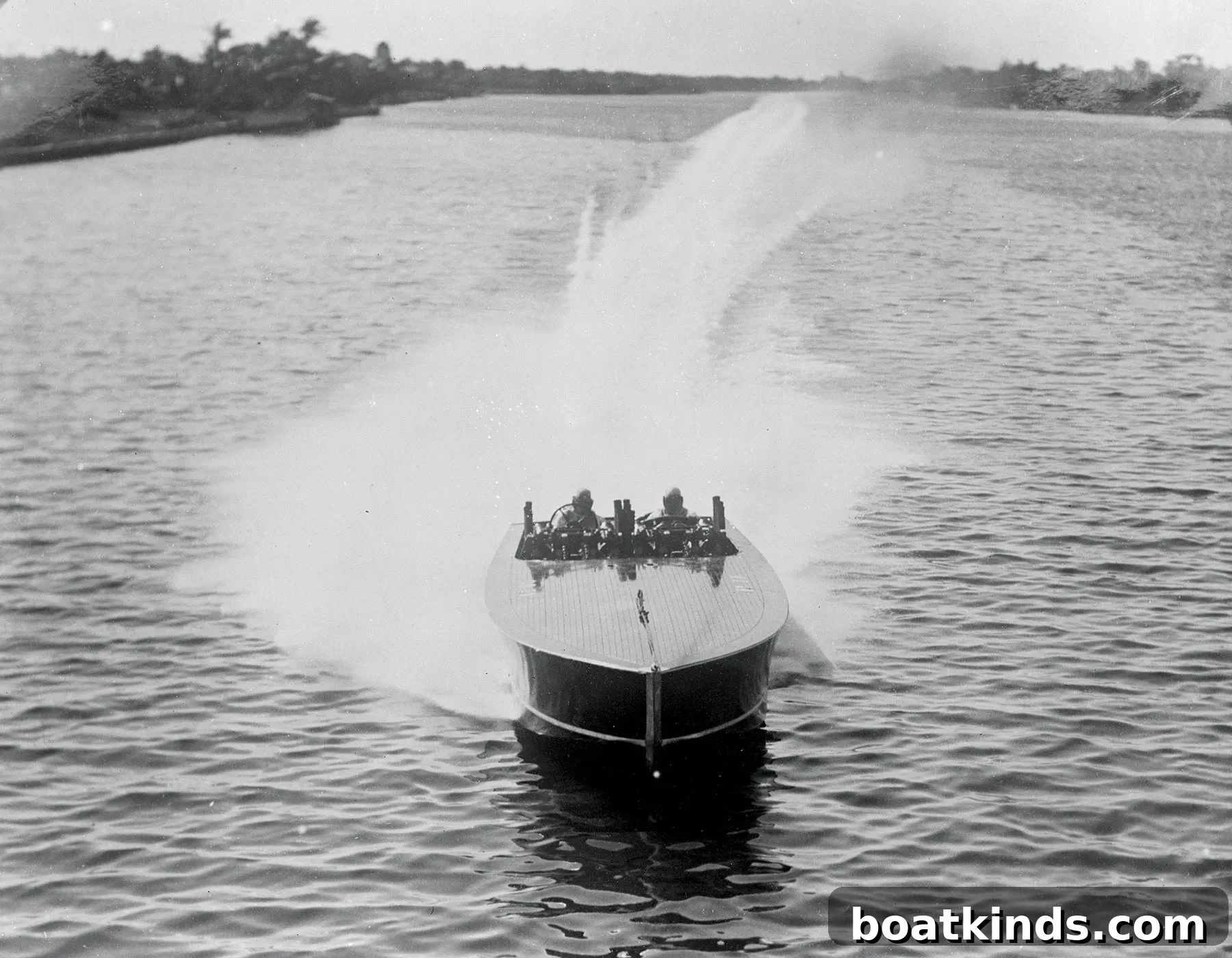
Wood’s determination to reclaim supremacy was dramatized on February 5, 1932, when he and his mechanic Orlin Johnson set a new record on Miami’s Indian Creek aboard Miss America IX. The iconic photo of that boat in action captures the raw power and precision that defined the era. The British team answered with Miss England III, seizing the record again in July 1932. Wood, intent on a decisive comeback, commissioned Miss America X, a radical design powered by four 1,800-horsepower supercharged Packard airplane engines. A few months after her debut, Miss America X established a new world water speed record at nearly 125 mph—a formidable achievement that Kaye Don ultimately declined to challenge.
Legacy of Innovation and Spectacle
Gar Wood’s contributions extend beyond headline-grabbing speed trials. By blending mechanical innovation, bold marketing, and a flair for showmanship, he helped transform powerboating into a glamorous, technically advanced sport and a viable commercial industry. His boats set benchmarks for performance and influenced hull and propulsion design for years to come. The Miss America series, in particular, stands as a symbol of an era when privately funded teams pushed aviation-derived engines and pioneering hulls to the edge in pursuit of a single number: the world water speed record.
This article was originally published in the January 2022 issue.