
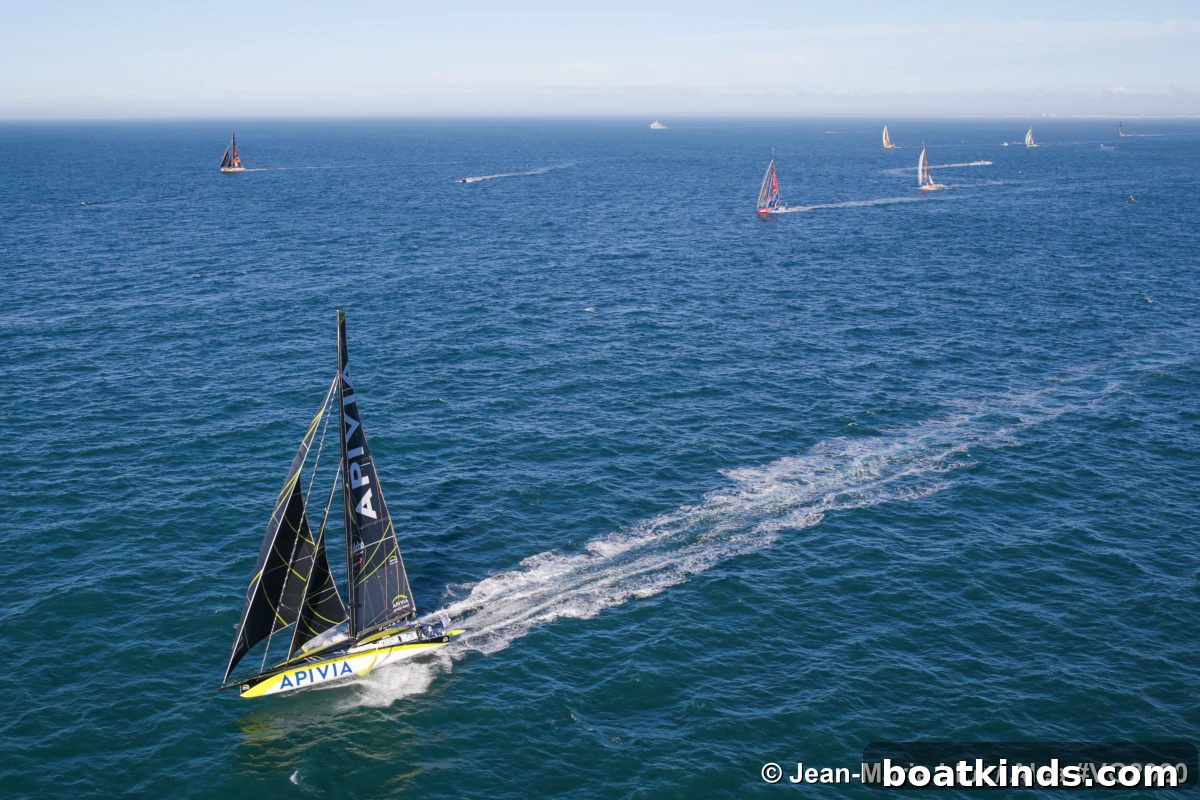
After nearly 80 days at sea and more than 24,300 nautical miles of intense solo ocean racing, the outcome of this edition of the Vendée Globe may be decided by a tactical choice in the final 100 miles: which layline each skipper chooses to reach the finish off France’s Atlantic coast. With the leading boats converging on Les Sables-d’Olonne, every decision about wind angle, timing and sail trim will matter.
Weather and routing models currently indicate that the winner is likely to cross late on Wednesday, and projections suggest the first three skippers could arrive within a roughly four-hour window. Depending on small shifts in wind and current, those margins could narrow even further and the podium positions may be decided in a matter of minutes. That level of closeness after more than two months of nonstop singlehanded racing highlights how tactical the final miles can be.
One of the key strategic variables is the layline — the imaginary line that determines the point at which a boat must bear away onto a direct course to the finish without needing another tack. Choosing an early layline can position a skipper to sail the final leg fast but risks missing favorable wind; waiting to sail the layline can let a skipper gain wind advantage, but may add distance. In light winds and complicated pressure fields, the layline decision can swing positions dramatically, so skippers are using every bit of meteorological information and their own instincts to choose the optimal route.
Mechanical and foil-related issues have added another layer of uncertainty. Several of the frontrunners are dealing with asymmetric foil performance, meaning a foil on one side gives good lift and speed while the foil on the opposite tack is less effective. That imbalance allows higher speeds on one tack but forces compromises on the other, influencing route choices and timing of maneuvers. When boats suffer reduced performance on a particular tack, skippers must compensate with tactical moves — running farther north or east, altering sail plans, or timing gybes differently — all of which affect who reaches the finish line first.
Beyond individual equipment, skippers have adopted differing routing strategies in the final approach. Some have opted for a more northerly track to capture stronger winds or better angles into the Bay of Biscay, while others have steered east to remain in steadier pressure or avoid a forecast lull. Those tracks will eventually converge, but uncertainty in the wind fields means it is still unclear which line will ultimately provide the best speed into Les Sables-d’Olonne.
The race’s unusual time compensation system also keeps the outcome open. Fifth-placed Yannick Bestaven, who was reported to be 253 miles behind leader Charlie Dalin as of Monday afternoon, received a 10-hour and 15-minute time allowance for his search efforts when responding to Kevin Escoffier’s distress after Escoffier’s boat sank in the Southern Ocean. That sizable compensation means Bestaven remains a mathematical contender for the overall victory, depending on how close the leaders finish and how the corrected times are applied. At the very least, the compensation could secure him a spot on the podium if his on-water finish is close enough.
Because multiple skippers are expected to arrive in a compact window, race organizers have adapted the finish logistics. The race director extended the official finish line from 0.3 miles to 1.9 miles to give incoming boats more space to decelerate safely after their timed finish. This change is intended to reduce congestion on the approaches and to provide a safer, more orderly conclusion to what has been a gruelling circumnavigation for the competitors.
With the fleet funneling through the Bay of Biscay and the final miles unfolding into the approaches to Les Sables-d’Olonne, the concluding hours of the Vendée Globe promise tactical drama, close-quarters strategy, and potentially a photo-finish after an epic solo challenge around the world. For those following the race, refer to the official Vendée Globe tracking map to monitor realtime positions as skippers make their final tactical choices and head for the finish line.